Every business has problems.
Late deliveries. Missed deadlines. Poor communication. Customer complaints. Processes that frustrate employees. Meetings that achieve very little.
Most leaders recognise these issues. Far fewer ask the question that really matters.
“What am I tolerating?”
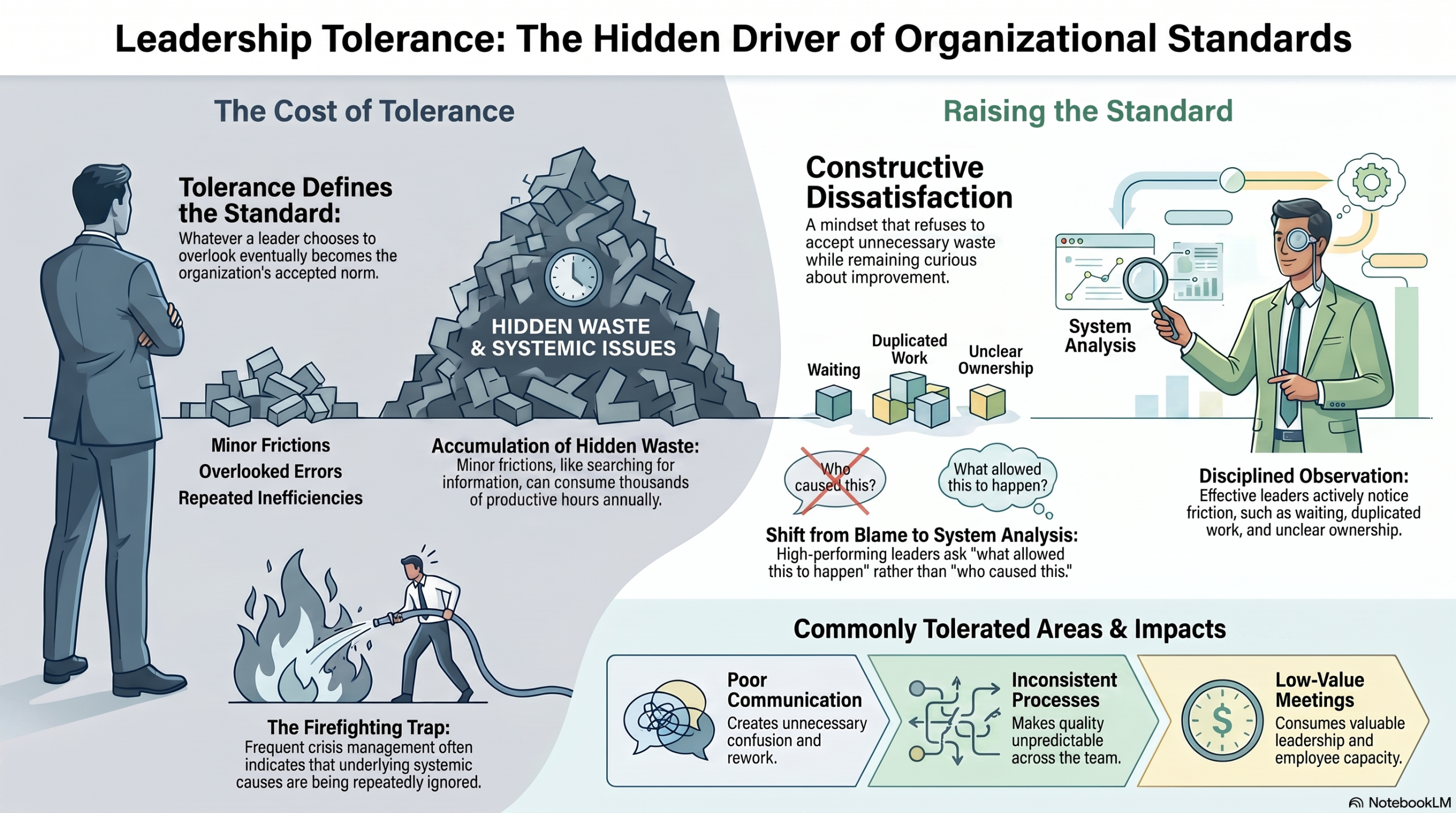
It’s a deceptively simple question, yet it has the power to transform the way leaders think about performance. Because whatever a leader tolerates eventually becomes the organisation’s standard.
If poor quality is accepted, poor quality becomes normal. If missed deadlines are excused, deadlines lose their meaning. If waste is ignored, waste becomes part of the process.
Culture isn’t created by what leaders say. It’s created by what leaders consistently allow.
Every Organisation Has a Tolerance Level
Walk into almost any workplace and you’ll hear familiar phrases.
“That’s just the way it is.”
“We’ve always done it like that.”
“It’s only a small issue.”
“We’ll fix it next month.”
These comments may sound harmless, but they reveal something much deeper. They reveal acceptance.
Over time, organisations become remarkably good at adapting to inefficient systems. Instead of fixing problems, they learn to work around them.
Additional spreadsheets are created. Extra approvals are added. People develop personal shortcuts. Temporary solutions become permanent.
The business continues to function—but never reaches its potential.
Small Problems Rarely Stay Small
Most major operational issues begin as minor irritations.
One delayed customer response. One recurring equipment fault. One unclear process. One unnecessary approval.
None appear significant on their own. Yet every unresolved issue adds friction to the organisation.
Eventually, small frustrations combine to create larger problems.
Employees become disengaged. Customers notice inconsistent service. Managers spend more time firefighting than improving.
Growth becomes harder because the organisation is carrying unnecessary complexity.
The cost isn’t simply financial. It’s cultural.
Leaders Set the Standard
One of the most important principles of Lean leadership is that leaders define acceptable performance.
Not through policies. Not through presentations. Through everyday behaviour. Employees quickly observe what attracts attention—and what doesn’t.
If leaders ignore recurring quality issues, teams assume quality isn’t a priority.
If leaders consistently arrive late to meetings, punctuality loses importance.
If leaders tolerate unclear accountability, confusion spreads throughout the organisation.
People rarely perform above the standards that leadership consistently demonstrates.
This is why Lean places such a strong emphasis on visible leadership. The behaviours leaders model become the behaviours organisations adopt.
Firefighting Creates Acceptance
Many leaders genuinely want to improve. The problem is they rarely have time.
Every day brings another urgent issue.
A customer escalation. A staffing challenge. A supply problem. An unexpected deadline.
The immediate issue gets solved. The underlying cause remains untouched.
Over time, firefighting becomes normal.
Ironically, organisations become proud of their ability to solve crises.
But constant crisis management isn’t evidence of agility. It’s often evidence that the same problems are being tolerated repeatedly.
High-performing organisations don’t celebrate firefighting. They reduce the number of fires.
Tolerance Creates Hidden Costs
Some costs appear in financial reports. Others quietly erode performance every day.
Consider the hidden cost of tolerated problems. Employees spending ten minutes each morning searching for information. Sales proposals delayed by unnecessary approvals. Repeated customer enquiries because communication was unclear. Meetings attended by people who add little value. Software systems requiring duplicate data entry.
Each issue appears insignificant. Together, they consume hundreds—sometimes thousands—of productive hours each year.
More importantly, they drain motivation. People become frustrated when they know a better way exists but nothing changes. Eventually, they stop suggesting improvements altogether.
Continuous Improvement Begins with Dissatisfaction
One of the defining characteristics of successful Lean organisations is constructive dissatisfaction.
Not negativity. Not criticism. A refusal to accept unnecessary waste.
Leaders continually ask:
● Why does this happen?
● Is there a better way?
● What problem are we really trying to solve?
● Why have we accepted this process?
This mindset keeps improvement alive.
Rather than protecting existing systems, leaders remain curious about making them better.
The moment an organisation becomes comfortable with mediocrity, improvement slows.
The Best Leaders Notice What Others Ignore
Experienced Lean leaders develop an unusual habit. They notice friction.
Not because they’re naturally critical. Because they’re naturally curious.
They notice:
● people waiting
● unnecessary movement
● duplicated work
● confusion
● recurring mistakes
● unclear ownership
Where others see routine, Lean leaders see opportunity.
This ability isn’t a talent. It’s a discipline developed through observation.
The more leaders spend time where work actually happens, the easier these opportunities become to recognise.
Raising Standards Without Creating Fear
Some leaders misunderstand high standards. They believe improvement requires constant pressure.
Lean takes a different approach. High standards and psychological safety work together.
Employees should feel comfortable identifying problems without fear of blame.
When mistakes occur, leaders ask:
“What allowed this to happen?” rather than “Who caused this?”
This shift changes everything. People stop hiding problems. They start solving them.
Improvement accelerates because learning replaces defensiveness.
Five Areas Leaders Commonly Tolerate
Every organisation is different, but these areas frequently deserve attention.
1. Poor Communication
Unclear expectations create unnecessary confusion and rework.
2. Inconsistent Processes
When every person completes the same task differently, quality becomes unpredictable.
3. Delayed Decision-Making
Slow decisions often create more waste than incorrect ones.
4. Low-Value Meetings
Meetings without purpose consume valuable leadership capacity.
5. Recurring Problems
If the same issue appears every month, the organisation is treating symptoms rather than causes. These aren’t isolated operational issues. They’re leadership opportunities.