If you’ve been in business for a while, you’ll probably remember the term VUCA. It became popular after the Global Financial Crisis and quickly found its way into boardrooms, strategic planning workshops and leadership discussions. Originally developed by the US military following the end of the Cold War, it described a world that had become Volatile, Uncertain, Complex and Ambiguous. At the time it was a useful way of explaining why traditional planning was becoming more difficult and why leaders needed to think differently.
I believe the term is still relevant today, but it no longer tells the whole story.
Over the past few years we’ve watched geopolitical conflict disrupt global supply chains, governments introduce sweeping regulatory and taxation changes, tariffs reshape international trade and inflation, interest rates and labour shortages place pressure on businesses across almost every sector. Add to that the rapid emergence of Artificial Intelligence and widespread digital transformation, and it’s easy to see why many business owners feel they’re operating in a completely different environment.
The difference isn’t simply that the world has become more volatile. The difference is that everything is happening faster. Before we’ve adjusted to one major event, another has arrived. Information moves instantly, customer expectations continue to rise and technology evolves faster than most organisations can comfortably absorb. That’s why I believe VUCA needs another letter.

S for Speed.
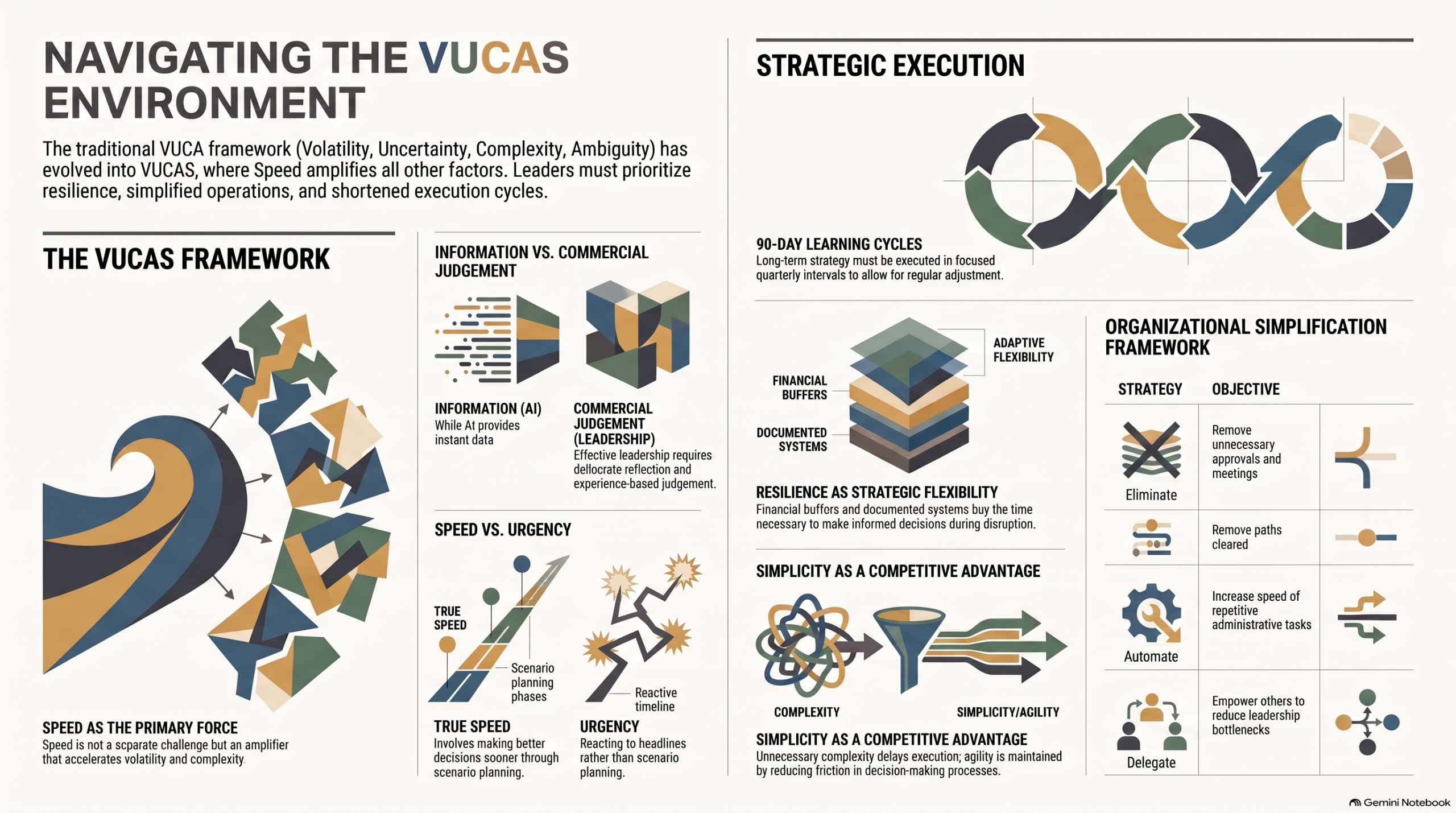
Not because speed is another business challenge, but because it amplifies every one of the others. We are no longer operating in a VUCA world. We are operating in a VUCA-S world, where volatility, uncertainty, complexity and ambiguity are all accelerated by the increasing speed of business.
Speed Changes Everything
Volatility isn’t new. Markets have always risen and fallen, governments have always changed policy and competitors have always emerged. Uncertainty has always been part of running a business, and every experienced owner knows that perfect information rarely exists when important decisions need to be made.
What has changed is the pace at which these forces now move.
Volatility arrives faster. Uncertainty spreads globally within hours. Complexity increases as businesses become more connected through technology, regulation and global supply chains. Ambiguity lasts longer because information now travels faster than facts, making it increasingly difficult to separate informed opinion from speculation.
For business owners and managers, that creates a very different leadership challenge. The issue is no longer simply understanding change. It’s understanding change quickly enough to make good decisions before circumstances shift again.
Speed Doesn’t Reward Panic
One of the biggest mistakes I see is businesses confusing speed with urgency. They aren’t the same thing.
Urgency often creates reactive behaviour. Every new headline demands attention. Every customer request becomes an emergency. Every new technology suddenly appears to require immediate investment. Before long, leadership teams spend their days responding to whatever seems most pressing rather than concentrating on what is most important.
The businesses that perform well in uncertain environments don’t necessarily move faster than everyone else. They make better decisions sooner because they’ve already invested time thinking about possible futures. They have clearer priorities, stronger systems and more disciplined decision-making processes. When disruption occurs, they don’t have to start thinking from scratch because they’ve already considered many of the possibilities.
That’s one of the reasons I’ve become such a strong advocate for scenario planning. As I discuss in The Questions You’re Not Asking About Your Business, the purpose of planning isn’t to predict the future. It’s to prepare for several possible futures so you’re ready to adapt as events unfold.
AI Is Accelerating the Speed of Business
Artificial Intelligence hasn’t created this new environment, but it has certainly accelerated it.
Tasks that previously took hours now take minutes. Marketing content can be produced almost instantly. Reports can be analysed in seconds. Customer enquiries are answered around the clock. Software development, research, forecasting and administration are all becoming significantly faster.
That’s an extraordinary opportunity, but it also creates a trap.
When information becomes instant, leaders can begin believing that every decision should also be instant. Yet judgement still takes time. Experience still matters. Reflection still matters. AI can process information at incredible speed, but it cannot replace the commercial judgement that comes from understanding your customers, your people and your business.
Technology should help us make better decisions, not simply faster ones.
Annual Planning Is No Longer Enough
None of this means strategic planning has become less important. If anything, it’s become more important than ever. What has changed is the rhythm of planning.
There was a time when many businesses developed an annual plan, reviewed it periodically and expected it to remain largely relevant for twelve months. In today’s environment that’s becoming increasingly unrealistic. Your long-term direction may remain unchanged, but the path you take to get there will almost certainly require regular adjustment.
That’s why I continue to encourage clients to think in multiple time horizons. Have a clear long-term strategy. Translate that into annual priorities. Then execute in focused 90-day cycles, reviewing assumptions and making adjustments as new information becomes available. Businesses that shorten their learning cycles will almost always outperform those that simply produce longer plans.
Resilience Has Become a Competitive Advantage
For years, businesses were encouraged to focus on efficiency. Reduce inventory. Minimise costs. Remove spare capacity. Optimise every process. Those disciplines remain important, but recent events have reminded us that efficiency without resilience can leave a business surprisingly vulnerable.
The organisations that have navigated uncertainty most successfully have generally shared a number of common characteristics. They have built financial buffers, developed stronger leadership capability, diversified key risks and created systems that allow them to respond calmly rather than react emotionally. They understand that resilience isn’t wasted capacity – it’s strategic flexibility.
As I explore throughout the book, resilience isn’t something you build during a crisis. It’s something you build before the crisis arrives. Cash reserves, capable people, documented systems and thoughtful planning all buy something incredibly valuable when uncertainty strikes: time. And time allows leaders to make better decisions.
260613 Questions A5 softcover – FINAL.pdf
Simplicity Is Becoming More Valuable
There’s another lesson hidden inside the VUCA-S world. As the speed of business increases, unnecessary complexity becomes a significant competitive disadvantage.
Every additional approval slows decision-making. Every unnecessary meeting consumes leadership capacity. Every extra system creates friction. Every poorly designed process delays execution. Complexity doesn’t simply reduce productivity; it reduces agility.
That’s why one of the simplest disciplines I encourage businesses to adopt is continually asking three questions:
Can we eliminate it?
Can we automate it?
Can we delegate it?
The goal isn’t simply to become more efficient. It’s to create a business that can respond quickly without becoming chaotic. In a world where change is accelerating, simplicity becomes a strategic advantage.
The Real Leadership Challenge
We can’t control geopolitical conflict, government policy, global markets or technological disruption. We can’t eliminate uncertainty, and we certainly can’t predict every change that’s coming next.
What we can do is build businesses that are capable of adapting without losing focus.
That means strengthening resilience before it’s needed, simplifying operations before complexity becomes overwhelming and reviewing strategy often enough to respond intelligently as circumstances evolve. It also means resisting the temptation to react to every new development and instead maintaining the discipline to focus on what matters most.
That’s what Focused Execution has always been about. It has never been about producing the perfect plan. It’s about creating the discipline to review, adjust and execute consistently as the world changes around you.
In a VUCA-S world, that discipline may become one of the few sustainable competitive advantages left.
Three Key Takeaways
VUCA still describes today’s business environment, but speed now amplifies every element of volatility, uncertainty, complexity and ambiguity.
Competitive advantage is increasingly determined by how quickly a business can adapt without losing strategic focus.
Focused Execution, Scenario Planning and regular 90-day reviews provide a practical framework for leading confidently in an increasingly unpredictable world.
Want to Think More Strategically in a VUCA-S World?
In a VUCA-S world, the goal isn’t to predict exactly what happens next. It’s to ask better questions, challenge your assumptions and build a business that is prepared to adapt as circumstances change.
That’s one of the central ideas behind my book, The Questions You’re Not Asking About Your Business. Several chapters are particularly relevant to leaders navigating today’s volatile, uncertain and fast-moving environment:
Chapter 13 – Are you planning for One Future or preparing for many?
Why single path planning limits agility and increases risk.
Chapter 19 – When did you last test your assumptions?
Why strong businesses invite pressure before the market applies it.
Chapter 24 – What is Your Strategy?
Why activity without clear choices is not strategy.
Chapter 25 – Are you reinventing without the panic?
Why delayed adaptation increases risks and limits opportunity.
Chapter 26 – Would your business withstand a shock tomorrow?
Why resilience is designed before it is needed.
 Explore The Questions You’re Not Asking About Your Business →