One of the biggest challenges facing business owners and managers is not a lack of ideas. It is finding enough uninterrupted time to think properly about those ideas before the next operational issue takes over.
Most working days are filled with meetings, emails, staff questions, customer demands and decisions that need to be made quickly. Somewhere in the middle of all that activity, an important thought appears. You might see a solution to a long-standing problem, recognise a new commercial opportunity or suddenly understand what needs to happen next. Unfortunately, those moments of clarity often arrive when you are nowhere near your desk.
Some of my best thinking happens while I am driving home from a client meeting, walking between appointments or reflecting after a strategy discussion. The problem is that by the time I get back to the office, another issue has taken priority and much of that thinking has disappeared.
For years, I relied on notebooks, emails to myself and voice memos. They captured fragments of information, but they rarely helped me organise the full train of thought. More often than not, they became another collection of notes that I planned to revisit but never did.
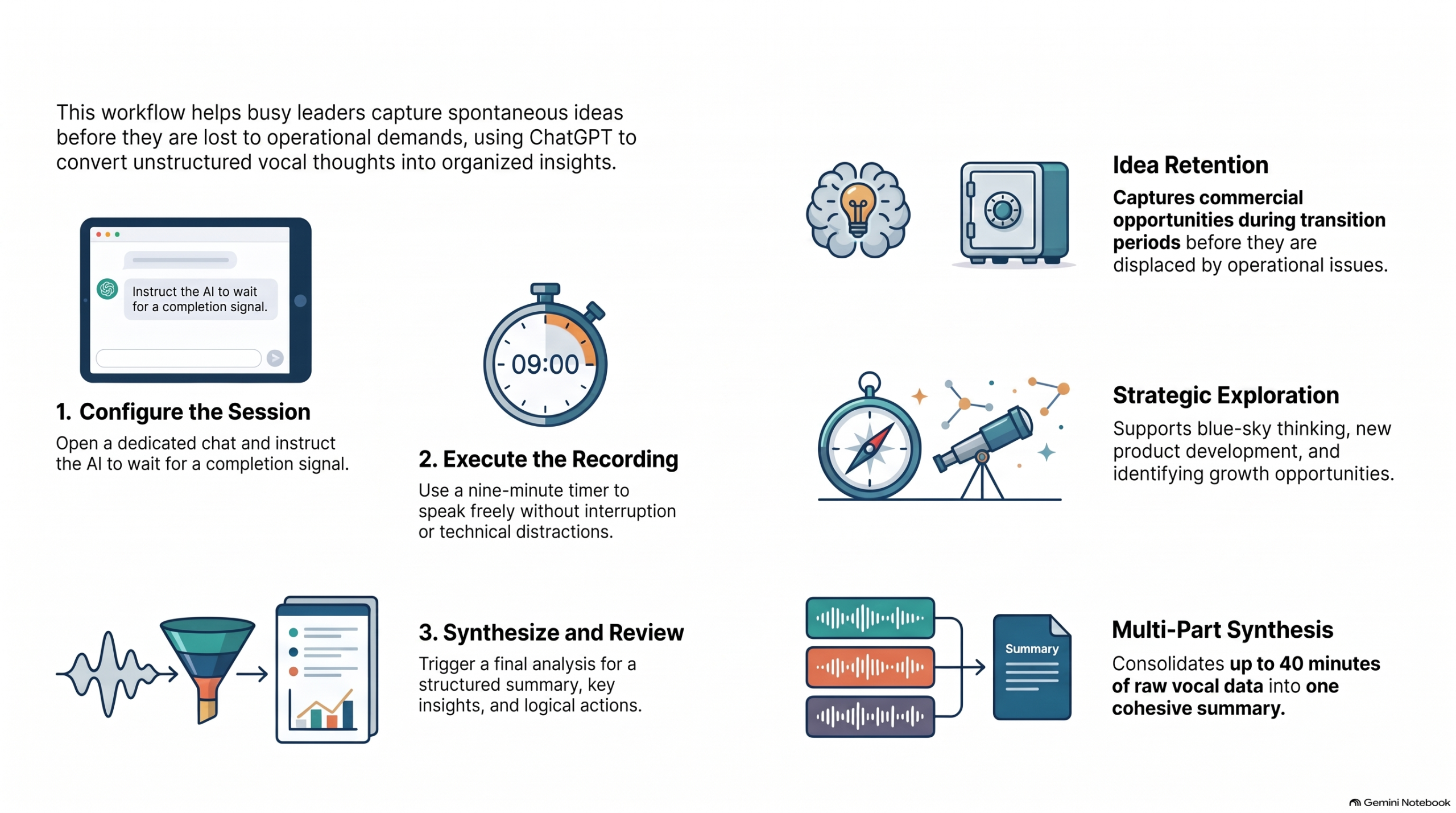
I now use a much simpler process. I open ChatGPT on my phone, navigate to the right chat, tell it what I am about to do, ask Siri to set a nine-minute timer and then think out loud. I do not try to structure the conversation or turn it into a polished explanation. I simply talk through the issue, idea or opportunity in the same way I would with a trusted adviser in a stream of consciousness flow. I let the ideas and comments come in whatever order they appear.
When the session is complete, ChatGPT organises everything I have said into a concise summary, identifies the key insights and highlights any actions that logically drop out of the update. It is one of the simplest ways I use AI, but it is also one of the most useful because it helps me capture and organise my thinking before it is lost.
Why use ChatGPT voice recording as a thinking tool?
Many people still think of ChatGPT mainly as a writing assistant. It is certainly useful for drafting emails, proposals, reports and marketing content, but that is only one part of its value. Used well, ChatGPT can also act as a practical thinking partner.
Most business owners do not think in perfectly structured paragraphs. We work through ideas by talking, testing assumptions, revisiting earlier points and following the conversation wherever it leads. If you have ever started explaining a problem to someone and realised halfway through that you already knew the answer, you have experienced the value of thinking out loud.
Talking helps you connect ideas and clarify what really matters. It can also surface assumptions, concerns and possibilities that are difficult to identify when you are staring at a blank page. The challenge is capturing the complete conversation and turning it into something useful once the thinking is finished.
That is where ChatGPT helps. It can remove repetition, group similar ideas, identify recurring themes and convert an unstructured stream of thought into a practical summary. The ideas, experience and commercial judgement still come from you. AI simply helps organise the material so you can review it more clearly and move towards action.
This is an important distinction. The purpose of the exercise is not to outsource your thinking. It is to make better use of the thinking you are already doing.
My five-step ChatGPT Thinking Session
I have deliberately kept this process simple because a complicated workflow is unlikely to become a regular habit. The whole setup takes less than a minute and can be used whenever you need to work through a problem, explore an opportunity or capture ideas while they are still fresh. I will refer to ChatGPT but you can use your AI platform of choice eg. Claude, Copilot, Gemini, etc
Step 1: Open ChatGPT and navigate to the right chat
Open the ChatGPT app on your phone and go to the conversation where you want to capture your thinking. You can use a normal chat, although I recommend creating a dedicated ChatGPT Project if you expect to use this approach regularly.
Keeping related Thinking Sessions together makes it easier to revisit earlier discussions, compare how your thinking has changed and build a useful record of decisions, ideas and opportunities. You might create Projects called Weekly Thinking Sessions, Business Strategy, Leadership Journal, Blue-Sky Ideas, New Product Development or Business Opportunities.
The name is not particularly important. The benefit comes from keeping related conversations together rather than allowing them to become scattered across dozens of unrelated chats.
Step 2: Set up the task
Before you start recording, tell ChatGPT what you are about to do and how you want it to manage the session. Explain that you will be thinking out loud, that your thoughts may be unstructured or repetitive, and that you may send several voice recordings on the same topic.
You should also tell ChatGPT not to analyse the information after every recording. Instead, it should simply acknowledge each part and wait until you say the full session is complete. This is particularly important when you are exploring a complex topic because you do not want the AI reacting to an incomplete version of your thinking.
I have included the full compound Thinking Session Prompt at the end of this article. It sets up both the data collection process and the final analysis before you begin, so you only need to give the instructions once. Copy and paste this into your AI platform of choice.
Step 3: Ask Siri to set a nine-minute timer
Before I press the microphone button, I say:
“Hey Siri, set a timer for nine minutes.”
I use nine minutes because the voice recording limit I work to in ChatGPT is around ten minutes. The nine-minute timer gives me a buffer, which means I do not have to watch the clock or worry that the recording will finish before I complete an important point. Obviously, you can do this on Android devices with a similar command. Check the recording length on your AI of choice – ChatGPt is currently about 10 minutes.
ChatGPT features and limits can change between versions, devices and plans, so it is worth checking the current limit in the version you are using. The practical principle remains the same: set the timer slightly below the recording limit so you can focus on the topic rather than the technology.
This small step makes the process much easier. Once the timer starts, I can give the conversation my full attention.
Step 4: Think out loud
Press the microphone button and start talking. Do not try to sound polished, organise every idea or create a logical structure before you begin. This is not a presentation, and you are not preparing formal meeting notes. It is simply a chance to work through the topic while your thinking is fresh.
Talk as though you are sitting with a trusted adviser. Explain the background, what you are trying to achieve, what concerns you, what opportunities you can see and what options you are considering. It is fine to repeat yourself, change direction or realise halfway through that your original view was wrong. That is how genuine thinking often works.
You might use the process for weekly planning, a difficult leadership issue, a client debrief, a sales opportunity or an important decision. It is also particularly useful when the topic is less defined and you want to explore possibilities rather than solve an immediate problem.
Examples include:
-
Blue-sky thinking about the future of the business
-
New product development
-
New service concepts
-
Market and growth opportunities
-
Partnership opportunities
-
New customer segments
-
Alternative business models
-
Improvements to an existing product or service
-
Marketing and content ideas
-
Priorities for the next 90 days
The objective is not to create a perfect transcript. The objective is to capture the full train of thought before it disappears.
[Screenshot: Recording a voice message in ChatGPT]
Step 5: Complete the session and review the analysis
When you have finished your final recording, type, or say:
Session complete.
Because you set up the process at the beginning, ChatGPT already knows what analysis you want. My preferred instruction is deliberately straightforward:
Give me a summary, key insights and any actions that logically drop out of the update. Be concise and organised.
This usually gives me exactly what I need. I receive a structured summary of the discussion, the most important insights and a practical list of actions that naturally arise from what I have said.
From there, I can continue the conversation if further work is needed. I might ask ChatGPT to turn the actions into a project plan, identify assumptions that need to be tested, draft an email, develop a 90-day plan or turn the thinking into a presentation or article.
The initial summary is useful, but it is often only the beginning of the process. Once your thinking has been organised, it becomes much easier to decide what should happen next.
How do you record more than ten minutes on one topic?
Some topics need more time than a single recording allows. A strategy review, a leadership issue, a new product idea or a major commercial opportunity may take 20, 30 or 40 minutes to unpack properly.
The solution is to keep every recording inside the same ChatGPT conversation.
When the nine-minute timer sounds, finish your sentence and send the recording. ChatGPT should reply only with:
Part received.
You can then reset the timer and start the next recording. Continue exactly where you left off, or briefly explain what the next part will cover. For example, you might begin by saying:
“This is Part 2. I want to explore the opportunity in more detail.”
“This is Part 3. I now want to think through the customer problem.”
“This is Part 4. I want to consider the risks and practical barriers.”
“This is Part 5. I want to identify what a small pilot might look like.”
You can repeat this process for as many recordings as required. The important point is not to request a separate summary after each section. Let ChatGPT collect the complete discussion first and analyse everything only after you say the session is finished.
I have found that multiple recordings can actually improve the quality of the Thinking Session. The short pause between each section gives me time to reflect, remember another point or recognise an assumption I have not yet challenged. Rather than interrupting the thinking, the pause often improves it.
By the time the session is complete, ChatGPT may have 30 or 40 minutes of material, but it can still consolidate that information into one concise summary, a set of key insights and a manageable list of actions. Type or say “Session Complete” and your AI will proceeed with the initial analysis and summary.
How can this help with blue-sky thinking, NPD and opportunities?
This process is not limited to solving operational problems. In fact, some of its best applications involve topics where the answer is not yet clear.
Blue-sky thinking often begins with fragments. You may have noticed a trend, heard repeated feedback from customers or recognised a capability in your business that could be used in a different way. At this stage, the ideas are rarely ready for a formal business case, and trying to structure them too early can shut down useful thinking.
A voice-based Thinking Session gives you space to explore the possibilities without forcing an immediate conclusion. You can talk through what you are seeing, why it might matter and where the opportunity could lead. ChatGPT can then organise those fragments into common themes and help identify which areas deserve further investigation.
The same approach is useful for new product development. You might discuss:
-
Problems customers repeatedly mention
-
Gaps in your current offer
-
Ideas for improving an existing product
-
New services you could provide
-
Different ways of packaging or pricing your offer
-
Potential customer segments
-
Delivery models or partnerships
-
Risks that may affect commercial viability
-
What a small pilot or test might involve
After the session, you can ask ChatGPT to help distinguish between an interesting idea and a genuine commercial opportunity. It can identify assumptions that need to be tested, suggest questions for customer research and help organise the next stage of evaluation.
For example, you might ask:
-
Which ideas appear to have the strongest commercial potential?
-
What customer problem does each idea solve?
-
What assumptions need to be tested?
-
What evidence would we need before investing further?
-
Which opportunity could be tested quickly and at low cost?
-
What are the major risks, barriers and dependencies?
AI should not make the final commercial decision, but it can help you start that decision with your thinking already organised.
The ChatGPT voice recording workflow works well whenever the topic benefits from reflection, exploration or structured thinking. It can be used for operational issues, strategic questions and creative work.
Common applications include:
-
Weekly and monthly planning
-
Leadership challenges
-
Staff performance and difficult conversations
-
Client meeting debriefs
-
Sales pipeline reviews
-
Strategic planning
-
Blue-sky thinking
-
New product development
-
New service development
-
Growth and market opportunities
-
Business model ideas
-
Partnership opportunities
-
Marketing and content planning
-
Workshop and presentation development
-
Quarterly business reviews
-
Identifying priorities for the next 90 days
It is also useful after a meeting, workshop or strategy session. Rather than relying only on rough notes, you can record your own reflections while the discussion is still fresh and ask ChatGPT to identify the implications, priorities and actions that matter most.
What are the limitations?
Like any AI workflow, this process is not perfect. ChatGPT may misunderstand names, acronyms, technical language or industry terms, so you should review the transcript and final summary before relying on it. A small transcription error can significantly change the meaning of an important point.
You should also be careful with confidential information. Think before sharing sensitive client details, employee information, financial data, commercially important material or early-stage intellectual property. Make sure your use of AI is consistent with your organisation’s policies and your professional responsibilities.
It is also important to remember that ChatGPT is organising your thinking rather than replacing your judgement. AI can summarise, identify patterns and suggest actions, but you remain responsible for deciding what is accurate, practical and commercially appropriate.
This matters particularly when you are discussing blue-sky ideas or new product development. AI can make an incomplete idea sound more developed or attractive than it really is. Customer demand, commercial viability and practical feasibility still need to be tested.
Finally, platform features and recording limits can change. Check the version of the AI platform you are using rather than assuming the same limits will always apply.
Why this AI habit works
People often focus on finding the perfect AI prompt, but prompts only create value when they are part of a practical routine. A good workflow used regularly will usually deliver far more value than a clever prompt used once.
This process works because it is easy to repeat. You open ChatGPT, navigate to the right conversation, set up the task, ask Siri for a nine-minute timer and start talking. There is no complicated preparation and no need to create a formal brief before you begin.
The real benefit is not better note-taking. It is better thinking.
You create space to work through an issue, explore an opportunity or develop an idea. You capture your thoughts before they disappear, identify what matters and turn the discussion into practical actions while the thinking is still fresh.
For a busy business owner or manager, that can save time, improve decision-making and reduce the number of valuable ideas that are lost during the working week.
Three key takeaways
-
Capture your thinking while it is fresh. Your best ideas often happen away from your desk. ChatGPT voice recording gives you a practical way to capture and organise them before they disappear.
-
Use multiple recordings for larger topics. Keep every recording in the same conversation, allow ChatGPT to acknowledge each part and request the analysis only after you say “Session complete.”
-
Use AI to explore opportunities as well as solve problems. Blue-sky thinking, new product development and commercial opportunity exploration are often where this workflow delivers its greatest value.
Bonus: Long-Form Thinking Session Prompt
Copy and paste this prompt into ChatGPT before you begin. It sets up both the collection of your recordings and the final analysis, so you do not need to provide new instructions after each part.
Step 1 – Purpose of the session
I am going to think out loud about one business topic. My comments may be unstructured, repetitive or incomplete, and my thinking may change as I talk through the topic.
Your role during the recording stage is to collect the information without interrupting the flow of the session or attempting to analyse an incomplete version of my thinking.
Step 2 – Collecting multiple recordings
I may send this Thinking Session across one or more voice recordings. Treat every recording as another part of the same continuous conversation and retain the context from all previous parts.
After each recording, reply only:
“Part received.”
Do not summarise, interpret, analyse, challenge or recommend anything after an individual recording.
Wait until I say:
“Session complete.”
Step 3 – Analysing the complete session
When I say “Session complete”, review every recording together as one complete Thinking Session.
Provide:
-
A concise summary of the overall update
-
The key insights that emerge from my thinking
-
Any actions that logically drop out of the update
Where relevant, group related ideas together, remove unnecessary repetition and note any important contradictions, gaps or unresolved questions.
Step 4 – Separating my thinking from AI suggestions
Clearly distinguish between:
-
Points, ideas or conclusions that came directly from me
-
Additional observations, interpretations or suggestions that you have added