
The Power of Reflection: Why Five Minutes a Day Can Change Your Performance

Build momentum for Q2 FY27
Strategy & execution / Q2 FY27
Build momentum
for Q2 FY27.
Why your next 90-day plan starts now.
From direction to daily action.A rhythm that keeps your priorities moving.
3-5 YEARSStrategy
FY27Annual plan
Q2 FY2790-day plan
MONTHLYMilestones
WEEKLYCommitments
DAILYAction
As September draws to a close, now is the time to prepare your 90-day plan for Q2 FY27: October to December 2026.
This quarter takes your business to the halfway point of the financial year. The priorities you choose now will influence both your December position and the platform you take into January.
There is also a practical reality. Customer deadlines, Christmas trading, staff leave and shutdown periods can compress the time available. Waiting until October is well underway makes it easier for immediate demands to take control.
But completing the plan is only the beginning.
The real value of 90-day planning is the momentum it creates through consistent action.
That momentum comes from connecting your longer-term direction to clear quarterly outcomes, then keeping those outcomes alive through monthly reviews, weekly commitments and daily priorities.
Start with the bigger picture
Your quarterly plan should sit within a clear planning structure.
Ideally, you already have a strategic plan that sets your direction for the next three to five years. You should also have an Annual Operating Plan for FY27 that translates that direction into the outcomes required by 30 June 2027.
The connection is straightforward:
- Strategic plan: Where do we want the business to be in three to five years?
- Annual Operating Plan: What must we achieve this financial year to move towards that future?
- 90-day plan: What must we achieve this quarter to keep the annual plan moving?
Each level makes the next one more focused.
Suppose your three-year ambition is to build a business that operates successfully without your involvement in every decision. Your annual plan might include developing managers, clarifying responsibilities and improving operating systems.
Your Q2 plan then identifies the next practical steps: delegate specific decisions, introduce a management reporting rhythm and document two critical processes.
Now the quarter has a purpose that everyone can understand.
If your annual plan needs attention, address that first. Our Annual Operating Planning video and template provide a practical starting point.
Use Q1 to make better Q2 decisions
Before deciding what comes next, take an honest look at the quarter just completed.
Where have you made progress? Which commitments remain unfinished? What have you learnt about your customers, your team and your own capacity?
Look beyond whether tasks were completed. Consider whether the work produced the intended result.
You might have launched a marketing campaign without generating enough qualified enquiries. You might have recruited a manager while still retaining every important decision yourself.
Activity and outcomes need separate attention.
Ask your team:
- What moved our annual priorities forward?
- What stalled and why?
- Which assumptions proved inaccurate?
- What should we continue, change or stop?
- What unfinished work still deserves a place in Q2?
Avoid automatically carrying every incomplete action into the next quarter. Some work needs renewed commitment. Other work needs redesigning or removing.
An effective review improves the quality of your next decisions. It also gives the team an opportunity to recognise progress before moving on.
Choose a few outcomes that matter
A useful 90-day plan gives people a manageable set of priorities.
For many businesses, three major priorities are a sensible starting point. The right number depends on the scope of the work and the capacity available alongside normal operations.
These priorities are your Big Rocks: the outcomes that deserve protected attention because they materially advance the annual plan.
Be specific about what success means.
“Improve sales” gives the team little direction. “Introduce a consistent enquiry follow-up process and lift quote conversion from 25% to 30% by quarter end” creates a clearer target.
“Develop the team” is broad. “Train two supervisors to run weekly production meetings independently by 30 November” makes the expected change visible.
For each priority, define:
- The outcome required.
- How you will measure success.
- One person accountable for delivery.
- The key milestones and deadlines.
- The time, support and resources needed.
Our 90-day planning video and instructions and editable 90-day plan template can help you structure this work.
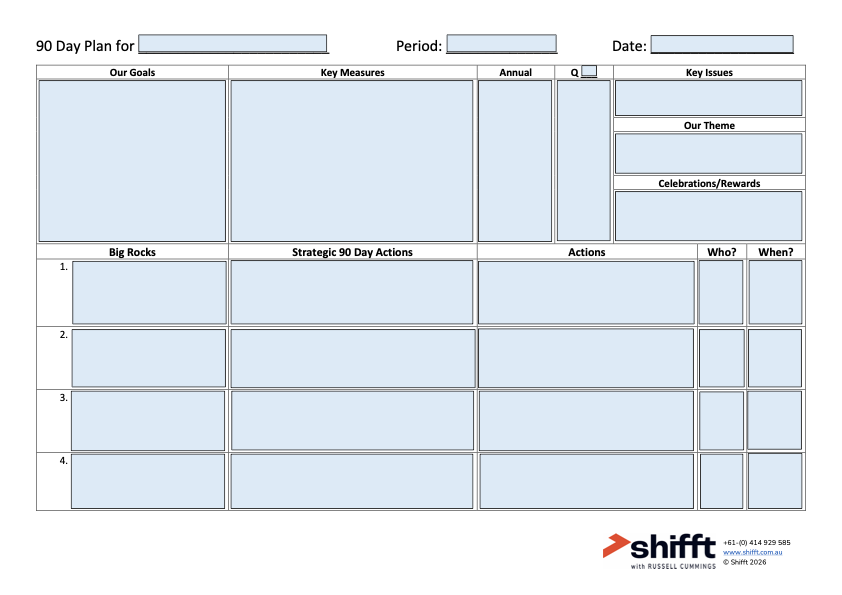
Download the editable 90-day planning template ↗
Plan for the quarter you actually have
October to December deserves a realistic capacity check.
A project that appears achievable across three months may become difficult once you account for leave, customer commitments, peak trading and supplier availability.
Put those constraints into the calendar before committing to deadlines.
If a key manager is away in December, their major implementation work may need to finish in November. If your business faces a Christmas rush, improvements intended to support that rush need to be operating beforehand.
Also consider dependencies. A new reporting process may require better data first. Delegating decisions may require training before responsibility can transfer.
Sequence the work so each step prepares the next.
Leave room for normal business demands and unexpected issues. A plan that consumes every available hour becomes fragile as soon as circumstances change.
Credible commitments help build trust. Repeated overcommitment makes planning feel disconnected from reality.
Build momentum through a regular cadence
Once the plan is agreed, establish the rhythm that will keep it moving.
Cadence is the regular pattern of planning, action and review that builds momentum.
It gives people repeated opportunities to make progress, see results and adjust their approach.
When a priority comes up every week, obstacles become visible sooner. When someone completes a milestone, the team sees evidence that the plan is working. When circumstances change, you can respond while there is still time to influence the result.
Over time, those small cycles strengthen confidence and follow-through.
The 90-day plan provides the overall framework. Monthly, weekly and daily routines turn it into a working system.
Monthly: check progress towards the outcome
At the start of each month, identify what needs to be achieved by month end to keep the quarter on track.
Review results against the quarterly measures. Check milestones, resources and emerging problems.
Ask: “Given where we are today, what needs our attention this month?”
For example, a Q2 priority to improve customer retention might involve reviewing lost accounts in October, testing a follow-up process in November and evaluating the results in December.
Each month advances the same outcome.
Weekly: turn priorities into commitments
Your weekly review connects the plan to immediate action.
Keep the conversation focused:
- What did we commit to last week?
- What was completed?
- What is getting in the way?
- What must happen this week?
- Who needs help or a decision?
Be clear about the next deliverable and its owner.
“Work on the customer process” is difficult to assess. “Complete the draft follow-up checklist and test it with three accounts by Friday” creates a useful commitment.
Use the meeting to resolve obstacles as well as report progress.
Daily: protect time for important work
Daily planning is where personal productivity supports business execution.
Before opening your inbox and responding to everyone else’s priorities, identify the work that will advance your weekly commitments.
Choose a small number of must-do actions. Allocate time for them in your calendar.
You still need to handle customers, operational issues and unexpected demands. However, important work needs a deliberate place in the day.
A protected hour spent improving a critical process can create more lasting value than a day filled entirely with reactive tasks.
Connect your business plan to your personal productivity
Every business priority eventually becomes someone’s responsibility.
For owners and leaders, this creates a practical challenge: how do you keep strategic commitments visible while managing a busy working day?
The connection needs to run all the way through:
Annual priorities → quarterly outcomes → monthly milestones → weekly commitments → daily actions.
Our Focused Execution 90-Day Productivity and Planning Journal supports this process by connecting your 90-day plan with monthly, weekly and daily priorities.
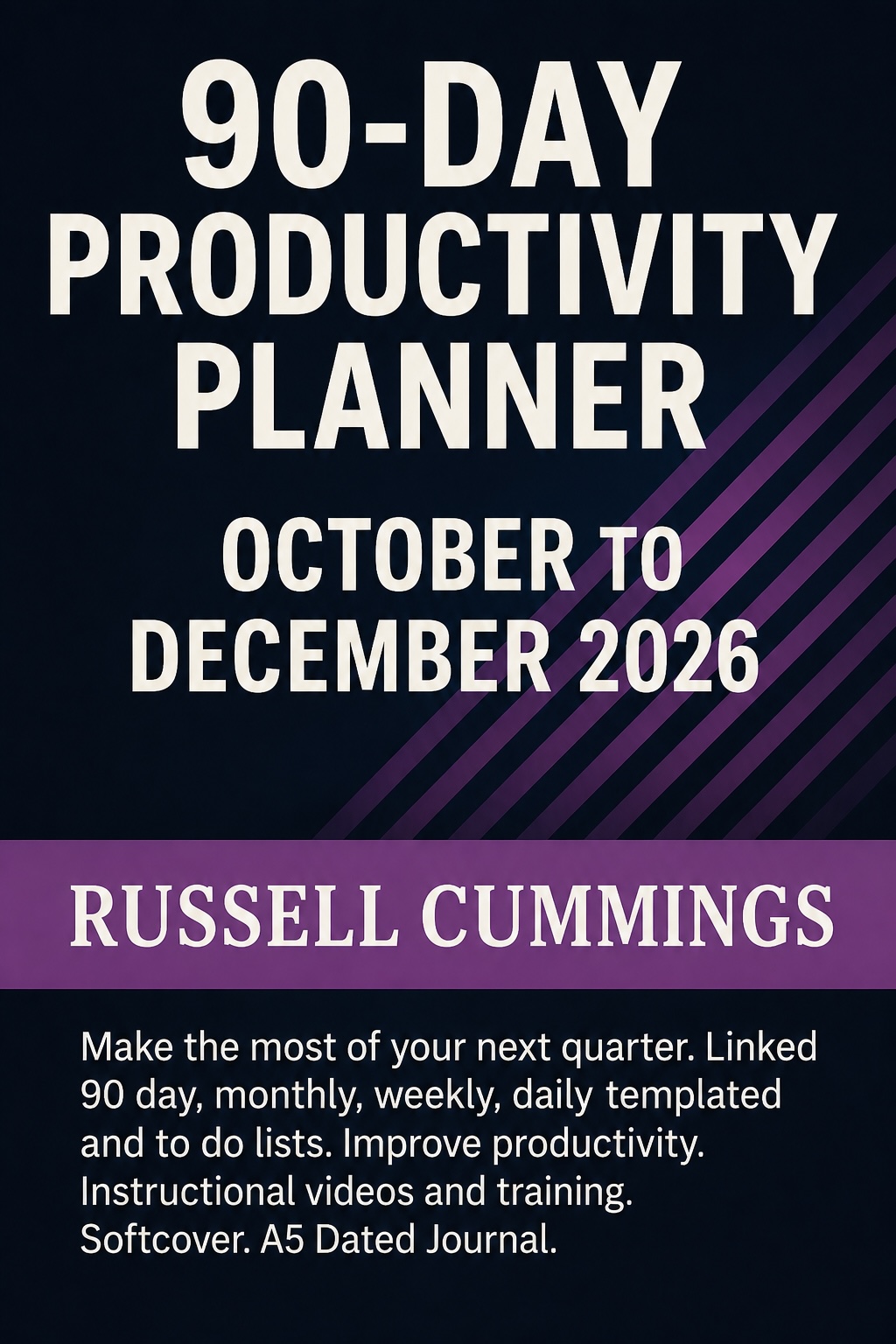
One practical daily companion.The October to December 2026 journal connects your 90-day priorities with monthly, weekly and daily action.
Explore the 90-Day Productivity Planner ↗
Use it as part of your working routine. Keep your priorities visible, schedule the next actions and review what you actually completed.
The journal provides structure. Consistent use turns that structure into a habit.
You can also use our planning and productivity videos for guidance on cascading plans, weekly planning, daily planning and time blocking.
Put the rhythm in place now
Before Q2 begins, book the planning session and schedule the reviews that will support delivery.
Bring your strategic direction, FY27 Annual Operating Plan and Q1 results into the discussion. Agree on the few outcomes that matter most by December. Assign ownership and check that the commitments fit your available capacity.
Then make sure everyone knows what happens in the first week.
Momentum starts with a clear next action. It grows when that action is completed, reviewed and followed by another.
By December, you want to see meaningful progress on the priorities that will shape your business. That requires attention throughout the quarter.
Build your Q2 plan now. Give it a place in your monthly conversations, weekly commitments and daily decisions.
The plan sets the direction.
The cadence builds the momentum.
The cadence builds the momentum.
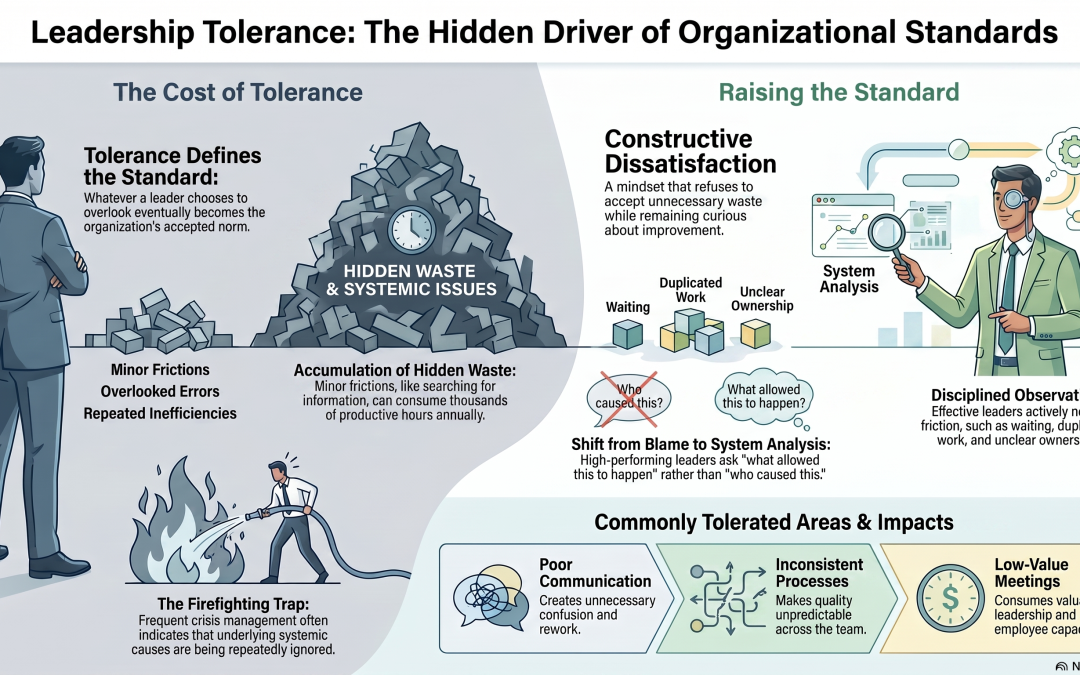
What are you tolerating? The leadership question that changes everything.
Skip to article
What are you

Leadership
What are you
tolerating?
The leadership question that changes everything.
Every business has frustrations. Missed deadlines. Unclear communication. Recurring customer complaints. Processes that require more effort than they should.
Most leaders can identify these problems quickly. The harder question is why they keep happening.
Sometimes the answer is uncomfortable: we have become used to them.
We work around the issue, explain it away or promise to address it when things settle down. Gradually, something that once frustrated us becomes an accepted part of running the business.
That is why one simple question deserves a place in every leader’s thinking:
Pause and consider
What am I tolerating today that I shouldn’t be accepting tomorrow?
It shifts attention towards the standards we set, the systems we maintain and the problems we allow to continue.
What you accept becomes the standard
Your team learns what matters by watching what happens each day.
If deadlines regularly slip without discussion, people may begin to treat them as optional. If recurring quality issues attract little attention, fixing them becomes less urgent. If meetings consistently start late, punctuality loses its value.
Written expectations still matter. Their credibility depends on what leaders consistently model and reinforce.
This applies to your own behaviour too. Are you clear about priorities? Do you follow through on commitments? Do you address difficult issues promptly?
The standard you demonstrate gives weight to the standard you expect.
Raising that standard starts with noticing where your actions and expectations have drifted apart.
How small frustrations become normal
Listen to the language people use around recurring problems:
- “That’s just the way it works.”
- “We’ve always done it like that.”
- “It’s only a small issue.”
- “We’ll fix it when we have time.”
These phrases can signal that a problem has become familiar enough to escape attention.
People are often very good at keeping work moving despite a poor process. They create another spreadsheet, add an extra check or develop a personal shortcut.
Those workarounds may help today. Over time, they can make the underlying problem harder to see.
Consider an illustrative example: a sales team regularly chases missing information before preparing quotes. Each person develops a way to fill the gaps. The quotes eventually go out, so the process appears to work.
Yet customers wait longer, staff repeat work and managers handle avoidable escalations. The team’s resourcefulness is keeping an inefficient system alive.
The leadership opportunity is to make the work easier to complete correctly.
The hidden cost of leaving things alone
Some problems are too small to appear as a separate line in your financial reports. Their combined effect can still be substantial.
Think about the time your business spends:
- Searching for information that should be easy to find.
- Entering the same details into different systems.
- Chasing decisions without a clear decision-maker.
- Repeating work because expectations were unclear.
- Attending meetings without a defined purpose.
For illustration, ten people each losing ten minutes a working day adds up to more than eight hours a week.
There is also a cost to motivation. When employees repeatedly raise an issue and nothing changes, they may stop suggesting improvements.
A recurring frustration can become a message: this is something the business is prepared to accept.
When firefighting becomes the routine
Many leaders want to improve their business. Finding time is the challenge.
A customer escalation needs attention. A staff member is away. A supplier misses a delivery. Another deadline approaches.
The immediate problem gets resolved, but its cause remains. Next week, the same issue returns in a slightly different form.
Responding well under pressure is valuable. It also helps to ask whether the pressure was preventable.
After a recurring problem, pause long enough to ask:
What needs to change so we are less likely to deal with this again?
That question connects day-to-day problem solving with longer-term improvement. It creates a reason to examine the process, clarify ownership or remove an unnecessary step.
Raise standards while making problems safe to discuss
Higher standards work best when people feel able to explain what is getting in their way.
If raising a problem leads to blame, useful information may stay hidden. Leaders then see the consequences without understanding the conditions that created them.
Start with curiosity:
- What happened?
- What made the task difficult to complete correctly?
- Were the expectations and responsibilities clear?
- What would help prevent a repeat?
This approach still leaves room for accountability. People need clear expectations and responsibility for their commitments. They also need workable processes, appropriate support and timely decisions.
Lean leadership encourages leaders to observe how work happens and involve the people doing it in improvement.
A practical starting point is to ask your team: “Where are we making good work unnecessarily difficult?”
Then listen carefully to the answer.
Five places to look in your business
You do not need to review everything at once. Start with a familiar source of frustration.
- Unclear communicationLook for tasks that require repeated clarification or rework. Are the expected outcome, owner and deadline clear?
- Inconsistent processesFind work where variation creates errors or delays. What needs a simple, agreed way of working?
- Delayed decisionsNotice where work waits for approval. Is it clear who can decide and when a decision is needed?
- Low-value meetingsReview meetings that continue out of habit. What decision, outcome or coordination do they support?
- Recurring problemsIdentify issues that return despite repeated fixes. Have you addressed the cause or only dealt with the immediate effect?
Choose one thing to improve this week
Set aside 15 minutes and consider three questions:
- What problem have I accepted because it has become familiar?
- Where is my team working around a process that needs fixing?
- If I joined this business today, what would I question first?
Choose one issue where a practical change could make a useful difference.
Discuss it with the people involved. Agree on what better looks like, assign an owner and set a review date. Check whether the change reduces the problem.
Three key takeaways
- What leaders consistently accept helps shape everyday standards.
- Small recurring frustrations can consume time and weaken motivation.
- Improvement starts by addressing one issue with clear ownership and follow-through.
Why the Same Business Problems Keep Coming Back (And How to Fix Them Permanently)
If the same problem keeps returning, you’re probably solving the symptom instead of the cause.
Every business experiences problems. Customers complain. Cashflow tightens. Staff leave. Projects run late. Margins shrink. Most leadership teams respond exactly as you would expect. They identify the issue, implement a solution and move on to the next challenge. For a while everything appears to improve. Then, a few months later, the same problem returns. It might have a slightly different appearance but it is fundamentally the same issue.
That is rarely bad luck.
It is usually a sign that the business has treated the symptom rather than addressed the underlying cause.
One of the most valuable questions any business owner can ask is not, “How do we solve this problem?” but, “What problem are we actually trying to solve?” It is a subtle change in language but it fundamentally changes the quality of the discussion. Instead of reacting to the issue in front of you, it forces you to understand why it exists in the first place. That is where meaningful improvement begins.
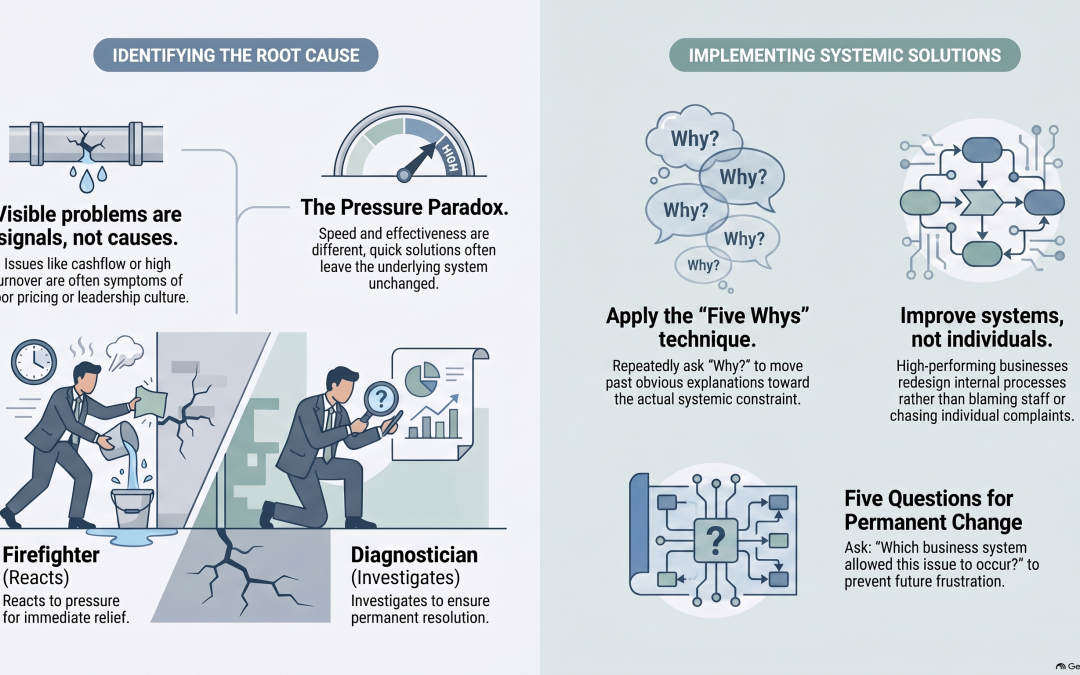
Most Business Problems Are Only Signals
One of the biggest misconceptions in business is that the visible problem is the real problem. In reality, most business issues are simply signals that something deeper within the organisation needs attention.
Take cashflow as an example. When cash becomes tight, many businesses immediately focus on collecting overdue invoices, extending supplier terms or increasing their overdraft. Those actions may relieve the immediate pressure but they rarely solve the underlying issue. The real cause may be poor pricing, declining margins, inefficient production, excessive inventory, weak project management or an overloaded operation that delays invoicing. Cashflow is simply where the problem eventually becomes visible.
The same pattern appears throughout almost every business. High staff turnover is often blamed on recruitment when the real issue is inconsistent leadership or a poor workplace culture. Declining sales are frequently attributed to the sales team when the real problem is an unclear value proposition or an undifferentiated offering. Customer complaints may seem to indicate poor service when they actually reveal broken internal systems, inconsistent processes or unrealistic expectations.
Symptoms are important because they tell us that something is wrong. They are rarely useful because they tell us what is wrong.
Why Intelligent Leaders Still Treat Symptoms
If identifying root causes is so important, why do so many capable business owners continue treating symptoms?
The answer is surprisingly simple. Leadership operates under pressure. Customers expect immediate answers. Employees need decisions. Suppliers want payment. Problems arrive faster than time allows for careful analysis. In that environment, taking action feels productive while investigation can feel like a luxury.
Unfortunately, speed and effectiveness are not always the same thing. A quick solution often provides immediate relief, which reinforces the belief that the problem has been solved. In reality, the underlying system remains unchanged. Eventually the symptom returns and the organisation finds itself investing more time, more money and more energy solving exactly the same issue again.
Over time this creates a culture of firefighting. Leaders become exceptionally good at responding to problems but make very little progress eliminating them. Meetings become dominated by operational issues. Teams become frustrated because familiar challenges keep resurfacing. Improvement slows because attention is continually drawn back to yesterday’s problems instead of tomorrow’s opportunities.
Think Like a Doctor, Not a Firefighter
Imagine visiting your doctor with recurring headaches.
A good doctor does not simply prescribe painkillers every time you walk through the door. They ask questions. They examine your lifestyle, medical history, stress levels and other possible contributing factors before recommending treatment. Their objective is not simply to remove the pain. Their objective is to understand why the pain exists.
Business leaders should approach problems with exactly the same discipline.
When a recurring issue appears, resist the temptation to immediately search for a solution. Instead, become curious. Ask what changed. Look for patterns. Examine the processes surrounding the issue. Challenge long-held assumptions. Sometimes the first explanation is correct. More often, it is only the beginning of the investigation.
Businesses improve far more quickly when leaders become skilled diagnosticians rather than highly efficient firefighters.
A Simple Tool That Reveals the Real Problem
One of the simplest techniques for uncovering root causes is the Five Whys. Popularised through the Toyota Production System, the technique is exactly what its name suggests. Rather than accepting the first explanation, you continue asking “Why?” until you uncover the underlying issue.
Imagine a business that regularly misses customer delivery dates.
The initial conclusion might be that production scheduling is poor. Asking why reveals that production is constantly falling behind. Asking why again shows that equipment is frequently unavailable. Another why reveals that preventative maintenance is continually postponed. Digging further uncovers that maintenance is postponed because the factory has no spare capacity to stop production. Finally, the business recognises that its real constraint is insufficient production capacity rather than poor scheduling.
Without this disciplined questioning, management might invest months refining production schedules while the underlying capacity constraint continues creating delays. The symptom changes very little because the system producing it has never been improved. This principle sits at the heart of Chapter 2, which encourages leaders to move beyond obvious explanations and identify the true source of recurring business problems.
Sustainable Improvement Comes from Better Systems
One of the defining characteristics of high-performing businesses is that they spend less time solving individual problems and more time improving the systems that create results.
Rather than continually responding to customer complaints, they redesign the customer experience. Rather than repeatedly replacing employees, they improve recruitment, onboarding and leadership capability. Rather than chasing cash every month, they strengthen pricing, forecasting and operational efficiency. Rather than blaming individuals, they examine whether the existing processes make success easy or difficult.
This approach requires patience because improving systems usually takes longer than implementing quick fixes. It also produces significantly better outcomes because well-designed systems continue delivering results long after the original problem has disappeared.
As the saying goes, every system is perfectly designed to produce the results it currently delivers. If the results are disappointing, the first place to look is the system itself.
Five Questions Worth Asking
The next time a recurring issue appears in your business, pause before discussing solutions and ask a different set of questions.
1. What problem are we actually trying to solve?
2. Have we experienced this issue before?
3. What evidence suggests this is a symptom rather than the underlying cause?
4. Which business system allowed this issue to occur?
5. If we solved the underlying cause, would this problem disappear permanently?
Those questions may take longer to answer than implementing another quick fix but they often prevent years of repeated frustration.
Frequently Asked Questions
What is a root cause?
A root cause is the underlying reason a problem exists. Removing the root cause reduces the likelihood of the problem recurring because it addresses the source rather than the symptom.
What are the Five Whys?
The Five Whys is a structured questioning technique that repeatedly asks “Why?” until the underlying cause of a problem becomes clear. It is a simple but highly effective way of improving business problem solving and is discussed in Chapter 2 of The Questions You’re Not Asking.
Why do the same business problems keep returning?
Recurring problems usually indicate that the underlying process, system or behaviour has not changed. Temporary solutions may remove the immediate symptom but they rarely prevent it from returning.
Can every business problem be traced to a single cause?
Not always. Many business issues have several contributing factors. The objective is not to find one perfect answer but to identify the few underlying causes that will have the greatest impact if addressed.
 Explore The Questions You’re Not Asking About Your Business →