
by admin | Aug 10, 2026 | Business Tips
If you’ve been in business for a while, you’ll probably remember the term VUCA. It became popular after the Global Financial Crisis and quickly found its way into boardrooms, strategic planning workshops and leadership discussions. Originally developed by the US military following the end of the Cold War, it described a world that had become Volatile, Uncertain, Complex and Ambiguous. At the time it was a useful way of explaining why traditional planning was becoming more difficult and why leaders needed to think differently.
I believe the term is still relevant today, but it no longer tells the whole story.
Over the past few years we’ve watched geopolitical conflict disrupt global supply chains, governments introduce sweeping regulatory and taxation changes, tariffs reshape international trade and inflation, interest rates and labour shortages place pressure on businesses across almost every sector. Add to that the rapid emergence of Artificial Intelligence and widespread digital transformation, and it’s easy to see why many business owners feel they’re operating in a completely different environment.
The difference isn’t simply that the world has become more volatile. The difference is that everything is happening faster. Before we’ve adjusted to one major event, another has arrived. Information moves instantly, customer expectations continue to rise and technology evolves faster than most organisations can comfortably absorb. That’s why I believe VUCA needs another letter.

S for Speed.
Not because speed is another business challenge, but because it amplifies every one of the others. We are no longer operating in a VUCA world. We are operating in a VUCA-S world, where volatility, uncertainty, complexity and ambiguity are all accelerated by the increasing speed of business.
Volatility isn’t new. Markets have always risen and fallen, governments have always changed policy and competitors have always emerged. Uncertainty has always been part of running a business, and every experienced owner knows that perfect information rarely exists when important decisions need to be made.
What has changed is the pace at which these forces now move.
Volatility arrives faster. Uncertainty spreads globally within hours. Complexity increases as businesses become more connected through technology, regulation and global supply chains. Ambiguity lasts longer because information now travels faster than facts, making it increasingly difficult to separate informed opinion from speculation.
For business owners and managers, that creates a very different leadership challenge. The issue is no longer simply understanding change. It’s understanding change quickly enough to make good decisions before circumstances shift again.
One of the biggest mistakes I see is businesses confusing speed with urgency. They aren’t the same thing.
Urgency often creates reactive behaviour. Every new headline demands attention. Every customer request becomes an emergency. Every new technology suddenly appears to require immediate investment. Before long, leadership teams spend their days responding to whatever seems most pressing rather than concentrating on what is most important.
The businesses that perform well in uncertain environments don’t necessarily move faster than everyone else. They make better decisions sooner because they’ve already invested time thinking about possible futures. They have clearer priorities, stronger systems and more disciplined decision-making processes. When disruption occurs, they don’t have to start thinking from scratch because they’ve already considered many of the possibilities.
That’s one of the reasons I’ve become such a strong advocate for scenario planning. As I discuss in The Questions You’re Not Asking About Your Business, the purpose of planning isn’t to predict the future. It’s to prepare for several possible futures so you’re ready to adapt as events unfold.
Artificial Intelligence hasn’t created this new environment, but it has certainly accelerated it.
Tasks that previously took hours now take minutes. Marketing content can be produced almost instantly. Reports can be analysed in seconds. Customer enquiries are answered around the clock. Software development, research, forecasting and administration are all becoming significantly faster.
That’s an extraordinary opportunity, but it also creates a trap.
When information becomes instant, leaders can begin believing that every decision should also be instant. Yet judgement still takes time. Experience still matters. Reflection still matters. AI can process information at incredible speed, but it cannot replace the commercial judgement that comes from understanding your customers, your people and your business.
Technology should help us make better decisions, not simply faster ones.
None of this means strategic planning has become less important. If anything, it’s become more important than ever. What has changed is the rhythm of planning.
There was a time when many businesses developed an annual plan, reviewed it periodically and expected it to remain largely relevant for twelve months. In today’s environment that’s becoming increasingly unrealistic. Your long-term direction may remain unchanged, but the path you take to get there will almost certainly require regular adjustment.
That’s why I continue to encourage clients to think in multiple time horizons. Have a clear long-term strategy. Translate that into annual priorities. Then execute in focused 90-day cycles, reviewing assumptions and making adjustments as new information becomes available. Businesses that shorten their learning cycles will almost always outperform those that simply produce longer plans.
For years, businesses were encouraged to focus on efficiency. Reduce inventory. Minimise costs. Remove spare capacity. Optimise every process. Those disciplines remain important, but recent events have reminded us that efficiency without resilience can leave a business surprisingly vulnerable.
The organisations that have navigated uncertainty most successfully have generally shared a number of common characteristics. They have built financial buffers, developed stronger leadership capability, diversified key risks and created systems that allow them to respond calmly rather than react emotionally. They understand that resilience isn’t wasted capacity – it’s strategic flexibility.
As I explore throughout the book, resilience isn’t something you build during a crisis. It’s something you build before the crisis arrives. Cash reserves, capable people, documented systems and thoughtful planning all buy something incredibly valuable when uncertainty strikes: time. And time allows leaders to make better decisions.
260613 Questions A5 softcover – FINAL.pdf
There’s another lesson hidden inside the VUCA-S world. As the speed of business increases, unnecessary complexity becomes a significant competitive disadvantage.
Every additional approval slows decision-making. Every unnecessary meeting consumes leadership capacity. Every extra system creates friction. Every poorly designed process delays execution. Complexity doesn’t simply reduce productivity; it reduces agility.
That’s why one of the simplest disciplines I encourage businesses to adopt is continually asking three questions:
Can we eliminate it?
Can we automate it?
Can we delegate it?
The goal isn’t simply to become more efficient. It’s to create a business that can respond quickly without becoming chaotic. In a world where change is accelerating, simplicity becomes a strategic advantage.
We can’t control geopolitical conflict, government policy, global markets or technological disruption. We can’t eliminate uncertainty, and we certainly can’t predict every change that’s coming next.
What we can do is build businesses that are capable of adapting without losing focus.
That means strengthening resilience before it’s needed, simplifying operations before complexity becomes overwhelming and reviewing strategy often enough to respond intelligently as circumstances evolve. It also means resisting the temptation to react to every new development and instead maintaining the discipline to focus on what matters most.
That’s what Focused Execution has always been about. It has never been about producing the perfect plan. It’s about creating the discipline to review, adjust and execute consistently as the world changes around you.
In a VUCA-S world, that discipline may become one of the few sustainable competitive advantages left.
VUCA still describes today’s business environment, but speed now amplifies every element of volatility, uncertainty, complexity and ambiguity.
Competitive advantage is increasingly determined by how quickly a business can adapt without losing strategic focus.
Focused Execution, Scenario Planning and regular 90-day reviews provide a practical framework for leading confidently in an increasingly unpredictable world.
In a VUCA-S world, the goal isn’t to predict exactly what happens next. It’s to ask better questions, challenge your assumptions and build a business that is prepared to adapt as circumstances change.
That’s one of the central ideas behind my book, The Questions You’re Not Asking About Your Business. Several chapters are particularly relevant to leaders navigating today’s volatile, uncertain and fast-moving environment:
Chapter 13 – Are you planning for One Future or preparing for many?
Why single path planning limits agility and increases risk.
Chapter 19 – When did you last test your assumptions?
Why strong businesses invite pressure before the market applies it.
Chapter 24 – What is Your Strategy?
Why activity without clear choices is not strategy.
Chapter 25 – Are you reinventing without the panic?
Why delayed adaptation increases risks and limits opportunity.
Chapter 26 – Would your business withstand a shock tomorrow?
Why resilience is designed before it is needed.
Together, these chapters explore many of the capabilities that matter most in a VUCA-S world: scenario planning, strategic clarity, challenging assumptions, adaptability and resilience.
You can’t eliminate volatility, uncertainty, complexity or ambiguity and you certainly can’t slow the world down. But you can build a business that is better prepared to respond to them.
 Explore The Questions You’re Not Asking About Your Business → https://amzn.asia/d/0a8fUXkU
Most business problems don’t appear suddenly.They build quietly while leaders stay busy reacting. In this practical and thought-provoking book, business coach Russell Cummings reveals the hidden questions many business owners avoid until it’s too late.
Drawing on four decades of experience across hundreds of businesses, Russell explores the real issues behind growth, leadership, culture, profitability, productivity, strategy, and resilience.

by admin | Aug 10, 2026 | Business Tips
Mention 5S to many business leaders and you’ll often get the same response.
“Isn’t that just about keeping the workplace tidy?”
It’s an understandable misconception.
Photos of neatly organised workshops, labelled shelves and colour-coded tool boards have become synonymous with 5S. While these are visible outcomes, they aren’t the purpose of the methodology.
5S was never designed to create tidy workplaces. It was designed to create productive workplaces. The difference matters. Because clutter isn’t simply untidy. It’s expensive.
Every minute spent searching for information, looking for equipment, correcting mistakes or working around disorganisation is time that adds no value for the customer.
5S eliminates that waste.
That’s why it remains one of the most powerful Lean practices – whether you operate a factory, an office, a construction business or a professional services firm.
What Is 5S?
5S is a structured approach to organising work so that people can perform their jobs safely, consistently and efficiently.
The five Japanese terms are:
● Sort – Remove what isn’t needed.
● Set in Order – Organise what remains so it is easy to find and use.
● Shine – Clean and inspect the workplace regularly.
● Standardise – Create consistent ways of maintaining the improvements.
● Sustain – Build habits that make the improvements permanent.
Although simple, these five steps fundamentally change how work is performed.
They reduce friction. They reduce errors. They reduce wasted time. Most importantly, they make problems visible.
Productivity Is Lost in Small Moments
Many organisations search for major productivity breakthroughs.
New technology. Large restructuring programs. Significant capital investment.
Meanwhile, they overlook the hundreds of small interruptions that quietly consume every working day.
Employees searching for files. Looking for tools. Checking which document is the latest version.
Walking across the office to collect information. Recreating work that already exists. Waiting because something couldn’t be found.
Each interruption lasts only a few minutes. Across an organisation, those minutes become hundreds of lost hours every month. 5S attacks these hidden losses.
Sort: Remove What Doesn’t Add Value
Most workplaces accumulate unnecessary items over time.
● Old files.
● Obsolete equipment.
● Duplicate forms.
● Unused software.
● Broken tools.
● Outdated templates.
The more unnecessary items that exist, the harder it becomes to find what really matters.
Sorting asks one simple question: “Do we actually need this?”
If the answer is no, remove it.
Less clutter means faster decisions, easier navigation and fewer distractions.
The goal isn’t minimalism. The goal is focus.
Set in Order: Make Work Easy
Once unnecessary items have been removed, everything else should have a logical place.
Think about your kitchen. You don’t spend time searching for cutlery because every item has a designated location.
Business should work the same way.
Frequently used items should be immediately accessible. Documents should follow consistent naming conventions.
Digital folders should be organised logically. Equipment should be stored where it is used. Information should be easy to locate.
The objective is simple. People should spend their time working – not searching.
Shine: Cleaning Reveals Problems
Cleaning is often misunderstood as a cosmetic exercise.
Lean sees it differently. Cleaning is inspection.
When equipment is cleaned regularly, wear becomes visible. Leaks are detected earlier. Loose fittings are identified. Damage is noticed before breakdowns occur.
The same principle applies in offices.
Reviewing documents uncovers outdated information. Cleaning shared drives exposes duplicate files. Tidying workflows reveals unnecessary complexity.
Clean workplaces expose problems that clutter hides.
Standardise: Create Consistency
One organised desk achieves very little.
An organised organisation creates sustainable performance.
Standardisation ensures improvements don’t depend on individual preferences.
Everyone understands:
● where information belongs
● how documents are stored
● how equipment is maintained
● how workspaces are organised
● how routine tasks are completed
Consistency reduces confusion. It simplifies training. It improves quality. Most importantly, it creates stability – the foundation of every successful Lean organisation.
Sustain: Build Habits, Not Events
This is where many organisations struggle.
They conduct a successful 5S activity. The workplace looks excellent.
Three months later, everything has returned to its previous state.
Why? Because behaviour didn’t change.
Sustaining 5S requires leadership.
Regular reviews. Clear expectations. Visible standards. Positive reinforcement. Daily discipline.
The goal isn’t to maintain tidiness. The goal is to maintain productivity. That requires habits.
5S in the Office
Many people assume 5S belongs on the factory floor. In reality, office environments often contain just as much waste.
Consider the average working day.
How much time is spent:
● searching for emails?
● locating the latest document?
● checking which spreadsheet is correct?
● waiting for information?
● recreating work because nobody can find it?
Digital clutter is still clutter.
Applying 5S to office environments might include:
● standard folder structures
● consistent document naming
● removing duplicate files
● organising shared drives
● simplifying templates
● reducing unnecessary paperwork
The result isn’t simply a tidier computer. It’s faster, more reliable work.
5S in Professional Services
Professional services firms can benefit enormously from 5S.
Imagine:
● A standard proposal template.
● Consistent client onboarding.
● Clearly organised project files.
● Shared knowledge libraries.
● Simple meeting agendas.
● Repeatable review processes.
Every improvement reduces time spent searching, clarifying and correcting. Clients experience faster service. Employees experience less frustration.
The business becomes easier to scale because good systems replace individual memory.
5S Improves More Than Productivity
Although productivity is the primary objective, organisations often experience additional benefits.
Higher quality. Fewer mistakes. Improved safety. Shorter training times. Greater employee engagement. Better customer experiences. Reduced stress.
People enjoy working in environments that make success easier.
Well-organised workplaces communicate professionalism, discipline and respect for both employees and customers.
Leaders Must Model the Standard
One of the quickest ways to undermine 5S is inconsistent leadership. If leaders ignore agreed standards, everyone else soon follows.
Successful organisations treat 5S as a leadership discipline.
Managers organise their own work. Digital files follow the same standards. Meeting agendas remain consistent. Improvement becomes visible at every level.
Culture is reinforced through example, not instruction.
Five Questions Every Leader Should Ask
Take a moment to reflect on your own organisation.
How much time do our people spend searching instead of working?
What unnecessary items create confusion every day?
Would a new employee know where to find everything they need?
Are our digital systems as organised as our physical workspace?
What daily habits ensure good organisation is maintained?
The answers often reveal opportunities hiding in plain sight.
Small Improvements, Big Results
Many leaders underestimate 5S because each improvement appears small.
One organised drawer. One simplified template. One clearly labelled shelf. One standard folder structure. One cleaner workspace.
Yet these small changes compound. Five minutes saved each day becomes hours every month.
Across an entire organisation, those hours become significant productivity gains. This is the real power of Lean.
Small improvements applied consistently, delivering extraordinary results over time.
Final Thoughts
5S has never been about cleanliness for its own sake.
It’s about removing the friction that prevents people from doing their best work.
When workplaces are organised, information is easy to find and processes are consistent, productivity naturally improves.
Employees spend less time searching. Customers receive better service. Leaders spend less time solving avoidable problems.
Improvement becomes easier because the workplace itself supports high performance.
That’s why 5S has remained a cornerstone of Lean for decades. Not because tidy workplaces look impressive. Because organised workplaces perform better.
Ready to Improve Productivity Without Working Harder?
Join our upcoming Lean Bootcamp Training Course and discover how practical Lean tools like 5S can eliminate wasted time, improve team performance and create the stable systems every growing business needs.
Whether you lead a manufacturing business, office, construction company or professional
services firm, you’ll leave with practical ideas you can implement immediately.
Because productivity isn’t created through harder work. It’s created through better systems.

by admin | Aug 6, 2026 | Business Tips
Many business leaders are introduced to Lean through diagrams.
One of the most recognisable is the Lean House – sometimes called the Lean Temple.
At first glance, it looks simple. A roof. Two supporting pillars. A solid foundation. People standing in the middle.
Unfortunately, many leaders see it as just another management model. It isn’t.
The Lean Temple is a blueprint for building an organisation that consistently delivers value to customers.
Like any building, its strength depends on its foundations. Without stability, every improvement eventually collapses.
That’s why successful Lean organisations don’t begin by chasing sophisticated tools or large transformation projects.
They begin by building stable, repeatable systems.
Why Stability Matters
Imagine trying to renovate a house while its foundations are moving.
Every improvement becomes harder. Walls crack. Doors no longer fit. New problems appear faster than old ones disappear.
Businesses experience the same challenge.
● When processes constantly change…
● When priorities shift every day…
● When people perform the same task differently…
Improvement becomes almost impossible.
Leaders spend all their time responding to variation rather than reducing it.
Stability provides something incredibly valuable. Predictability.
Predictable processes make problems visible. Unpredictable processes hide them.
Understanding the Lean Temple
Although different versions exist, the Lean Temple is generally made up of four essential components.
● The foundation
● The pillars
● The people
● The roof
Together, they create a system rather than a collection of individual tools.
Let’s explore each part.
The Foundation: Stable Processes
Every successful Lean organisation is built on stable processes.
That doesn’t mean rigid bureaucracy. It means having clear, repeatable ways of performing important work.
Stable processes include:
● agreed standards
● documented procedures
● consistent workflows
● organised workplaces
● reliable equipment
● predictable scheduling
Without consistency, improvement becomes guesswork.
If every employee completes the same task differently, leaders cannot determine whether changes actually improve performance.
Standardisation isn’t the enemy of innovation. It’s the platform that allows innovation to succeed.
Standard Work Creates Freedom
Many people misunderstand standard work. They assume it removes flexibility. In reality, it removes unnecessary variation.
Consider airline pilots. Every flight follows standard operating procedures. Not because pilots lack expertise. Because consistency improves safety.
The same principle applies in business.
When routine work follows agreed standards:
● quality improves
● training becomes easier
● mistakes decrease
● problems become easier to identify
Once stability exists, improvement becomes far more effective.
The First Pillar: Continuous Improvement
One pillar of the Lean Temple is continuous improvement.
Known through the philosophy of Kaizen, this pillar encourages organisations to improve every day.
Rather than waiting for major transformation programs, employees continually ask:
● Can this process be simpler?
● Can we reduce waiting?
● Can we improve quality?
● Can we eliminate waste?
Small improvements accumulate over time. Eventually, they transform the organisation.
Continuous improvement keeps the business moving forward.
The Second Pillar: Built-in Quality
The second pillar focuses on quality.
Traditional organisations often inspect quality after work has been completed. Lean aims to build quality into the process itself.
Problems are identified early. Errors are corrected immediately. Employees stop work when necessary rather than allowing defects to continue downstream.
This approach reduces rework. It improves customer satisfaction. Most importantly, it prevents problems becoming expensive.
Quality isn’t inspected into products or services. It’s designed into the system.
At the Centre: People
Many people are surprised to discover what sits between the pillars.
People. Not technology. Not machinery. Not software. People.
Lean has always recognised that sustainable improvement depends on engaged, capable employees.
The people closest to the work often understand the problems better than anyone else.
Successful Lean organisations invest heavily in developing their teams.
They encourage learning. They welcome ideas. They coach problem-solving skills. They build capability throughout the business.
Technology supports performance. People create it.
The Roof: Delivering Customer Value
Every part of the Lean Temple supports the roof.
The roof represents the ultimate outcomes.
These typically include:
● customer satisfaction
● quality
● productivity
● safety
● profitability
● sustainable growth
Notice something important.
Profit sits alongside customer value – not above it.
Lean does not pursue profit at the expense of customers. Instead, it improves profitability by creating greater value with less waste.
Financial performance becomes the outcome of operational excellence. Not the starting point.
Why Businesses Skip the Foundation
Many organisations become excited by Lean tools.
Visual boards. Kanban. Value Stream Mapping. 5S. Problem-solving workshops.
These are all valuable. But implemented too early, they often disappoint.
Why?
Because unstable organisations struggle to sustain improvement.
Without clear processes:
● Visual boards become outdated.
● Improvement ideas disappear.
● Meetings lose focus.
● Performance varies.
● Leaders conclude that Lean “didn’t work.”
In reality, they simply started in the wrong place.
The strongest buildings always begin with the foundations.
Stability Doesn’t Mean Standing Still
Some leaders worry that standardisation will reduce innovation. The opposite is true.
Stable organisations improve faster. Why? Because consistency makes opportunities easier to recognise.
When everyone follows the same process, even small improvements become obvious.
Changes can be tested. Results can be measured. Successful improvements become the new standard. Then improvement begins again.
Lean creates a cycle. Standardise. Improve. Standardise again. Improve again.
Progress becomes continuous.
Applying the Lean Temple Beyond Manufacturing
Despite its origins, the Lean Temple applies to almost every industry.
Professional Services
● Stable client onboarding.
● Consistent proposal development.
● Standard project reviews.
● Regular client communication.
Healthcare
● Standard clinical procedures.
● Reliable patient handovers.
● Consistent documentation.
● Daily quality reviews.
Construction
● Standard project planning.
● Visual site management.
● Consistent safety routines.
● Daily coordination meetings.
Professional Offices
● Clear workflows.
● Standard meeting rhythms.
● Document management systems.
● Defined approval processes.
● Different industries.
● The same principles.
● Stable systems.
● Engaged people.
● Continuous improvement.
● Customer value.
Five Questions Every Leader Should Ask
Before launching your next improvement initiative, ask yourself:
Do our people perform important processes consistently?
Where does unnecessary variation create problems?
Are we improving processes or simply working around them?
Do employees understand how they contribute to customer value?
Are we building systems that improve every year – or simply solving the same problems repeatedly?
The answers reveal the strength of your organisational foundations.
Building Your Own Lean Temple
You don’t need a major transformation program to begin.
Start by strengthening the foundation.
Document one key process. Create one clear standard. Organise one workspace. Simplify one approval process.
Introduce one daily review meeting. Encourage one improvement idea from every employee.
Build consistency first then improve it.
Small foundations support large organisations.
Final Thoughts
The Lean Temple isn’t simply a diagram. It’s a reminder that sustainable performance is never built on shortcuts.
The strongest businesses don’t rely on exceptional individuals rescuing poor systems. They create stable foundations. They develop capable people. They improve continuously. They deliver consistent value to customers.
Everything starts with stability. Because when the foundations are strong, every improvement
has somewhere solid to stand. And that’s how great businesses are built.
Ready to Build Stronger Foundations?
Join our upcoming Lean Bootcamp Training Course and learn how to apply the principles of the Lean Temple to your own organisation.
You’ll discover practical ways to strengthen your processes, engage your people and create a culture of continuous improvement that delivers lasting business performance.
Because successful Lean organisations aren’t built from the roof down.
They’re built from the foundations up.

by admin | Aug 5, 2026 | Business Tips
Ask almost any business owner or manager how their week has been and you’ll hear a familiar response.
“Busy.”
Pressed for time. Constant interruptions. Unexpected problems. Urgent customer issues. Staff questions. Last-minute deadlines.
For many leaders, this feels normal. In fact, some wear it as a badge of honour.
“I’m solving problems all day.”
But here’s the uncomfortable truth. If you’re constantly firefighting, you’re probably not leading.
You’re managing the consequences of problems that should never have occurred in the first place.
One of the biggest shifts Lean thinking introduces is helping leaders move from reacting to problems to preventing them altogether. That’s where real leadership begins.
The Firefighting Trap
Firefighting is addictive. Every problem solved provides a sense of achievement.
A customer issue is resolved. A project gets back on track. A major crisis is avoided.
The leader feels valuable because they stepped in. Unfortunately, there’s a hidden cost.
Every hour spent solving recurring problems is an hour not spent improving the system that created them.
The organisation becomes dependent on heroic leaders instead of reliable processes.
Eventually, success depends on who is available rather than how well the business operates.
That’s not sustainable.
Busy Doesn’t Mean Effective
Many leaders confuse activity with progress.
A full calendar. Hundreds of emails. Back-to-back meetings. Constant decision-making. These create the appearance of productivity.
Lean asks a different question.
How much of your day creates value?
If most leadership time is consumed by:
● resolving avoidable issues
● approving routine decisions
● chasing updates
● answering repeated questions
● fixing preventable mistakes
Then the business has a systems problem – not a workload problem.
High-performing leaders don’t simply work harder. They build systems that require less intervention.
Every Fire Has a Cause
Imagine a building where the fire alarm sounds every afternoon.
The staff become highly skilled at extinguishing fires. They respond quickly. Communication improves. The process becomes efficient.
But nobody asks why the fires keep starting. Absurd? Perhaps. Yet many organisations operate exactly this way.
Recurring customer complaints. Repeated quality issues. Missed deadlines. Staff confusion.
The symptoms are managed brilliantly. The causes remain untouched.
Lean encourages leaders to move upstream.
Instead of asking: “How do we solve today’s problem?”
Ask: “What allowed this problem to happen?”
That’s where improvement begins.
Leaders Should Design Better Systems
One of the fundamental principles of Lean is simple.
Every system is perfectly designed to produce the results it currently delivers.
If delays are common, the system allows delays. If quality varies, the system allows inconsistency. If customers regularly complain, the system permits those failures.
Blaming individuals rarely changes outcomes. Improving systems does.
The role of leadership is to create processes that make success easier and failure less likely.
Strong systems don’t replace good people. They allow good people to perform consistently.
Daily Management Beats Crisis Management
Successful Lean organisations don’t rely on luck. They rely on rhythm. Daily management creates that rhythm.
Instead of waiting until problems become urgent, leaders review performance every day.
Short team meetings. Visual performance boards. Clear priorities. Immediate identification of issues. Regular coaching. Nothing complicated. Just disciplined routines that keep small issues from becoming major disruptions.
Think of it like maintaining a vehicle. Checking the oil each week is easier than replacing the engine.
Business works the same way.
Visibility Changes Behaviour
Many operational problems remain hidden until they become expensive. Lean encourages leaders to make performance visible.
Visual management boards. Simple dashboards. Daily performance measures. Team improvement boards.
When everyone understands:
● today’s priorities
● current performance
● outstanding issues
● improvement actions
Teams become more proactive.
Problems are identified earlier. Decisions become faster. Accountability improves naturally.
People no longer rely on memory or assumptions. They work from facts.
The Best Leaders Spend Time at Gemba
One of the most powerful concepts in Lean leadership is Gemba, meaning “the real place.”
Rather than managing solely through reports and meetings, Lean leaders spend time where value is actually created.
They visit production areas. They observe customer interactions. They watch administrative processes. They ask questions.
Not to inspect people. To understand the work.
Many operational problems become obvious within minutes of careful observation.
Reports often hide complexity. Reality rarely does.
Coaching Replaces Commanding
Traditional management often relies on giving answers.
Lean leadership relies on asking better questions.
Instead of saying: “Here’s what we’re going to do.”
Lean leaders ask:
● What problem are we trying to solve?
● What evidence do we have?
● What is causing this issue?
● What options have you considered?
● What have we learned?
This approach develops capability throughout the organisation.
Employees become confident problem solvers rather than passive recipients of instructions.
That’s how continuous improvement becomes sustainable.
Continuous Improvement Is Built into Daily Work
Many organisations view improvement as something extra. Something that happens when workloads reduce.
Unfortunately, workloads rarely reduce.
Successful Lean businesses think differently. Improvement isn’t separate from work.
Improvement is part of the work.
Every employee is encouraged to identify opportunities. Every leader creates time for reflection.
Every process can be improved.
Small changes become daily habits. Those habits compound over months and years.
Five Signs You’re Leading Through Firefighting
Ask yourself these questions.
1. Do the same problems appear repeatedly?
Recurring issues usually indicate unresolved root causes.
2. Do staff constantly seek your approval?
Strong systems create clear decision-making boundaries.
3. Are meetings dominated by urgent issues?
Healthy organisations spend increasing amounts of time discussing improvement rather than emergencies.
4. Could your team operate effectively without you for several days?
If everything depends on one leader, capability hasn’t been embedded into the system.
5. How much time do you spend preventing problems rather than solving them?
The answer often reveals whether you’re managing or leading.
From Hero to Architect
Many leaders unintentionally become organisational heroes. Everyone relies on them.
They solve problems quickly. They make difficult decisions. They keep everything moving.
It feels rewarding. Until they take leave. Or become overwhelmed. Or the business grows beyond what one person can manage.
Lean leadership requires a different identity. Not hero. Architect.
Architects design systems that continue performing whether they’re present or not. That’s what creates sustainable businesses. That’s what creates scalable businesses. And that’s what gives leaders their time back.
Final Thoughts
Firefighting may feel productive. Sometimes it’s unavoidable. But if crisis management becomes your normal way of leading, the business is telling you something. Your systems need attention.
Lean leadership isn’t about becoming busier. It’s about becoming more intentional. Creating clarity. Building routines. Developing people. Improving processes. Preventing tomorrow’s problems rather than repeatedly solving yesterday’s.
The strongest organisations aren’t those with the best firefighters. They’re the ones that build businesses where fires become increasingly rare.
That’s the real goal of Lean leadership.
Ready to Lead Instead of Firefight?
Join our upcoming Lean Bootcamp Training Course and learn how to replace reactive management with practical Lean leadership systems that improve performance every day.
You’ll discover how Daily Management, visual leadership and structured problem solving can reduce firefighting, engage your team and create a business that performs consistently without depending on constant intervention.
Because great leaders don’t spend their lives putting out fires.
They build organisations where fewer fires ever start.
by admin | Jul 29, 2026 | Business Tips
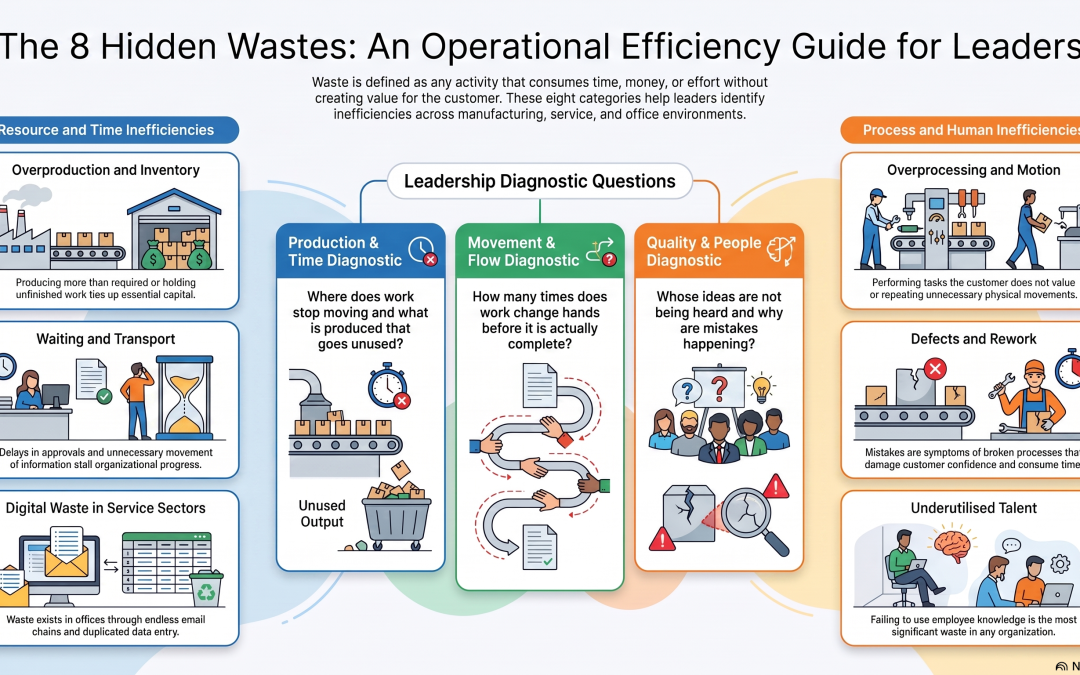
When most people hear the word waste, they picture overflowing bins, scrap materials or excess inventory. In Lean thinking, waste is something much broader.
Waste is anything that consumes time, money or effort without creating value for the customer.
That definition changes everything. Because waste exists in every organisation.
It exists in factories. It exists in offices. It exists in hospitals. It exists in professional services firms. It exists in government departments. It even exists in businesses that believe they’re already highly efficient.
The challenge isn’t whether waste exists. The challenge is whether leaders can see it.
Toyota developed a simple framework known as the Eight Wastes to help organisations identify activities that consume resources without adding value. More than 70 years later, these eight categories remain one of the most powerful tools for improving productivity, profitability and customer experience.
The surprising part? Once you learn to recognise them, you’ll begin seeing them everywhere.
Why Waste Is So Difficult to See
Waste rarely arrives as a major crisis. Instead, it creeps into everyday work.
A five-minute delay. An unnecessary approval. A report nobody reads. A meeting without decisions.
One small frustration seems insignificant. Multiply it by every employee, every day, and the impact becomes enormous.
Businesses often accept these inefficiencies because “that’s the way we’ve always done it.”
Lean challenges that assumption. Every process should earn its place.
Waste #1 – Overproduction
Creating more than the customer needs—or producing it before it’s required.
Manufacturing examples are obvious.
Producing inventory that sits in storage ties up cash and creates additional handling costs.
But overproduction is just as common in offices.
Examples include:
● Preparing reports no one reads.
● Creating presentations “just in case.”
● Producing detailed proposals before understanding client requirements.
● Building features customers never requested.
More isn’t always better.
Producing exactly what is needed, when it is needed, creates greater value with fewer resources.
Leadership Question:
What work are we producing that nobody actually uses?
Waste #2 – Waiting
Waiting is one of the biggest hidden productivity killers.
People waiting. Customers waiting. Projects waiting. Decisions waiting. Every delay slows the entire system.
Examples include:
● Waiting for management approval.
● Delays between departments.
● Equipment downtime.
● Waiting for information from another team.
● Customers waiting for responses.
While no one appears busy during waiting time, the organisation is still paying for it.
Reducing waiting often produces some of the fastest improvements in customer satisfaction.
Leadership Question:
Where does work stop moving?
Waste #3 – Transport
Every unnecessary movement of materials, information or work creates additional cost.
In manufacturing, this might involve moving products across multiple warehouses.
In service businesses, transport often becomes digital.
Examples include:
● Endless email chains.
● Multiple handovers between departments.
● Documents transferred between different systems.
● Information entered repeatedly into separate software platforms.
Every transfer introduces delay and increases the likelihood of mistakes.
The smoother the flow, the better the performance.
Leadership Question:
How many times does work change hands before it’s complete?
Waste #4 – Overprocessing
Doing more work than the customer actually values.
Many businesses mistake complexity for quality.
Examples include:
● Requiring multiple approvals for routine decisions.
● Producing lengthy reports where a dashboard would suffice.
● Collecting information that is never used.
● Entering identical data into multiple systems.
● Excessive documentation created to satisfy internal habits rather than customer needs.
Customers rarely pay for unnecessary complexity. They value outcomes.
Lean encourages businesses to simplify wherever possible.
Leadership Question:
If we started this process today, would we design it this way?
Waste #5 – Inventory
Inventory isn’t limited to warehouses. Any unfinished work represents inventory.
Examples include:
● Unanswered emails.
● Projects waiting to begin.
● Sales proposals sitting in draft form.
● Customer enquiries waiting for allocation.
● Large queues of work between departments.
Inventory hides problems. It masks bottlenecks. It delays feedback.
Reducing work in progress helps businesses respond faster and identify issues sooner.
Leadership Question:
Where is work piling up?
Waste #6 – Motion
Motion refers to unnecessary movement by people.
Unlike transport, which focuses on moving work, motion concerns how people perform their tasks.
Examples include:
● Searching for documents.
● Walking between poorly organised workstations.
● Switching constantly between software applications.
● Looking for tools or equipment.
● Repeating manual administrative tasks.
Every interruption reduces concentration and increases fatigue.
Well-designed workplaces make the right way the easiest way.
Leadership Question:
What unnecessary effort does our team repeat every day?
Waste #7 – Defects
Mistakes are expensive.
Not only because they require correction, but because they damage customer confidence and consume valuable time.
Examples include:
● Incorrect invoices.
● Quotation errors.
● Data entry mistakes.
● Product defects.
● Poor communication requiring clarification.
● Rework caused by incomplete instructions.
Most defects are symptoms of broken processes rather than careless people.
Lean asks leaders to improve the system instead of blaming individuals.
The goal isn’t perfection. The goal is designing processes where mistakes become less likely.
Leadership Question:
Why are these mistakes happening—not who made them?
Waste #8 – Underutilised Talent
This is often considered the most significant waste because it limits every other improvement.
Businesses hire capable people, then fail to use their knowledge.
Employees frequently know:
● where customers become frustrated
● which systems waste time
● what processes could be simplified
● which approvals add no value
Yet many organisations never ask. Or worse, they ask but never act.
Continuous improvement depends on involving the people closest to the work.
Their experience is one of the organisation’s greatest competitive advantages.
Leadership Question:
Whose ideas aren’t we hearing?
Waste Exists Beyond Manufacturing
One reason Lean continues to gain popularity is its universal application.
Consider these examples.
Professional Services
● Preparing proposals clients never request.
● Waiting for partner approval.
● Re-entering client information.
● Excessive reporting.
● Rework after unclear client briefs.
Construction
● Trades waiting for materials.
● Equipment standing idle.
● Design changes causing rework.
● Poor coordination between contractors.
● Excess inventory stored on site.
Healthcare
● Patients waiting for appointments.
● Duplicate paperwork.
● Delayed test results.
● Medication errors.
● Multiple handovers between departments.
Retail
● Overstocked shelves.
● Long checkout queues.
● Incorrect pricing.
● Manual stock counts.
● Staff spending time searching for products.
Different industries. The same categories of waste.
Learning to See Waste
One of the greatest lessons from Toyota is that improvement begins with observation.
Most leaders spend their time reviewing reports. Lean encourages something different.
Go where the work happens. Watch. Ask questions. Remain curious. Observe without judgement.
You will quickly discover opportunities that never appear on dashboards.
Seeing waste is a skill. Like any skill, it improves with practice.
Start Small
Many businesses believe they need a major transformation program before they can improve.
In reality, meaningful progress often begins with one small observation.
One unnecessary approval. One duplicated task. One delay. One repeated
Remove one source of waste today. Tomorrow, remove another.
Small improvements accumulate into significant competitive advantage. That’s the power of continuous improvement.
Final Thoughts
Waste is rarely dramatic. It’s usually hidden inside everyday routines that have become accepted over time.
The organisations that outperform their competitors aren’t necessarily working harder. They’re simply better at recognising and removing activities that don’t create value.
When leaders learn to see waste, they also learn to see opportunity.
Opportunity to improve customer experience. Opportunity to reduce frustration. Opportunity to increase productivity. Opportunity to build a business that performs better every single day.
The eight wastes aren’t just a Lean framework. They’re a different way of seeing your business.
And once you start seeing them, it’s impossible to look away.
Ready to Learn How to Spot Waste Like a Lean Leader?
Join our upcoming Lean Bootcamp Training Course and discover practical techniques for identifying hidden waste, improving business processes and creating a culture of continuous improvement.
You’ll leave with simple tools you can apply immediately—whether you lead a manufacturing business, professional services firm, construction company or growing SME.
Because every business has waste.
The best businesses simply learn to see it first.