
Why Most Lean Programs Fail (And What Successful Businesses Do Differently)
Walk into almost any organisation and you’ll find evidence of improvement initiatives.
A Lean project from two years ago. A Continuous Improvement committee that no longer meets. A collection of process maps sitting untouched on a shared drive. A wall covered with sticky notes from a workshop everyone has forgotten.
The intention was good. The results rarely lasted.
According to numerous industry studies, the majority of Lean transformations either stall or fail to deliver sustainable improvements. Not because Lean doesn’t work, but because organisations misunderstand what makes it successful.
Too many businesses treat Lean as a collection of tools. The best businesses treat it as a leadership system. That difference changes everything.
Lean Doesn’t Fail. Implementations Do.
When leaders say, “We tried Lean and it didn’t work,” they’re usually describing something very different from Lean itself.
Perhaps they introduced 5S into the warehouse. Perhaps they ran a Kaizen event. Perhaps consultants redesigned several processes.
These activities may improve isolated areas, but they don’t necessarily change how the organisation thinks or operates.
Lean was never intended to be a short-term project.
It is a management philosophy built around creating value, eliminating waste and continuously improving how work is performed.
When organisations focus only on the tools, they miss the philosophy that makes those tools effective.
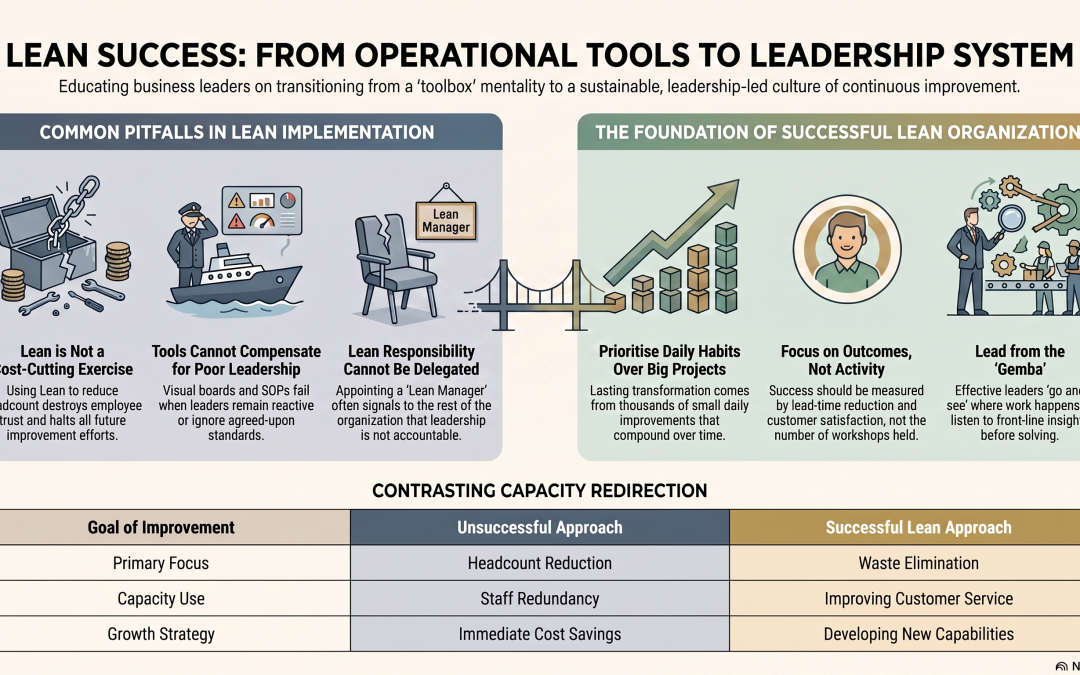
Mistake 1: Treating Lean as a Cost-Cutting Exercise
One of the quickest ways to lose employee support is to present Lean as a way to reduce headcount.
People quickly learn an unfortunate lesson.
“If I improve my job, I might eliminate my own position.”
When that belief takes hold, improvement stops.
Successful organisations position Lean very differently.
Their objective is to remove waste, not people.
The capacity created through better processes is redirected towards:
• improving customer service
• increasing output
• reducing lead times
• supporting growth
• developing new capabilities
Employees become partners in improvement rather than victims of it.
Mistake 2: Expecting Tools to Solve Leadership Problems
Many Lean implementations begin with training.
Teams learn about visual management. They explore Value Stream Mapping. They create Standard Operating Procedures.
These are valuable tools. But they cannot compensate for poor leadership.
If priorities constantly change… If managers ignore agreed standards… If leaders spend every day reacting to crises… No Lean tool will fix the underlying culture.
Lean starts with leadership behaviours long before it reaches improvement tools.
Mistake 3: Delegating Lean to Someone Else
Many organisations appoint a Lean Manager and assume the work is done. Unfortunately, this sends an unintended message.
“Lean is their responsibility.”
Successful businesses understand something different. Lean is everyone’s responsibility, but leadership owns the culture. The CEO cannot outsource continuous improvement. Managers cannot delegate accountability for better processes.
The most successful Lean organisations have leaders who actively participate in improvement activities, ask questions, remove barriers and model the behaviours they expect from others.
Mistake 4: Chasing Big Projects Instead of Daily Improvement
Large transformation programs often generate excitement. They also generate complexity.
Months of planning. Consultants. Workshops. Reports. Project teams.
Meanwhile, dozens of smaller opportunities remain untouched.
Toyota became famous not because of occasional breakthrough projects but because thousands of small improvements occurred every year.
Continuous improvement compounds. Fixing one small frustration each day may appear insignificant. Across an entire organisation, it becomes transformational.
The businesses that improve consistently don’t wait for major change initiatives. They improve
every day.
Mistake 5: Ignoring the Front Line
Senior leaders often believe they understand where problems exist. Sometimes they do.
More often, the people performing the work have a much clearer view.
They know:
• where delays occur
• which systems create frustration
• what customers complain about
• where rework happens
• which approvals create bottlenecks
Successful Lean organisations spend time listening before they start solving.
The Japanese concept of Gemba encourages leaders to “go and see” the work where it actually happens.
Real improvement begins with observation rather than assumption.
Mistake 6: Measuring Activity Instead of Outcomes
Many organisations proudly report:
• number of improvement ideas submitted
• workshops completed
• people trained
• projects launched
While these measures indicate effort, they don’t necessarily demonstrate value.
Successful organisations focus on outcomes.
• Has customer satisfaction improved?
• Has lead time reduced?
• Have defects decreased?
• Has productivity increased?
• Has work become easier for employees?
Improvement should always be visible in business performance, not simply in project statistics.
What Successful Businesses Do Differently
High-performing Lean organisations share several common characteristics.
They Lead with Purpose
Everyone understands why improvement matters. It’s connected to customer value, business performance and organisational strategy—not simply operational efficiency.
They Build Stability First
Before chasing optimisation, they establish consistent processes. Stable processes make problems visible. Unstable processes hide them. Consistency creates the foundation for continuous improvement.
They Develop Problem Solvers
Instead of managers solving every issue, employees are taught structured problem-solving techniques.
People closest to the work become confident identifying root causes and implementing practical improvements. Capability grows throughout the organisation.
They Create Daily Improvement Habits
Continuous improvement isn’t reserved for quarterly workshops. It’s embedded into daily management.
Short team meetings. Visual performance boards. Regular reviews. Small experiments. Ongoing learning. Improvement becomes part of normal work rather than an additional task.
They Never Stop Learning
The best Lean organisations remain curious.
Every mistake becomes a lesson. Every success becomes a new standard. Every process can still improve.
Perfection may never be achieved, but the pursuit of it drives extraordinary performance.
Lean Is a Leadership System
One of the biggest misconceptions about Lean is that it’s an operational methodology. In reality, it is a leadership system.
Leaders shape culture. Culture shapes behaviour. Behaviour shapes performance.
Without leadership commitment, Lean becomes another improvement program.
With leadership commitment, Lean becomes the way the organisation thinks.
That distinction determines whether improvement lasts for months or decades.
Five Questions Every Leader Should Ask
Before launching another improvement initiative, consider these questions.
1. Are we trying to improve processes or simply reduce costs?
The objective matters because it influences every decision that follows.
2. Are our leaders modelling continuous improvement?
Employees observe behaviour far more closely than they listen to presentations.
3. Do our people feel safe identifying problems?
If raising issues attracts criticism, problems remain hidden.
4. Are we solving root causes or repeatedly fixing symptoms?
Recurring problems usually indicate deeper systemic issues.
5. Are improvements becoming part of everyday work?
Sustainable change happens through habits, not projects.
Final Thoughts
Lean has transformed organisations around the world for one simple reason. It works.
But only when businesses understand what Lean really is.
It’s not a toolbox. It’s not a project. It’s not a cost-cutting exercise.
It’s a leadership philosophy built around creating better systems, developing capable people and continuously improving the way work is done.
The organisations that achieve lasting success don’t ask, “Which Lean tools should we implement?”
They ask a far more important question:
“How do we build a culture where improvement becomes everyone’s responsibility?”
That’s the difference between organisations that experiment with Lean and those that build lasting competitive advantage.
Ready to Move Beyond Lean Tools?
If you’re serious about creating a culture of continuous improvement, join our upcoming Lean Bootcamp Training Course and discover why successful Lean transformations start with leadership, not tools.
You’ll learn practical frameworks for engaging your team, identifying hidden waste and embedding continuous improvement into the way your business operates every day.
Because Lean isn’t something you implement. It’s something you lead.
Register here: https://leanbootcamp.shifft.com.au/

The Hidden Power of No: How Smart Leaders Create Space to Win
Most leaders assume improvement comes from addition. More projects, more ideas, more tools, more meetings, more customers, more everything. The logic seems sound: if you want progress, add more effort.
Yet the longer you lead, the clearer one truth becomes.
Businesses don’t get stuck because they lack opportunities. They get stuck because they choke on them.
The real challenge isn’t figuring out what to add. It’s having the discipline and courage to remove what no longer strengthens the business.
This is where the power of “No“ lives. Not as a negative mindset, but as a strategic lever that protects focus, energy and performance.
This article invites you to flip your thinking. Instead of asking “What should we do next?” ask “What should we stop doing so the right things can actually thrive?”
Why Leaders Fear “No”
Many owners and managers know they’re overloaded. They know their teams are stretched. They know the calendar is full of low-value work. Yet they keep saying yes.
Why?
Because saying yes feels safe. It feels helpful. It feels like momentum. “No” feels like risk.
This fear usually shows up in four ways:
⁍ Fear of disappointing customers
⁍ Fear of missing out on revenue
⁍ Fear of conflict or confrontation
⁍ Fear that saying “no” makes you small instead of strategic
These fears are understandable, but they come at a cost. Each “yes” hands away a small slice of your time, energy and attention. Eventually those slices add up and you realise you’re barely working on the things that matter most.
At that point, saying yes isn’t generosity. It’s self-sabotage.
Why “No” Creates Strategic Advantage
When you strip away noise, you give your business space to grow. This is where “No” becomes a competitive edge.
1. “No” sharpens direction
Most businesses drift, not because the strategy is wrong, but because the day-to-day decisions aren’t aligned with it. When you start saying “no” to anything that doesn’t serve your strategy, direction becomes clearer for everyone. People stop guessing. Complexity drops. Confidence rises.
2. “No” protects the engine of execution
Every project, customer or idea requires fuel. People, time, attention, cash, emotion. You only have so much to give. If you allocate it broadly, nothing receives enough. If you concentrate it, progress accelerates.
3. “No” creates quality
When you stop spreading your team thin, quality improves. Clients feel it. Staff feel it. Your confidence rises because you can deliver what you promise without burnout or compromise.
4. “No” signals leadership maturity
Leaders who can say “no” calmly and consistently project strength. They demonstrate discipline rather than desperation. This builds trust internally and respect externally.
Subtraction Is a Skill – and Most Businesses Never Learn It
Your book chapter on “No” highlights the idea that businesses usually die from indigestion not starvation.
Here’s the deeper lens behind that idea.
Growth rarely fails due to a lack of opportunity. It fails due to the inability to prioritise, simplify and focus. That means subtraction becomes a primary leadership discipline.
Ask yourself:
⁍ Which products generate revenue but destroy margin?
⁍ Which customers pay well but erode morale?
⁍ Which initiatives look exciting but distract from what matters?
⁍ Which meetings, reports or processes continue out of habit?
The core idea is simple:
Improvement by removal is often more powerful than improvement by addition.
This is how elite businesses scale without losing control. They prune aggressively. They keep only what adds value. Everything else is cut, delegated or replaced.
A More Useful Question Than “What Are We Missing?”
Strong leaders deliberately shift the conversation from addition to subtraction by asking better questions.
Try these:
⁍ What is taking up space that a more valuable project could use?
⁍ What have we continued doing simply because we always have?
⁍ Which customers or commitments drag us away from our strategy?
⁍ What do we need to stop so we can start doing the right work properly?
These questions expose clutter. Once exposed, it becomes easier to act on.
Making “No” Practical – A Simple Four-Part Filter
Saying “no” shouldn’t be emotional. It should be systematic.
Here’s a simple filter that helps you judge whether something deserves a yes.
1. Strategy Fit
Does this align with our strategy?
If not, it’s a “no” by default.
2. Value vs Effort
Will the result justify the time, energy and disruption required?
High effort and low value signal a “no”.
3. Capacity
Do we genuinely have the space to do this well?
If the answer is “no”, then the answer is “no”.
4. Timing
Is this the right move now or just a good idea at the wrong time?
If it’s not a priority today, then it becomes a “not yet.”
This filter helps you make decisions without guilt or second-guessing.
Creating a Culture Where “No” Is Safe
Many businesses encourage saying yes because it looks proactive. Yet high-performing teams thrive when “No” is normalised.
Here’s how to build that rhythm.
1. Make strategy visible
When everyone knows the plan, it becomes easier for them to assess whether a new idea fits. Clarity empowers good judgment.
2. Reward focus, not volume
Celebrate the work that moves the business forward, not the number of projects in motion. Value progress, not busyness.
3. Protect your team’s bandwidth
Teach your managers to say “no” to low-value work. Make it acceptable for them to challenge ideas that dilute focus. This strengthens accountability and reduces overwhelm.
4. Remove outdated commitments
Every quarter, run a Stop Doing Review. Ask the team to identify:
⁍ Tasks that “no” longer add value
⁍ Reports “no” one reads
⁍ Processes that slow things down
⁍ Activities done from habit not necessity
Removing clutter builds momentum quickly.
The Real Reason “No” Matters for Leaders
Saying “no” well is not about being harsh or rigid. It’s about stewardship.
Your most limited resources are not cash or tools. They are:
⁍ time
⁍ attention
⁍ energy
⁍ strategic bandwidth
Every unnecessary “yes” dilutes one of these. Every thoughtful “no” protects them.
When leaders reclaim these resources, execution improves. Stress drops. Strategy clarifies. Teams find rhythm. Owners regain control.
“No” is not rejection. It is refinement.
“No” is not shutting the door. It is choosing the right one to walk through.
“No” is not playing small. It is making space to play bigger.