Delegation Is Not About Letting Go — It’s About Taking Control

Delegation Is Not About Letting Go — It’s About Taking Control

We’ve been sold a lie.

“Just delegate more.” “Let go and trust your team.” “Stop being the bottleneck.”

Sounds great. But most of the advice on delegation is either vague or downright dangerous. Because if you let go without structure, clarity, or boundaries — things fall apart fast.

Delegation isn’t about trust falls and blind faith. It’s about control. Not micromanagement, but real, structured control over the outcomes you need.

And that’s why most leaders get it wrong. They hand over tasks without handing over the right tools, context, or decision-making framework. Then they’re shocked when it blows up — and they go back to doing everything themselves.

I’ve seen this pattern a hundred times. That’s why I built the Delegation Planner — a no-fluff tool to help you delegate like a leader, not like a gambler.

Step 1: Clarity Over Comfort

Most people delegate to get things off their plate. That’s the wrong goal.

Your first job isn’t to hand it off. Your first job is to get crystal clear on:

  • What needs to be done — and what success actually looks like
  • Why it matters — so the task doesn’t get dropped when pressure hits
  • Who is accountable, not just involved
  • When it’s due — with real, non-negotiable deadlines
  • Where the team member can go for help or resources
  • How to deliver it — standards, boundaries, format

This isn’t micromanagement. This is leadership.

Clarity reduces rework. Clarity builds capability. Clarity creates momentum.

Step 2: Delegate Authority, Not Just Activity

Here’s a harsh truth: if you’re still the decision-maker on every delegated task, you haven’t really delegated anything.

The Delegation Planner forces a real conversation about decision rights:

  • Can they recommend only?
  • Can they decide within limits?
  • Or are they fully owning it, end to end?

Most leaders skip this step. Then they wonder why their team keeps coming back for approval. Every. Single. Time.

Decide up front. Then step back accordingly.

Step 3: Close the Loop — Or Don’t Bother

The final piece? Follow up. Not in a “checking up” way, but in a “let’s learn and grow” way.

Ask:

  • What worked well?
  • What could have been done better?
  • What support was missing?

Without this step, you’re just hoping they get better next time. Spoiler alert: they won’t. Feedback is what drives improvement — not just repetition.

The Bottom Line
Delegation isn’t about dumping. It’s not about “empowering people” with vague instructions and crossed fingers.
It’s about being deliberate. Structured. Focused.
When you delegate with discipline, you grow your team and take control of your time.
So stop winging it. Download the Delegation Planner. Use it. Share it. Make it a regular part of your leadership toolkit.
Delegation Planner
A practical template designed to help you assign tasks, clarify responsibilities, and track progress for efficient team management.
Get the free Delegation Planner


Explore more practical tools, not fluffy advice at www.shifft.com.au.

Why Business Owners and Managers Struggle with Execution (and How to Fix It)

Why Business Owners and Managers Struggle with Execution (and How to Fix It)

If you’re a business owner or manager, you’ve probably had days where you’ve been flat out all day but still felt like nothing important actually got done. You’ve ticked boxes, put out fires, handled emails and meetings, but the big strategic priorities are still sitting there untouched.

That’s the reality for many leaders I work with. The issue isn’t lack of effort – most business owners are some of the hardest working people you’ll meet. The problem lies in time and priority management. Too often, we confuse being busy with being productive.

The good news? With the right mindset, tools, and discipline, you can take control of your time and start driving results that matter.

Why Time and Priorities Get Away From Us

There are three common reasons why owners and managers find themselves drowning in tasks but starving for progress:

1. Lack of Focus

Without a clear plan, everything feels urgent. You end up reacting to the loudest problem of the day rather than progressing the goals that will move your business forward.

2. Weak Discipline

Even when you know your priorities, sticking to them is tough. Distractions, interruptions, and shifting demands can pull you off course.

3. Low Control

Many owners don’t shape their environment – they let meetings, emails, and other people’s priorities dictate their time. The result? Long hours, little progress, and mounting frustration.

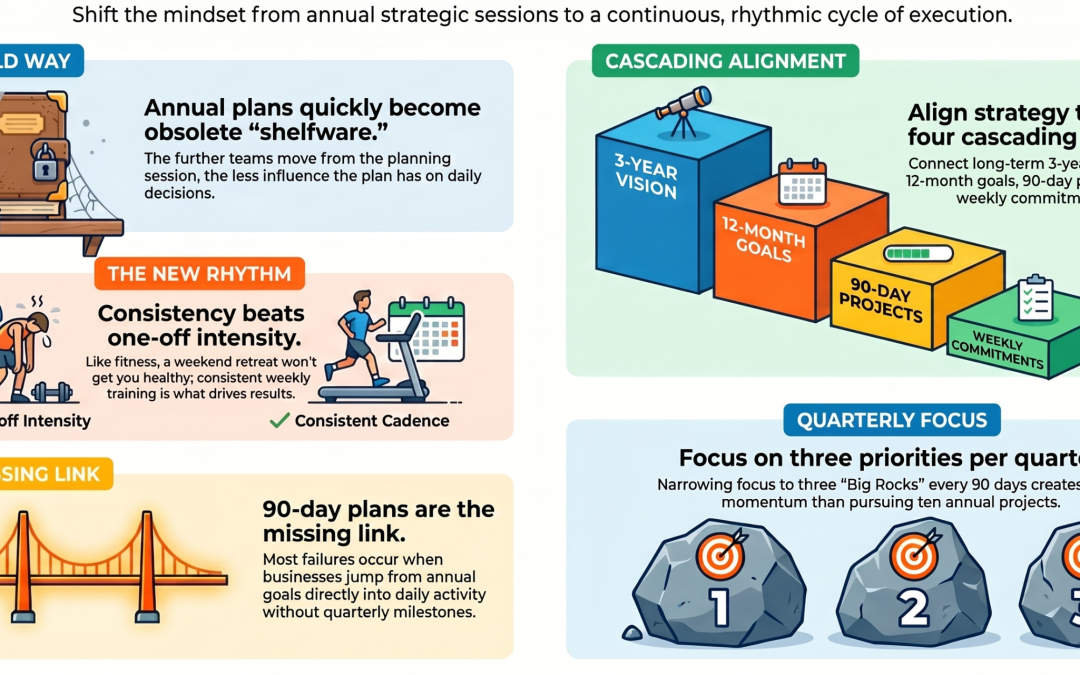
Why 90-Day Plans Are the Answer

The first step is to get “Focus” and a 90-Day Plan is my usual starting point for businesses and leaders. Its one of the most powerful tools we use at SHIFFT as It’s short enough to create urgency, but long enough to make meaningful progress.

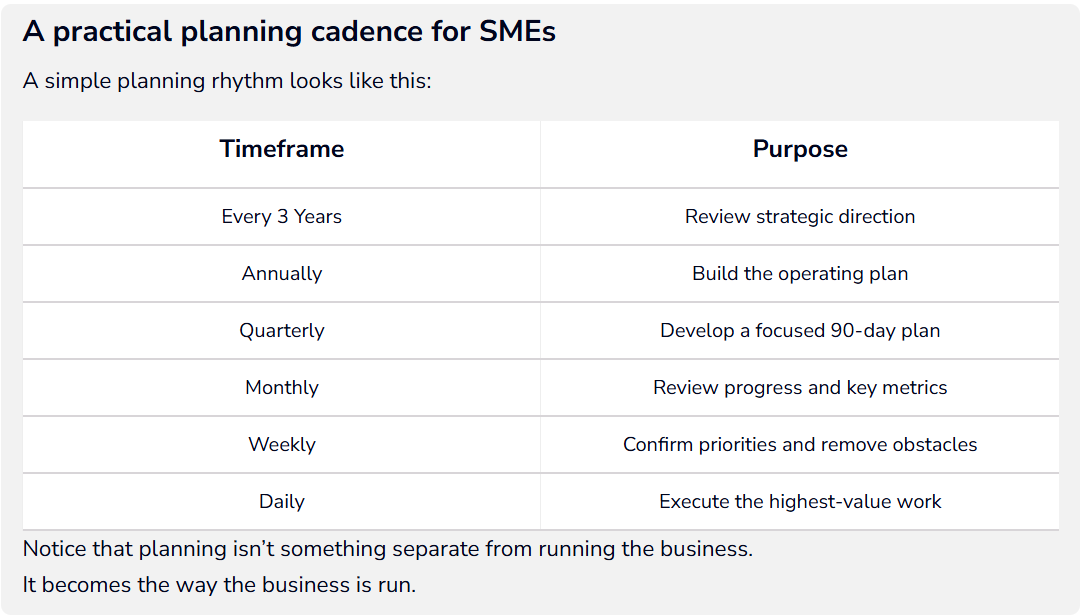
The hierarchy of planning works like this:

  • Strategic Plan: 3–5 years
  • Annual Plan: 12 months
  • 90-Day Plan: the next quarter
  • Monthly, Weekly, and Daily Plans

As you cascade from long-term down to daily, the timeframe shrinks, the detail increases, and accountability sharpens. That’s how strategy becomes execution.

When you start your quarter with a clear 90-Day Plan, you’ve set the stage for focus. Then, by breaking that plan into monthly, weekly priorities and daily “Must Do’s”, you ensure you’re working on the right things every day – not just the noisy things .

Practical Example: From Strategy to Daily Action

Let’s say your strategic goal is to grow revenue by 20% next year.

  • Annual Plan: Add two new sales channels.
  • 90-Day Plan: Launch the first channel and lock in three new major clients this quarter.
  • Monthly Plan: Complete the campaign setup and outreach by Month 1.
  • Weekly Plan: Identify and pitch 10 top prospects.
  • Daily Plan: Make 5 outbound calls and prepare one proposal.

That’s how strategy stops being a nice idea in a document and starts becoming a lived reality in your calendar.

How to Regain Control of Your Time

Here are three steps to bring your time and priorities under control:

1. Start Every Quarter with a 90-Day Plan

Decide on your 3–4 “Big Rocks” for the quarter – the things that must be achieved. Then cascade those down into monthly, weekly, and daily actions.

2. Use the Must-Should-Could Method Daily

Identify your 2–4 “Must-Do’s” each day. These are the non-negotiables. If they’re done, the day is a success – even if nothing else gets touched

3. Build Habits that Reinforce Discipline

Use time-blocking, set boundaries on meetings and email, and create routines that protect your focus. Discipline beats motivation every time.

Key Takeaways
1. It all starts with a 90-Day Plan. Without one, you’ll drift into busyness instead of progress.
2. Discipline beats motivation. Daily habits, time-blocking, and Must-Do’s keep you on track.
3. Cascading plans create clarity. Strategy becomes real when it flows into monthly, weekly, and daily action.
Don’t let this quarter slip away. Join us at the Finish Strong webinar and set yourself up to finish 2025 with momentum and confidence.
👉 Register Now for our free “Finish Strong” webinar.


Custom resources to help you improve your execution

The Finish Strong Challenge
We’re heading into the final quarter of 2025. Many businesses slow down in the lead-up to Christmas – but that doesn’t have to be you. The next 90 days could be your most productive and profitable of the year if you get your plan clear and executed .
That’s why I’m running a free webinar next week:
Finish Strong: Plan the Run to Christmas so You Close Out 2025 & Set Up for 2026
📅 Friday, 10 October 2025 🕘 9:00am–11:00am (Brisbane time)
👉 Register here


Books & Journals

Focused Execution
“Focused Execution: How to stop wasting time and focus on what really matters” by Russell Cummings.
This book summarises the key elements for improving your personal productivity. Russ utilised the tools, concepts and principles outlined in the book to lift his personal productivity by 4X. He went from working 70+ hours/week to 35 hours over 4 day each week on double the revenue.
Focused Execution gives business owners and managers a proven system to take back control of their time and achieve results without burnout.
Available now in print and e-book version on Amazon – Click here
90 Day Productivity Planner
If “Focused Execution” – the book – is the “WHY”, then our Productivity and Planning Journals are the “HOW”!
Stay disciplined as you cascade your 90 Day Plans to monthly, weekly and daily priorities integrating strategies, tactics and operational priorities. Built on the powerful tools and concepts highlighted: The Focused Execution Book, this journal is ultimate daily planner that includes links to free videos and templates to enhance your planning experience.
Available on Amazon in A5 dated paperbased format – Click here


Annual Operating Planning Journal
Focused Execution: Annual Operating Plan: Planning for the next year and beyond” by Russell Cummings.
Turn your strategy into action with the powerful AOP process. Our AOP Journal dovetails neatly with out 90 Day Planning Journal to help you move from Annual to 90 Day to daily plans.
The book includes links to videos and templates to enhance your planning experience.
Available on Amazon in A5 softcover format – Click here
AI Prompt Libraries
The biggest challenges our clients have with AI is what to ask it. To help Russ, created a series of AI prompt libraries that include a range of prompts to help you navigate through a variety of scenarios.
Accelerate your results with our growing collection of AI Prompt Libraries – real words tested prompts for ChatGPT, Co-pilot and other AI Tools to streamline work, increase productivity and spark new ideas.
Each book contains approximately 700 prompts tailored to your specific industry, role or situation. Simply “cut and paste”, tailor for your situation to get amazing result.

AI Business Success – Industries & Professions Series
Targeted prompts for industries and professions including: accounting, consulting, marketing, transport, lawyers, manufacturing, horticulture and more – Click here


AI Prompt for Exec – Roles & Responsibilities Series
Focused prompts for Business Owners, Managers, CEOs, Executives, Partner, etc. – Click here


Ai Prompts – Key Areas & Situations Series
AI Prompts books for essential business areas such as productivity, sales, learn, workforce, planning, etc. – Click here


Bigger is Not Always Better: Navigating the Challenges of Business Growth

Bigger is Not Always Better: Navigating the Challenges of Business Growth

Growth is often seen as the ultimate marker of success in business. More sales, more clients, more employees—all signs that your business is thriving, right? However, bigger doesn’t necessarily mean better. While revenue might climb, profit margins don’t always follow suit. In fact, as businesses grow, complexity increases, requiring higher levels of management skill and more sophisticated systems. In this article, we’ll explore the challenges of growth, the life cycle of businesses, and how to navigate the inevitable plateaus with a focus on sustainable success.

The Business Growth Life Cycle

Business growth follows a predictable pattern that can be visualised as an S-curve. Each phase of the curve comes with its own opportunities and challenges:

1. Startup Phase: At the beginning, businesses focus on generating sales and turning those sales into early profits. This is a high-energy, entrepreneurial phase where processes and systems are often minimal.

2. Process and System Building: As the business grows, the need for structured processes and systems becomes clear. These provide the foundation for scalability but often lead to a plateau as the business consolidates and adjusts to the new complexity.

3. Team Expansion: With solid systems in place, businesses can hire additional team members to take advantage of the efficiencies created. However, scaling up often exposes weaknesses in systems and processes, leading to new challenges.

4. Rapid Growth Phase: Once the business has optimised systems, processes, and team capacity, it can ramp up sales again, entering a phase of accelerated growth.

This cycle repeats itself as the business grows, creating a rhythm of consolidation and expansion. Recognising where you are in the cycle is crucial to understanding the specific actions needed to move forward.

The Challenges of Growth

While growth is desirable, it comes with inherent challenges that can derail even the most ambitious businesses. Here are some of the key hurdles:

1. Sales Outpacing Capacity

Businesses that excel at sales often find themselves growing faster than they can deliver. This leads to overstretched resources and the need to hire quickly. Unfortunately, without robust systems and processes, new hires may struggle to perform efficiently, leading to declining profit margins.

2. The Plateau Effect

Investing in processes and systems is essential, but it doesn’t always deliver immediate results. In some cases, it can make the business more complex and slow operations temporarily. Processes designed to meet quality or safety standards can add necessary layers of complexity but may also stifle agility and innovation.

3. People and Productivity

Even with strong systems, businesses can struggle to see a return on their investment if employees aren’t operating in a focused and productive manner. Without clear priorities and accountability, teams may go through the motions without driving meaningful results.

Breaking Through Plateaus with Focused Execution

One of the keys to overcoming growth challenges is cultivating a culture of focused execution. Borrowing from methodologies like Scrum, focused execution emphasises prioritisation and accountability, ensuring that every team member is aligned on what needs to be achieved.

Key Components of Focused Execution:

  • Must, Should, Could Prioritisation: Identify tasks and projects in terms of what absolutely must be done, what should be done if resources allow, and what could be tackled if there’s additional capacity.
  • Weekly and Daily Focus: Break down larger goals into manageable, actionable tasks. Teams should know exactly what is expected of them each week and have a clear understanding of how their work contributes to larger business objectives.
  • Accountability and Management: Productivity improvements don’t happen overnight. Leaders must actively manage the team, holding them accountable for outcomes while providing support and guidance.
  • Cultural Alignment: New hires should embrace the culture of focused execution or be coached to align with it. This ensures that everyone is moving in the same direction, maximising productivity across the board.

The Impact of Focused Execution:

When implemented effectively, focused execution can lead to productivity increases of 30% to 300%. It aligns teams around clear goals, improves utilisation of new systems, and creates a foundation for sustainable growth.

The Interplay Between Systems, Processes, and People

While systems and processes are critical to scaling a business, they are not enough on their own. Without engaged, focused people to execute them effectively, even the best systems can fail to deliver results.

To achieve true leverage, businesses must integrate systems and processes with a culture of focused execution. This combination enables teams to work smarter, not harder, and ensures that the business is ready to ramp up sales without sacrificing profitability.

Practical Steps for Sustainable Growth

1. Evaluate Your Current Phase: Identify where your business is in the growth cycle. Are you building systems, hiring a team, or consolidating after a period of rapid growth? Tailor your strategy to match your current phase.

2. Focus on Execution: Build a culture of prioritisation and accountability. Ensure that every team member understands their role in driving the business forward.

3. Simplify Complexity: Streamline systems and processes where possible. Avoid over-engineering solutions that could slow your team down unnecessarily.

4. Invest in Training and Management: Equip your team with the skills and tools they need to operate effectively within the new systems. Provide regular feedback and hold them accountable for results.

5. Prepare for the Next Growth Phase: Once your systems, processes, and team are optimised, switch on your sales engine to capitalise on the new capacity.

Conclusion

Growth is not a straightforward journey. It requires careful planning, a willingness to adapt, and a deep understanding of the business growth cycle. By recognising the challenges of growth and focusing on systems, processes, and people, businesses can achieve sustainable success without falling into the trap of “bigger is better.”

With the right strategies in place, your business can navigate plateaus, break through barriers, and continue climbing the growth curve—profitably.

What is holding you back?

What is holding you back?

As we move to the close of another year, (they seem to go faster and faster as I get older) its a good time to stop, prop and reflect on the year that has just passed before you race headlong into another year.

There are a range of tools and techniques that you can use but a really simple, and powerful, technique shown to me by my colleague, James Atkins (www.vantagemarketing.com.au) is to ask yourself some simple questions that really cut to the heart of the issue.

The questions revolve around 2 inter-connected concepts:

1. Shackles – these are the “things” that are holding you back from achieving your full potential. They can be external factors, but I find that in most cases they are really the internal challenges that we all need to face. Our Shackles are the real barriers to us moving forward.

2. Shields – these are the what we hide behind. Shields are the things that enable the Shackles to restrain us. Again they are usually internal factors rather than external factors. Your Shields will be the constructs that give validity to your Shackles.

For example: Your shackles could relate to your perception of yourself – “I’m not good enough” or “I can only work with X type of clients” or “In the past, I did Y…”. The Shield could then be something like I hide behind…. “my lifestyle” or “a lack of qualifications”.

So, the process is simple.

  1. Focus on the relevant area e.g. personal performance, departmental performance, product performance, business performance, etc.
  2. Ask yourself the following questions:
    Shackle: What is holding me/us back from achieving our full potential?
    Shield: What are we hiding behind that enables the Shackles to exist?
  3. Develop some action plans to address your Shackles and Shields – use a tool like ForceField Analysis for extra leverage in this task.

POWER TIP: If you are unsure of whether you have identified the core issue then ask some trusted colleagues for their take on your shackles and shields and/or use a tool like “5 Why’s” to help you drill down. You will find a short video on the 5 Why’s technique here.

I have found this technique very powerful and have used it on myself and my business as well as with clients. Make sure you take the time to really drill down to what are the key issues for you.

Use this as the starting point for your reflection and planning in 2019.

Wishing you a happy, healthy and prosperous New Year

Russ

The 7R’s of Innovation

The 7R’s of Innovation

If you want to apply some innovative thinking in your business, the “7Rs of Innovation” is a framework in which you can work in with 7 key areas to think about.

1. RETHINK

The first step in innovative thinking is that you ALWAYS need to rethink things. You need to continuously be thinking about how you can do things differently. Remember, this should be a constant process.

2. RECONFIGURE

Then you need to think about how you can reconfigure things especially in low-value or waste activities. How can you restructure things to make your business become more efficient, more effective, and more innovative? In this step, consider the following:

  • How can this activity be eliminated?
  • How can common activities be consolidated?
  • How can reconciliation be reduced by putting quality at the source?
  • How can information sharing with suppliers and customers improve the process?
  • How can intermediaries and non-value-added work be eliminated?
  • How can best practices from other industries be borrowed and improved upon?

3. RESEQUENCE

In this step, think about how you can resequence your business processes in a more parallel or efficient way when time compression is crucial.

  • How can predicting increase efficiency?
  • How can postponement increase flexibility?
  • How can parallelism reduce time?
  • How can the number of interconnections and dependencies be minimised?

4. RELOCATE

Apply this step when activities require a high level of teamwork or collaboration i.e. when distance from customer or supplier has introduced delay, miscommunication or error. Consider the following:

  • How can the activity be moved closer to the customer or supplier to improve effectiveness?
  • How can the activity be moved closer to related activities to improve communication?
  • How can we decrease cycle time by reducing travel time and distance?
  • How can geographically virtual organisations be created?

5. REDUCE

Apply when higher accuracy is needed, or critical resources are performing non-value added or waste work. What could you reduce in your process to be innovative? Can you reduce inputs, manpower? For example, you could reduce product quality even to get back to a price point where you’re competitive.

  • How can the frequency of the activity be reduced or increased?
  • How would more information enable greater effectiveness?
  • How would less information or fewer controls simplify and improve efficiency?
  • How can critical resources be used more effectively?

6. REASSIGN

Reassess your business. Do you have the right people doing the right jobs? Do you have the right companies, organisations doing the right jobs? Think about reassigning things to get improved outcomes.

  • How can existing activities and decisions be moved to a different organisation?
  • How can the activity be outsourced?
  • How can the customer perform this activity?
  • How can the organisation perform an activity that the customer is already performing?
  • How can cross-training integrate and compress tasks?
  • How can suppliers/partners perform this activity?

7. RETOOL

And lastly, in this globally competitive business environment, it is crucial to think about how you can use technology to drive change in your business. How could you retool or reskill your people? Consider multiskilling, cross-skilling to get your business to an innovative level.

  • How can technology transform the process?
  • How can the activity be automated?
  • How can assets or competencies be leveraged to create competitive advantage?
  • How can up-skilling, down-skilling, or multi-skilling improve the process?
  • Use the 7Rs as a framework to stimulate some innovative thinking in your business.

To fully understand the 7Rs process, download the sheet here and use it in detail as a guide to improve and apply innovative thinking in your business.

For more strategic and innovative ideas, check out our other resources – videos, diagnostics, webinars, etc. – on this website to help you grow your business and take it to the next level.