Every New Year brings a fresh start, a new life, a new outlook or perspective. And for most people, the New Year usually brings to mind a bunch of resolutions they would like to accomplish and fulfill. This rings true for businesses too which is why last year, I talked about 10 new year’s resolutions for business owners. But this year, I’ve decided to present a new view for businesspeople to welcome the New Year – instead of resolutions, I’ll talk about New Year’s Affirmations.
Wikipedia defines the term affirmation as a declaration that something is true. If in 2012, you’ve made some amazing changes in your life, on how you view and manage your business, now is the time to look back at these changes and declare and confirm that what you’ve done is part of your goals and that it is right to continue what you’ve done this 2013.
Positive affirmations are very important when you’re a business person. Although these do not guarantee success, they can be a powerful tool to help you change the attitudes, beliefs and thoughts you have that hinder you from growing and achieving success.
So to do that, I recommend creating a series of positive affirmations like, “I manage my time efficiently and do not waste it,” (no more than ten), type them up and place them in a prominent place where you will see them every day (your bathroom mirror or wardrobe door are great places). Read them out loud every day.
Other positive affirmations that I found around the web that you can use to start creating your list are:
1. I believe in myself. 2. I am successful in what I do. 3. My possibilities are endless. 4. I am clear about what I want to do.
As you read your affirmations aloud every day, they will easily become a part of your beliefs and create a new you. Encourage yourself and the people around you, whether it’s your family, friends, and team to take great pride in affirming their accomplishments not only in the past but also to positively look ahead and continue to do great things for 2013.
Note that the power of positive affirmations in our businesses and personal lives is a direct reflection of our attitudes.
The term “Family business ” usually refers to a small or mid-sized company that has a local focus and is plagued with a familiar set of dilemmas such as succession. In spite of that very simple description, family businesses have played a powerful role in the world economy and have included, through the years, big businesses worldwide. Some examples in Australia of successful family businesses are linFox, smorgon group, cooper’s brewery and there are plenty of others.
Most of the time, the key to success of a family business lies in its unique ownership structure that allows them to plan and thrive in the long-term. But other researchers believe that it is also this structure that causes many of them to fall. So what’s really the case?
In a recent article from Harvard Business Review, What You Can Learn from Family Business by Kachaner, Stalk and Bloch, presented a rigorous analysis of how family businesses and non-family controlled businesses differ in management and performance.
And from this article, we’ve derived seven points on how family-run businesses manage for resiliency and how business managers can benefit from these principles.
1.Family business is frugal in good and bad times.
In most cases, family businesses view their money as “the family’s money” which is why they often do a better job of keeping expenses under control. This can be a weakness as often, to save a buck, they invest with shorter timeframes in mind rather than thinking of the long term.
2.a family business keeps their bar high for cAPEX.
Family-run firms have a simple rule when it comes to capital expenditures – they make sure they do not spend more than they earn. They often run “leaner” than their corporate cousins.
3.a family business has little debt.
Family businesses, because of their close-knit and simple structure usually associate debt with fragility and risk, and tend to avoid it. They usually have very strong balance sheets.
4.Family business make few and small acquisitions.
Although an acquisition can transform a company and pay large rewards, it can carry a high risk. And this is why family businesses shy away from large acquisitions and prefer to make few of these deals and only favor companies that are close to the core of their existing businesses.
5.a family business is diversified.
In this day and age, diversification is important to keep a business alive and it is no different with a family-run business. Diversification has become one of the key ways to protect family wealth. In fact, the Smorgon Group in Australia is an example of a diversified family business that went from meat to steel, and paper.
6.a family business is more international.
Contrary to what most people know, family businesses are ambitious about expanding overseas. In fact, they often generate more sales out of the country (USA) than other businesses do.
7.a family business is better at keeping talent.
Businesses that are family-owned prefer to extol the benefits of longer employee tenures thus creating a stronger culture.
With these seven points, we can conclude that despite its small and simple structure, family businesses have shown to be resilient in times of economic uncertainty. I think this is largely driven by a strong sense of ownership of the brand and finances. Yes, they are not without pitfalls, the largest being inter-generational transfer but they survive through the years by focusing more on resilience than performance.
If you find yourself overwhelmed with all of the stuff you need to do, here’s a great productivity tool I found on the web that can help you get organized easily.
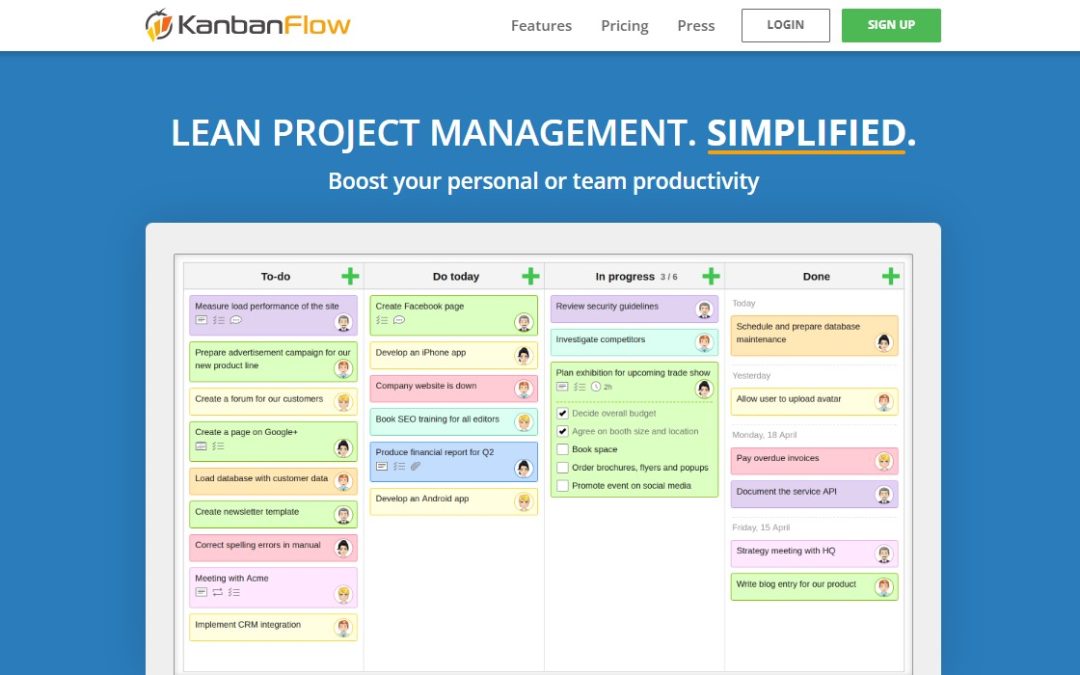
This tool is called the KanBan Flow tool which you can find onwww.kanbanflow.com. It is web-based and also has a version that you can download to your iPhone, iPad or Android devices so it’s with you wherever you go.
The KanBan Flow tool is a web-based board that gives you an excellent overview of your current work situation. It is divided into four columns – To-do, Do today, In progress and Done so you can easily monitor which things you worked on, you should be working on and what’s coming up. You can also have other people linked into your KanBan board.
Aside from the fact that it’s a productivity tool, what I like about this is that it’s visual, you can use color to mark and organize things, and simply drag and drop things to where you want them to be.
Learn more about this tool with my personal review. watch the video.
The flipside of “success” is “failure” and it’s the latter that every business owner and manager strive hard to avoid. By definition, the term “business failure” refers to the cessation of a company’s operations following its inability to generate enough revenue to cover expenses without adequate reserves.
In the recent times, there are many examples of strong businesses that have failed to adjust to the changing markets and economic times or to take advantage of opportunities – and this has ultimately led to their downfall.
Based on my 26 years experience working closely with business owners, here are my 9 key tips to avoiding business failure:
1. always ensure that you target your marketing.
Too many businesses have an undifferentiated product/service offering and fail to understand who their target customer is and what they require. Don’t be undifferentiated, make sure you’re speaking the right language and using the right channels and/or media in targeting your main group of consumers. Focus on delivering exceptional value. ACTION:Develop a structured Marketing Plan for your business and revise it regularly.
2. always plan ahead.
Talk about what you want to do next and where you’d want your business to go by preparing strategies that will help you focus on your business goals and objectives and to make sure that appropriate and sufficient resources are in place. Be rigorous in your planning and hold yourself and your Team accountable. ACTION:Develop a 5-year Strategic Plan supported by Annual Plans. Have 90 Days Actions. Cascade your plans so that everyone in your business is part of a plan.
3. have great business models.
It is a fact that most businesses fail because of poor business models – a business model describes you will engage your target market to profitably generate revenue. To avoid this, make sure that you have great and well-thought pricing models and economic cost models that will help your business focus more on creating, delivering and capturing value needed by your customers. ACTION:Understand your Business Model – there are some great tools to do this.
4. have effective processes.
All businesses are driven by processes. However, few businesses have well documented processes. Many businesses fail to have any continuous improvement processes and have a well entrenched view that they are already efficient. The reality is far from this and many businesses can improve productivity by up to 30%. The challenge is to avoid waste in: time, resources, opportunities, materials, etc. caused by inefficiency – this results in higher than necessary costs and lower margins. ACTION:Apply simple Process Improvement Tools, like 7 Wastes to your business on a regular basis. Never stop searching for improvement.
5. engage your team.
As a leader, you should be a good example to your team. Teach them how to own issues, take responsibility, be accountable and model proper engagement, not only with their customers and clients, but also with each other. An effective team will overcome most business obstacles and enable your business to seize opportunity, when required. ACTION:Engage your Team by improving communication and feedback.
6. have great sales processes.
Sales is the engine that drives your business. Most businesses that fail do not have effective sales processes in place. So with that said, make sure you have great processes that your salespeople can follow. ACTION:Clearly define your Sales Pipeline and develop a Sales Model that delivers.
7. ensure you have adequate cash buffers.
“Cash is fact – Profit is opinion!” This great quote from Andrew Russo (Master Accountant) gets straight to the heart of the matter. Ensure you build adequate cash reserves in your business to ride out changing markets and economic conditions. Cash reserves also allow you fantastic flexibility when looking at opportunities. ACTION:Develop a plan for how you can build cash reserves in your business. Engage your Coach or Accountant in this process.
8. avoide uncontrolled growth.
Uncontrolled growth is often a pre-cursor to business failure. When business growth is “out of control” often cash flow is uncontrolled. Rising sales are barely enough to cover rising costs and cash is at a premium. Cash flow, staff, customers and production are all stretched often to breaking point. Avoid this by “taking your foot off the accelerator” – be more discerning in taking on clients – engage strategies that will slow demand (like lift your prices) – say “No” to opportunities that aren’t in your sweetspot – and introduce tighter financial controls and KPI’s. ACTION:Monitor key drivers in your business and ensure that you have the capability to meet demand. Develop strategies to maintain control.
9. take early action.
Too many businesses fail to “take effective action” until it is too late. Act early and avoid the Receivers! Set up effective monitoring systems. Plan for different scenarios (revenue, cost. Market conditions, competition, etc) and define “trigger points” – bank balance, sales$, profit %, market KPIs, etc – that will cause you to evaluate your options well in advance. These options should include plans for how you will address the challenge – reduce staff numbers, cut costs, close non-performing divisions/products, etc. Make these decisions now rather than trying to make them when under pressure. aCTION:Develop plans to address particular scenarios with effective trigger points.
Focus on ensuring that you have all 9 elements covered and you will do more than stave off failure you will be on the road to success.
What is the element that has the highest priority for you? Pick one and start working on it now.
I recently stumbled across a great resource for getting a benchmark on your website.
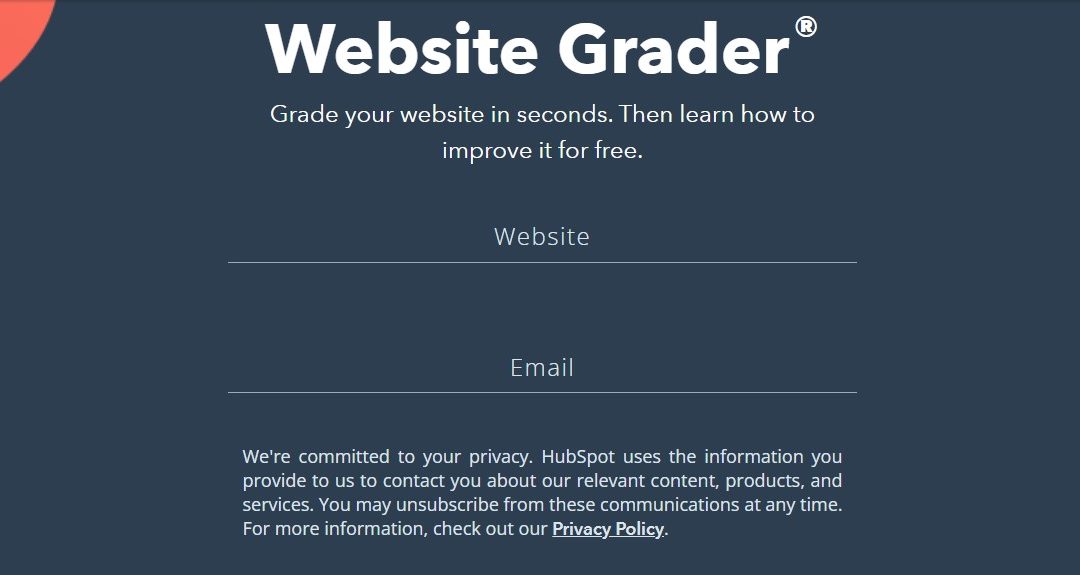
It a free service from Hubspot.com called “Marketing Grader” and you’ll find it at http://marketing.grader.com
What I liked most about Marketing Grader is that it completes a comprehensive scan of your website, rates it in 3 key areas and then provides you with a range of actions and strategies too help you improve the marketing ability of your site. You can also compare your website to competitors or colleagues. It gives you an overall rating out of 100 points so you can see the impact of any changes you make.
The report is broken down into 3 key areas:
top of the funnel– reviews your activities designed to attract visitors to your site middle of the funnel – once you have visitors – “how do you treat them?” analytics – What do your stats tell you about your website
Each area is again broken down into some key sections and addresses issues such as Blogs, SEO and Social Media. Marketing Grader provides useful stats, actions to fix at the issue and links to resources that may help.
For a free service, this is excellent.
So – take the plunge. Go to marketing.grader.com enter your URL and email address and it will run a free Diagnostic Report.
Take notice of the feedback and use it to ensure that your website is covering the basics.
As part of my role as a Coach, I tend to deliver a range of tailored training programs for my clients. This usually involves a laptop computer, a presenter remote, a data projector and laptop speakers.
However, since purchasing an iPad over 2 years ago, I have found that I no longer have much use for a laptop – in fact, I have just purchased my first desktop computer in over 15 years – an iMac (and I love it!).
The catalyst for this was working out that I can use my iPad 2 to deliver my presentations with ease. So how does it work? What gear do I need?
What Equipment Makes it Work?
In addition to a presentation device, like a data projector or TV screen, you will need the following:
iPad – you will need an iPad 2 or iPad 3 as they allow you to share whatever is on your screen with your audience. This is useful when you want to show a YouTube clip or use custom software live. You can use an iPad 1 but it will only allow you to show a Keynote (PowerPoint) presentation.
You will need your iPad loaded with the Keynote App. Keynote is Apple’s answer to PowerPoint. You can download this from the App Store.
iPhone – I have an iPhone 4GS and use it as my remote to drive the presentation on my iPad. You will need the Keynote Remote app (it’s free) otherwise you will have to manually navigate through your presentation using the iPad screen. The Keynote Remote app allows you to preview the next slide or to view your notes on a current slide on your iPhone.
Adapter Leads – Apple sells a range of adapters that will enable you to link your iPad to a presentation device eg. data projector, large screen TV, computer monitor, etc. I carry VGA and HMDI adapters as these seem to cover most of the situations that I encounter.
Bluetooth Speakers (optional) – if you want to have sound as part of your presentation for example: for listening to a YouTube video, playing “mood” music, audio files, etc, then you will need external speakers. I have a set fromJambox that are excellent – great sound good volume for a small to medium room – bluetooth connectivity so no cables and great battery life. There are plenty of these devices on the market so find one that suits your needs and budget.
For larger venues, I have been able to plug into their in-house audio using the headphone jack on the iPad.
Power Adapter – you will need to manage your battery life on the iPad (we will discuss this more in detail below) so make sure you have your power adapter with you. I have recently purchased a 2-in-1 adapter from Sprout that will simultaneously charge my iPad and my iPhone, making it ideal for travelling and presentations.
Extenstion Keyboard (optional) – if you are planning to use the keyboard for live demonstrations of software or systems, you might find it beneficial to invest in an extension keyboard or numeric pad. There are numerous models to choose from including an Apple Wireless Keyboard. I use a Logitech model that has a great bluetooth QWERTY keyboard and also doubles as cover for iPad when travelling.
Making It Happen
Once you have all the gear, then you can set it up for your presentation as follows:
STEP 1: Import your presentation from your Desktop to the iPad – use either PowerPoint or Keynote or Google Docs to develop it. Import via email, iTunes or 3rd party programs like Docs-2-Go (my choice). Make sure that other presentation media are available as well – music, video, etc.
STEP 2: Load the presentation using the Keynote App on your iPad. Check that formatting changes during importation haven’t changed the look of your presentation.
STEP 3: Using the appropriate adapter link your iPad to the data projector or TV. Test and check that all systems are go.
STEP 4: Link the speakers via bluetooth or headphone adapter and test.
STEP 5: Use the Keynote Remote app to link your iPhone and iPad presentation. Test and check. Take the time to practice using the iPhone Remote and your iPad as the remote is sensitive and accidental touches on the screen can cause you to move backwards and forwards through your presentation.
Optimising Your iPad Battery
I found that the major limitation on the day was the battery life of my iPad and so if you have a big presentation to do (more than about 2 hours), you will need to use some battery management strategies. This is a real challenge as you cannot charge the battery and use the adapter cords as they all use the same socket.
Using the power strategies, below, I recently ran a series of full-day workshops using the tools outlined above.
1. Use “Airplane mode” on the iPad to shut down all excess power. Wifi, Bluetooth and Wireless internet connections will chew up a heap of power quickly. To use Keynote Remote (iPhone) and wireless speakers you will need to turn Bluetooth “ON” in the “Settings” app on your iPad.
2. Reduce the brightness of your iPad screen. You can adjust this in “Settings” or use the on-screen slide control. This will significantly reduce your power consumption.
3. Recharge the iPad during breaks using the power adaptor.
Make Use Of Great Technology
I find that by focusing on making the best use of the technology that I have at my disposal, I am able to: travel lighter, improve my personal productivity and get better outcomes for me and my clients. Imagine if you can use your iPad (or Android tablet) in concert with your smartphone and “the Cloud” to deliver all your needs while you travel.
I still bump into people carrying an iPhone, iPad and Laptop with them when they travel – surely at least one of these devices is redundant!
For me, the capability to deliver workshops and presentations on my iPad means that my laptop has become redundant.
What is the technology mix that is working best for you?