Why Leaders Are Drowning in Work

Why Leaders Are Drowning in Work

Leadership today does not look like it used to.

Most leaders are not short of ideas. They are not short of ambition either. What they are short of is space.

Space to think. Space to decide properly. Space to focus on the work that actually moves the business forward.

Instead, many leaders are drowning in work.

Their calendars are full. Their inbox never stops. Their day gets eaten by meetings, interruptions, urgent requests and operational noise. They work hard, stay late and carry more than they should. Yet despite all that effort, progress still feels frustratingly slow.

This is the trap.

A lot of leaders assume the answer is better time management. It is not.

The real issue is that most leaders are carrying too much of the wrong work, making too many reactive decisions and operating without a clear leadership rhythm. The result is predictable: high activity, low leverage and constant pressure.

Being busy is not the same as being effective.

The real problem is not workload. It is leadership overload.

When leaders say they are overwhelmed, what they often mean is this:

  • They are involved in too many decisions.
  • They are responding to too many people.
  • They are working inside the business far more than they are working on it.
  • And, they are carrying issues that should have been filtered, delegated, systemised or stopped altogether.

This matters because leadership work is different from general work.

A leader’s job is not just to get things done. It is to create clarity, direction, priorities and momentum for others. But when leaders become the central point for every decision, every problem and every piece of follow-up, they stop leading and start absorbing.

That is when the business begins to slow down around them.

The irony is that many capable leaders create this situation themselves. Not intentionally, of course. But through habit.

  • They say yes too often.
  • They keep control of too much.
  • They tolerate poor systems.
  • They confuse responsiveness with value.
  • And, over time, they become the busiest person in the business.

That may look committed from the outside. In practice, it is usually a sign that something is
broken.

Why smart leaders get trapped here

This problem is not caused by laziness or lack of capability. In fact, it often affects high-performing leaders the most.

Why? Because competent leaders are easy to rely on.

If you are the person who solves problems quickly, people bring you more problems. If you are the one who cares most, you end up carrying more than others. If you can move fast, the organisation starts depending on your speed rather than building better structure.

Over time, leadership becomes reactive by default.

The day starts with good intentions. Then the phone rings, emails pile up, team members need input, clients want answers and a few unexpected issues land on your desk. By lunchtime, your priorities have been hijacked. By the end of the day, you feel exhausted but unclear on what really moved forward.

This is how leaders drown. Not through one dramatic failure, but through the steady accumulation of noise, dependency and poor priority discipline.

The hidden cost of staying overloaded

Many leaders normalise this pressure. They treat it as part of the job.

It is not.

There is a real business cost when a leader is overloaded.

First, decision quality drops. Fatigue narrows judgement. You start making quick calls instead of good calls. Third, teams become less accountable. If everyone knows the leader will step in, fix the issue or make the decision, they do not build the muscle to solve problems themselves.
Second, strategic work gets delayed. Important work rarely shouts. It is the thinking, planning, improvement and people-development work that gets pushed aside when the urgent takes over. Fourth, execution suffers. The business becomes highly active but poorly aligned. Lots of effort. Not enough traction.

And finally, the leader pays the personal price. Constant overload erodes energy, patience and perspective. It becomes harder to lead well when you are mentally cluttered and permanently behind.

This is not just a productivity problem. It is a leadership performance problem.

The shift leaders need to make

The answer is not to simply work harder, become more efficient or squeeze more into the day.

The answer is to shift from being a responder to being a designer. Effective leaders design how their time is used. They design decision flow. They design priorities. They design operating rhythm.

That starts with accepting one uncomfortable truth:

You cannot lead effectively if your time is controlled by everyone else.

That means some things must change.

  • You need fewer priorities, not more.
  • You need clearer filters around what deserves your attention.
  • You need stronger delegation.
  • You need better systems for recurring work.
  • And, you need protected time for leadership tasks that create leverage.

This is where many leaders resist. They want better outcomes without reducing inputs. They want more control without more structure. They want less overwhelm without saying no.

It does not work like that.

Leaders get out of drowning mode when they become more deliberate about what they do, what they stop and what they expect others to own.

Four practical causes of leadership overload

1. Too many priorities

If everything matters, nothing really does.

Many leaders run with an overloaded list of objectives, projects, requests and good ideas. The result is scattered effort and constant context switching.

A leader with three genuine priorities has a chance of creating momentum. A leader with fifteen is usually just treading water.

2. Poor decision filters

Some leaders get pulled into issues they should never have touched in the first place.

Not every question requires the leader. Not every problem deserves immediate attention. Not every email needs a reply.

Without decision filters, leaders become the default escalation point for everything.

3. Weak delegation

Delegation is not dumping tasks. It is transferring ownership with clarity.

Many leaders think they delegate, but they actually reassign fragments and then stay heavily involved. That creates more follow-up, more checking and more mental load.

True delegation reduces decision traffic back to the leader.

4. No operating rhythm

When there is no weekly rhythm for planning, reviewing and resetting priorities, leadership becomes reactive.

A good operating cadence helps leaders step back, think ahead and allocate time intentionally. Without it, the urgent fills every gap.

What to do instead

If you feel like you are drowning in work, do not start by trying to fix everything.

If leadership overload is already present, the solution is not a dramatic overhaul. Start with one
small but meaningful change.

Look at your last week and ask three questions:

1. Where was my time genuinely valuable?
2. Where was I involved unnecessarily?
3. Where should ownership sit instead?

Then remove one category of unnecessary involvement.

  • One meeting.
  • One approval process.
  • One recurring decision.

Small changes like this compound quickly.

Then, start with these three moves.

1. Get clear on your real leadership priorities

Ask yourself: where does my involvement create the most value?

Not what can I do. Not what am I capable of. What actually needs me?

Usually, the answer sits in a handful of areas: direction, decisions, clients, team capability and performance.

Anything outside that core should be questioned.

2. Remove one layer of unnecessary involvement

Look at your week and identify one category of work you should no longer be carrying.

  • It may be routine approvals.
  • It may be internal admin.
  • It may be meetings you no longer need to attend.
  • It may be decisions your team should be making without you.

Do not underestimate how powerful this is. One layer removed creates breathing room.

3. Build a weekly leadership rhythm

Set time each week for three things: planning, review and protected focus.

  • Planning ensures you choose your priorities before the week chooses them for you.
  • Review helps you see what is working and what is drifting.
  • Protected focus creates the space to think and move the important work forward.

This is not complicated. But it is disciplined. And discipline is what most overwhelmed leaders
are missing.

A better measure of leadership

Many leaders still judge themselves by how much they can carry.

That is the wrong measure.

The better question is this: does the way you work create clarity, momentum and stronger performance in the business?

Because leadership is not about absorbing more. It is about enabling better execution.

The best leaders are not always the busiest people in the room. Often, they are the clearest. The calmest. The most deliberate. They know what matters, what does not and where their attention creates the greatest leverage.

That is not accidental. It is designed.

Final Thought

If you are drowning in work, the issue is probably not that you need better personal efficiency.

It is more likely that your leadership model is carrying too much weight in the wrong places.

The solution is not to become faster at reacting. It is to become more disciplined about leading.

➤ Reduce the noise.
➤ Tighten the priorities.
➤ Lift the delegation.
➤ Create rhythm.

Because the goal is not to fit more work into your day.

The goal is to do the work that only a leader can do and do it well.

If you are looking for resources to help you be more productive then look no further.

I have gone from working 70 hours/week to 35 hours/week over 4 days for double the revenue. I have created a range of resources to help my clients and you.

Click links for more details. 

Focused Execution Book


 
This book summarises the key elements for improving your personal productivity. Russ utilized the tools, concepts and principles outlined in the book to lift his personal productivity by 4X.

    Webinars


     
    Our next webinar is on “Why business leaders are drowning in work” on 31st March at 1pm AEST.

    FE Learning Sprint


     
    We will be conducting a 6 week learning sprint on Focused Execution: Time and Priority Mastery in may 2026. This is to fast-track your personal productivity improvement.

    The Hidden Productivity Killers Most Business Owners Ignore

    The Hidden Productivity Killers Most Business Owners Ignore

    You’re working hard. You’re busy all day. You’re exhausted by 6pm. And yet… the big goals barely move.

    The problem isn’t effort.

    It’s invisible productivity killers quietly stealing your day.

    Most business owners don’t notice them – because they look like “work”.

    Let’s expose them.

    Killer #1: Constant Context Switching

    Switching between tasks feels efficient. In reality, it’s draining.

    Every time you jump from:

    • Email → Proposal
    • Proposal → Slack
    • Slack → Meeting
    • Meeting → Spreadsheet

    Your brain resets.

    Research shows it can take 10–20 minutes to fully regain deep focus.

    Now multiply that by 15–20 interruptions per day.

    That’s hours lost.

    Fix: Create Focus Zones

    • Batch similar work
    • Check email 2-3 times daily
    • Use 60-90 minute deep work blocks

    Single-tasking is a performance advantage.

    Killer #2: Meetings Without Decisions

    Many meetings:

    • Lack a clear purpose
    • Run too long
    • Include too many people
    • End without defined actions

    They create the illusion of progress.

    Try this simple filter:

    The 4-Question Meeting Check

    Before accepting or scheduling a meeting, ask:

    • What decision are we making?
    • What outcome do we need?
    • Who truly needs to attend?
    • Could this be handled via written update?

    If there’s no decision, it’s probably not a meeting.


    Killer #3: Email as a To-Do List

    If your inbox drives your day, you’re reactive.

    Email is other people’s priorities.

    Not yours.

    The Cost of Constant Email Checking

    • Breaks concentration
    • Creates stress spikes
    • Shifts focus to low-value tasks

    Fix: Batch and Filter

    • Schedule two daily email windows
    • Turn off push notifications
    • Use rules and folders
    • Apply the 2-minute rule

    Your calendar – not your inbox – should control your day.

    Killer #4: Too Many “Shoulds”

    Most leaders spend too much time on:

    • Improvement ideas
    • Nice-to-have projects
    • Admin tidy-ups
    • Internal polishing

    They feel productive. But they’re not critical.

    That’s where Must–Should–Could becomes vital.

    If your Musts don’t get done, your business stalls.

    Killer #5: Lack of 90-Day Focus

    Without a defined 90-day horizon:

    • Projects drift
    • Teams lose clarity
    • Energy gets scattered
      Annual goals are too distant. Weekly goals are too narrow.

      A 90-day rhythm creates:

      • Urgency
      • Focus
      • Accountability
      • Measurable progress
      A Practical Example

      David runs a manufacturing company.

      He believed his biggest issue was staff inefficiency.

      After a simple time audit, we found:

      • 35% of his time in low-value meetings
      • 20% reacting to internal email
      • Almost zero time on strategic growth

      We implemented:

      • 30-minute meeting maximum
      • Two email windows
      • Three daily Musts
      • Weekly 90-minute strategy block

      Within 90 days:

      • Revenue improved
      • Decision speed increased
      • Stress reduced significantly

      The killers weren’t dramatic. They were subtle – and consistent.

      Your 30-Minute Audit

      Try this tomorrow:

      1. Track your day in 30-minute blocks
      2. Mark each block:

      • Essential
      • Maybe Needed
      • Wasteful

      3. Eliminate, automate or delegate one Wasteful activity
       
      Small leaks sink big ships. Small corrections transform performance.

      Final Thought

      Productivity killers don’t look dangerous.

      They look normal.

      “Just checking email.”
      “Quick meeting.”
      “Multitasking.”
      “Catching up.”

      But they quietly consume your best energy.

      Focused execution starts with elimination. Remove the hidden drain – and performance lifts naturally.

      Stop Managing Time. Start Managing Priorities

      Stop Managing Time. Start Managing Priorities

      Most business owners say the same thing, “I just need better time management.”

      But here’s the truth: you don’t have a time problem. You have a priority problem.

      Time is fixed. Priorities are not.

      When you try to “manage time”, you squeeze more into an already full schedule. When you manage priorities, you decide what truly deserves your time – and what doesn’t.

      That shift changes everything.

      Why Time Management Fails

      Traditional time management focuses on tools:
      • Better calendars
      • Smarter apps
      • Colour-coded to-do lists
      • Productivity hacks

      Yet many leaders still work 60–70 hours a week and feel behind.

      Why?

      Because they’re organising chaos.

      If everything is important, nothing is.

      The Real Issue: Urgency vs Importance

      Most days are driven by urgency:

      • Emails
      • Messages
      • Meetings
      • “Quick questions”
      • Client requests

      Urgent work feels productive.

      But important work builds the future.

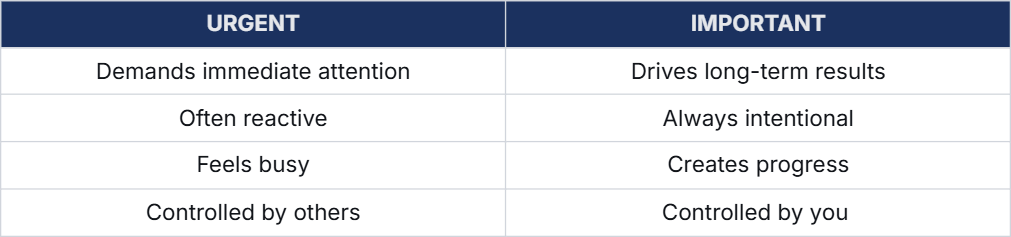
      Here’s the difference:

      If you spend your day reacting to urgent work, you’ll always feel behind — no matter how efficient you are.

      The Shift: From Time to Priorities

      Instead of asking: “How do I fit everything in?”

      Ask: “What actually matters today?”

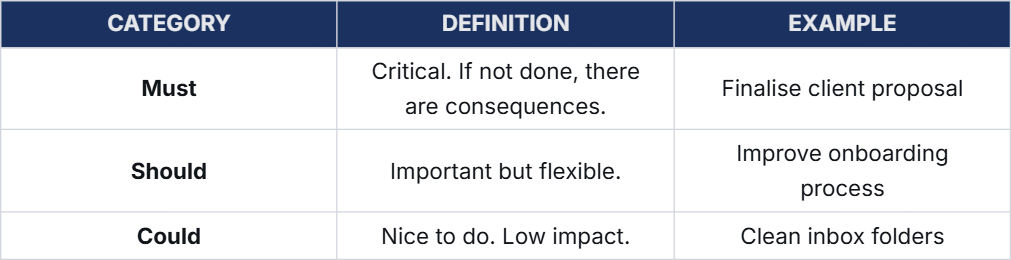
      This is where the Must–Should–Could framework becomes powerful.

      Must–Should–Could in Action


      If you complete your Musts, your day is a success.

      That’s priority management.

      A Relatable Example

      Emma runs a 12-person professional services firm. She used to start each day in her inbox. By 4pm, she felt exhausted – yet her strategic projects never moved.

      We changed one thing.

      Each morning she now:

      1. Identifies three Musts
      2. Time-blocks 90 minutes for the most important one
      3. Delays email until 11am

      Within weeks:

      • Strategy moved forward
      • Stress dropped
      • Working hours reduced

      Same time. Better priorities.

      How to Start Managing Priorities Today

      Step 1: Define Your Daily 3

      Every morning (or the evening before):

      • Write down three Musts
      • Everything else is secondary

      If you only finish those three, the day still counts.

      Step 2: Protect One Focus Block

      Schedule one 60–90 minute Focus Zone.

      • No phone
      • No email
      • No Slack
      • Door closed if possible

      Treat it like a client meeting. Because it is — a meeting with your most important work.

      Step 3: Audit Your Calendar

      Look at next week’s diary.

      Ask:

      • Which meetings are truly essential?
      • Which could be 30 minutes instead of 60?
      • Which don’t need you at all?

      Time doesn’t disappear. It gets allocated.

      You’re in charge of the allocation.

      The Bigger Mindset Shift

      Stop saying, “I don’t have time.”

      Start saying, “That’s not a priority.”

      It’s confronting – but empowering.

      You always have time for what you prioritise.

        Final Thought

        Time management is about squeezing more in.
        Priority management is about choosing what matters.

        The goal isn’t to do more. It’s to do what matters most – consistently.

        That’s how you reduce hours and increase results.

        From Insight to Execution

        From Insight to Execution

        What the Mindshop Business Leaders Report 2026 Really Means for Business Owners

        The Mindshop Business Leaders Global Trends Report 2026 delivers a clear and timely message. The performance gap between business owners who execute well and those who do not is widening. This gap is not driven by a lack of ideas, ambition or access to technology. It is driven by clarity, discipline and execution.

        AI sits at the centre of this shift, but not in the way many people expect. The report is explicit. AI does not replace leadership fundamentals. It amplifies them. Strong leadership becomes stronger. Weak leadership becomes more visible.

        For business owners, this matters deeply. You do not have layers of management to absorb poor decisions or inconsistent execution. Your focus, judgement, and habits directly shape results.

        This is not a report about technology trends. It is a report about leadership performance in a world where AI is now part of everyday work.

        The Real Shift in 2026
        From Experimentation to Augmentation
        Over the past two years, many businesses have experimented with AI. They have tried tools, generated content, and explored automation. In 2026, that phase is ending.
        The Mindshop report describes a shift from experimentation to AI augmentation. This means redesigning how decisions are made, how work flows, and how leaders think, plan, and execute.
        AI literacy alone will not differentiate business owners. What matters is how AI is embedded into:
        • Judgement
        • Decision-making
        • Productivity
        • Execution rhythm
        The goal is not to automate everything. The goal is to improve outcomes without eroding what makes leadership effective in the first place.


        The Eight Leadership Priorities Reframed

        The report outlines eight leadership performance priorities. When viewed through a business owner lens, these priorities form a practical roadmap.

        1. AI Integration and Augmentation

        AI should sit inside your thinking, not outside it. The most effective business owners use AI to prepare options, test assumptions, and explore scenarios before committing time or money.

        A realistic action is to apply AI to one repeat decision you make every week. Pricing, resourcing, prioritisation, or planning are good starting points. AI supports the thinking. You still make the call.

        2. Relearning Core Leadership Skills

        AI exposes weak fundamentals. If priorities are unclear, AI will not fix that. If decisions are reactive, AI will amplify the noise.

        Business owners who perform well in 2026 use AI as a challenger. They ask it to critique plans, identify risks, and surface blind spots. Insight, not ego, guides action.

        The discipline here is simple. Be willing to adjust when the evidence suggests a better path.

        3. Psychological Endurance

        The report is clear. Sustained performance now depends less on speed and more on endurance.

        For business owners, this is not a wellbeing discussion. It is a performance issue. Fatigue erodes judgement. Stress narrows thinking. Burnout creates business risk.

        A practical step is to identify one low-value task that drains energy and remove or simplify it using AI. This protects cognitive bandwidth for higher-quality decisions.

        4. Strategic Productivity Mastery

        Strategic productivity is about doing less work for more impact.

        Many business owners are busy but not leveraged. AI helps by reducing time spent on drafting, summarising, analysing, and preparing. This frees attention for leadership work that actually moves the business forward.

        The question to ask is not “How do I get more done?” but “Where does my involvement create the most value?”

        5. Leadership Operating Cadence

        Execution requires rhythm. Without a cadence, leadership becomes reactive.

        The report highlights the importance of a consistent operating rhythm that aligns strategy, execution, and performance. For business owners, this often means weekly planning, regular review, and disciplined follow-through.

        AI can support this cadence by helping prepare weekly priorities, highlight risks, and summarise progress. The habit is what matters. The tool simply supports it.

        6. Reputation Intelligence

        Trust remains human. AI does not change this.

        Business owners build reputation through consistency, clarity, and authenticity. AI can help articulate ideas and improve communication quality, but it must never replace judgement or personal voice.

        A realistic use of AI here is drafting thought leadership or internal communication, then refining it to reflect lived experience and values. Credibility is built through alignment between words and behaviour.

        7. The Connector-in-Chief

        High-performing leaders connect dots faster than others. They draw insight from diverse inputs and translate it into action.

        AI accelerates research, pattern recognition, and scanning across industries. The mistake is consuming more information without deciding what to do with it.

        The discipline is to turn insight into one experiment, one adjustment, or one decision. Curiosity without action creates noise.

        8. Strategic Performance

        The final priority is the outcome of the previous seven. Strategic performance is not about ideas. It is about execution.

        The report reinforces a simple truth. Ideas are easy. Execution is everything.

        AI supports performance by reducing friction between thinking and doing. It helps convert insight into clear actions, timelines, and accountability. But execution still requires leadership discipline.


        The Simple Starting Point
        Many business owners overcomplicate change. The report offers a more grounded approach.
        A simple starting point is:
        • Pick one priority that creates leverage
        • Apply AI in one workflow
        • Change one habit to support consistency
        This sequence matters. Focus first. Leverage second. Habits last.
        Small shifts compound when applied consistently.
        Insight Over Ego
        One of the most important themes running through the report is the difference between ego-based and insight-based leadership.
        Ego protects identity. Insight protects results.
        AI is neutral. It reflects patterns and trade-offs without emotion. Business owners who succeed in 2026 are those willing to listen, adjust, and simplify when evidence points in a better direction.
        This is not about being less confident. It is about being more effective.
        Final Thought
        The Mindshop Business Leaders Report 2026 is not a warning. It is a roadmap.
        The future belongs to business owners who:
        • Lead with clarity
        • Execute with discipline
        • Use AI as leverage, not a crutch
        AI will not save poorly led businesses. But in the hands of focused, disciplined leaders, it becomes a powerful force multiplier.
        Ideas are easy. Execution is everything.
        AI Will Not Save Bad Leadership

        AI Will Not Save Bad Leadership

        Everyone is talking about AI. Most leaders are still missing the point.

        The real risk in 2026 is not being replaced by AI.
        It is using AI to amplify poor judgement, weak priorities, and sloppy execution.

        That is the blunt message behind Mindshop’s Business Leader Global Trends Report 2026. And it is refreshingly contrarian in a market obsessed with tools, prompts, and automation hacks.

        The leaders who will win in the next few years are not the most tech-literate.
        They are the most disciplined, focused, and human.

        AI is not the strategy

        The report is clear. AI literacy alone will not differentiate leaders in 2026.
        What matters is how AI is used to augment judgement, sharpen decisions, and improve execution.

        In practice, most leaders are doing the opposite:

        Using AI to move faster without thinking deeper
        Producing more output without improving quality
        Delegating thinking instead of strengthening it

        Technology does not fix weak leadership fundamentals.
        It amplifies them.

        High performance is going back to basics

        After years of disruption, change fatigue is real. The best leaders are not chasing the next shiny thing. They are doubling down on fundamentals and using AI to support them.

        The report highlights eight leadership performance trends that matter most in 2026. A few stand out.

        Strategic productivity over busyness

        Productivity is no longer about hours worked or tasks completed. It is about increasing the value and relevance of what you do while reducing stress and wasted effort. Doing less but better beats doing more every time.

        Psychological endurance beats hustle

        Sustained performance depends on energy, resilience, and judgement under pressure. Leaders running at the redline are not high performers. They are fragile systems waiting to break.

        Operating cadence beats motivation

        The best leaders do not rely on bursts of effort. They build a consistent rhythm for strategy, execution, review, and decision-making. Cadence creates control. Control creates results.

        Reputation is now a performance asset

        Your personal brand is no longer optional. Trust, credibility, and consistency directly affect how quickly teams and stakeholders back your decisions. Performance might open the door. Reputation keeps you in the room.

        Human plus AI is the real edge

        One of the strongest ideas in the report is this:
        The future belongs to Human plus AI, not Human versus AI.

        High-performing leaders use AI as a thinking partner, not a replacement. They stress-test ideas, explore scenarios, connect dots faster, and then apply human judgement, intuition, and emotional intelligence.

        AI speeds things up.
        Leadership decides what matters.

        Insight is useless without execution

        The final trend in the report is the most uncomfortable. Strategic performance is not about ideas. It is about follow-through.

        Most leaders already know what they should change.
        Very few do it consistently.

        That is why the report pushes leaders to:

        • Rate themselves honestly across the eight trends
        • Identify the weakest areas holding performance back
        • Translate insight into a simple one-page action plan

        Execution is still everything. AI just raises the stakes.

        Why this matters now
        If you are a business owner or senior leader, 2026 will reward clarity, focus, and discipline. Not noise. Not volume. Not clever tools used without intent.
        This report cuts through the hype and brings the conversation back to what actually drives results.
        If you want a clearer view of what high-performance leadership really looks like next year:
        Then ask yourself the uncomfortable question the report keeps returning to:
        Is what I am doing helping or harming my leadership performance?
        The answer will shape your next 12 months.

        AI and Marketing in 2026: How to Use It Without Losing Focus, Brand or Results

        AI and Marketing in 2026: How to Use It Without Losing Focus, Brand or Results

        AI changed marketing in 2025, but not in the way many expected.

        It did not replace marketers.
        It did not make strategy optional.
        It did not automatically improve results.

        What it did do was expose a gap.

        Businesses with clear positioning, strong strategy and disciplined execution moved faster and produced more.

        Businesses without those foundations simply created more content, more noise and more confusion.

        As we head into 2026, the role of AI in marketing is becoming clearer. The opportunity is real, but only for those who use it deliberately.

        The biggest shift: AI has lowered the cost of content, not the cost of thinking

        In 2025, the volume of content exploded.

        Blogs, posts, emails, landing pages, and ads became easier to create than ever. The result was predictable. Attention became scarcer, not more available.

        AI reduced the effort required to produce content, but it did nothing to clarify:

        ⁍ who you are
        ⁍ what you stand for
        ⁍ who you serve
        ⁍ or why someone should choose you

        That work still belongs to leadership and strategy.

        Key lesson for 2026
        AI should accelerate good marketing. It cannot fix bad marketing.

        Where AI genuinely adds value in marketing

        Used well, AI is a powerful support tool across the marketing system.

        High-performing businesses are using AI to:

        ⁍ generate first drafts faster
        ⁍ repurpose existing content intelligently
        ⁍ summarise insights and reports
        ⁍ refine messaging for different audiences
        ⁍ improve consistency of tone and structure
        ⁍ reduce admin and coordination effort

        This frees up time for:

        ⁍ strategy
        ⁍ customer insight
        ⁍ offer development
        ⁍ and quality control

        AI does not replace marketers. It gives them leverage.

        The rise of “good enough” marketing – and why it’s dangerous

        One of the quiet risks emerging is complacency.

        Because AI can generate content quickly, many businesses are settling for “good enough”:

        ⁍ generic posts
        ⁍ bland blogs
        ⁍ surface-level advice
        ⁍ repetitive messaging

        In a crowded market, this is invisible.

        2026 will reward fewer, better assets, not constant output.

        Quality, clarity, and relevance now matter more than frequency.

        SEO is changing – but it is not disappearing

        One of the most common questions we hear is whether SEO still matters in an AI-driven search environment.

        The answer is yes, but how SEO works is evolving.

        Search engines are increasingly:

        ⁍ answering questions directly
        ⁍ summarising content using AI
        ⁍ prioritising authority and clarity
        ⁍ rewarding genuinely helpful content

        This changes how businesses should approach SEO in 2026.

        SEO principles that matter in an AI-driven world

        1. Authority beats volume

        Publishing fewer, deeper, more thoughtful articles will outperform shallow content farms.

        Search engines and AI models look for:

        ⁍ expertise
        ⁍ consistency
        ⁍ credibility
        ⁍ clarity of point of view

        Being useful matters more than being prolific.

        2. Clear positioning improves discoverability

        AI-powered search tools reward clarity.

        Businesses with:

        ⁍ clear niche
        ⁍ defined audience
        ⁍ consistent language
        ⁍ strong point of view

        are easier for AI systems to understand, summarise, and recommend.

        Vague businesses disappear.

        3. Human insight is a ranking advantage

        AI can summarise information. It cannot replace lived experience.

        Content that includes:

        ⁍ real-world observations
        ⁍ practical application
        ⁍ leadership insight
        ⁍ commercial context

        stands out to both humans and algorithms.

        4. Structure matters more than keywords

        SEO is moving away from keyword stuffing toward:

        ⁍ clear headings
        ⁍ logical flow
        ⁍ concise explanations
        ⁍ question-based structure

        Well-structured thinking is now a technical advantage.

        5. Original thinking beats recycled content

        AI search systems are becoming better at detecting duplication and derivative thinking.

        Original perspectives, even if narrower, will outperform generic commentary.

        How AI supports better SEO in practice

        AI is most effective when used behind the scenes.

        Strong use cases include:

        ⁍ outlining content before writing
        ⁍ identifying gaps in existing articles
        ⁍ improving readability and structure
        ⁍ generating meta descriptions
        ⁍ repurposing blogs into multiple formats
        ⁍ updating older content to stay relevant

        The goal is not automation for its own sake.
        The goal is consistency and clarity at scale.

        The danger of over-automation

        One of the biggest risks in 2026 marketing is over-automation.

        When everything is automated:

        ⁍ tone flattens
        ⁍ insight disappears
        ⁍ differentiation fades

        Customers can tell.

        The strongest brands are using AI as an assistant, not a substitute.

        Marketing still starts with strategy

        AI does not remove the need for:

        ⁍ clear target markets
        ⁍ compelling offers
        ⁍ strong value propositions
        ⁍ consistent brand voice

        In fact, it amplifies weaknesses when these are missing.

        Before investing further in AI-driven marketing, leaders should ask:

        Do we know exactly who we are marketing to?
        Is our message clear and consistent?
        Do we have something meaningful to say?

        If the answer is unclear, AI will simply make the problem louder.

        What strong AI-enabled marketing looks like in 2026

        The businesses getting results share common traits.

        They:

        ⁍ use AI to save time, not replace judgment
        ⁍ publish less but better content
        ⁍ focus on thought leadership over volume
        ⁍ integrate marketing into strategy and execution
        ⁍ maintain strong editorial control
        ⁍ measure outcomes, not activity

        They treat marketing as a strategic asset, not a content factory.


        Three practical moves to make now
        1. Audit your existing content
        Identify what still reflects your thinking and what needs updating.
        Depth beats novelty.
        2. Define where AI fits and where it doesn’t
        Be explicit about which tasks AI supports and which require human input.
        3. Focus on authority-building content
        Choose topics where you have real experience and insight.
        That is where SEO and credibility align.
        Final thought
        AI has changed marketing, but not the fundamentals.
        ⁍ Clarity still wins.
        ⁍ Relevance still matters.
        ⁍ Strategy still comes first.
        In 2026, the businesses that succeed with AI in marketing will not be the ones producing the most content.
        They will be the ones producing the most useful, credible, and focused content, consistently.
        AI will help them do it faster.
        It will not do it for them.