How Much Flexibility Does Your Cash Really Buy You?
Why cash flow, not profit, determines the quality of your business decisions
Quick Answer
Many profitable businesses fail because they run out of cash, not because they run out of customers. Profit tells you how the business has performed, but cash determines what the business can do next. Healthy cash reserves give you the flexibility to make strategic decisions, invest when opportunities arise, protect your team during difficult periods and avoid being forced into expensive short-term choices.
This article expands on the first question in The Questions You’re Not Asking: How much flexibility does your cash really buy you?
The Question Most Business Owners Don’t Ask
 Most business owners keep an eye on their bank balance, but far fewer ask what that balance actually allows them to do. If revenue stopped tomorrow, how long could the business continue operating? Could you keep your team, continue investing, meet your commitments and negotiate from a position of strength? Or would every decision immediately become about survival?
These are not simply finance questions. They are leadership questions because the amount of cash available to a business directly affects the quality of its decisions. After more than four decades working with privately owned businesses, I have seen that the businesses which consistently outperform their competitors are not always the ones reporting the highest profit. They are often the businesses with the greatest flexibility.
That flexibility gives owners and leadership teams time to think. It allows them to respond to changing conditions without being driven by panic, urgency or fear. In practical terms, flexibility means having options, and in most businesses those options are created by cash.
Profit Measures Performance. Cash Determines Your Options.
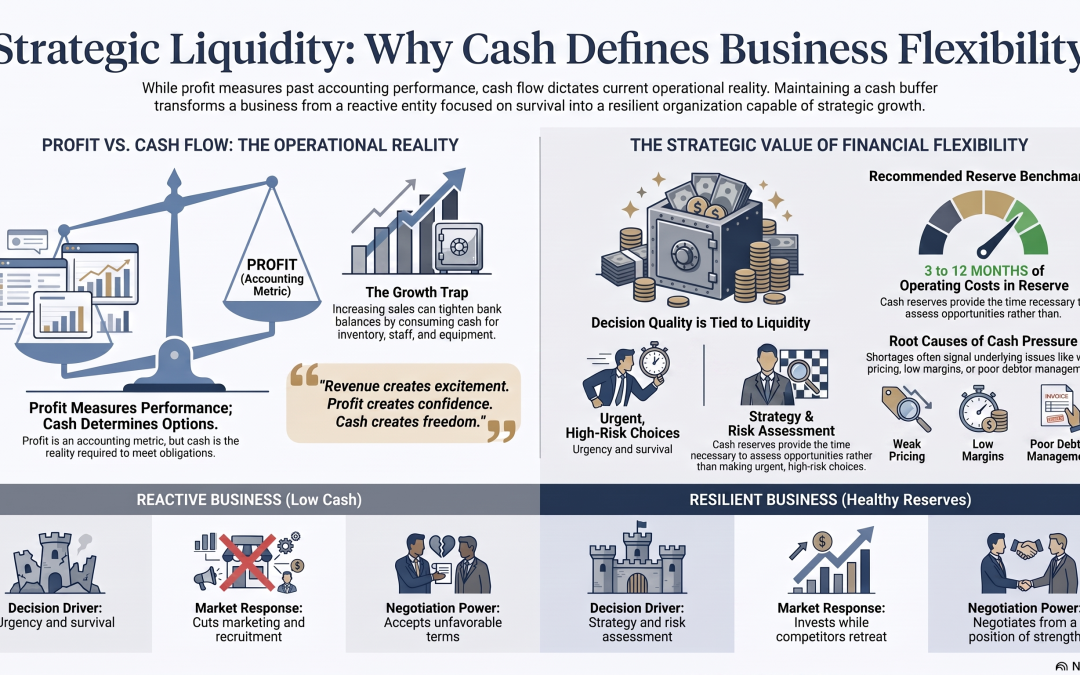
Profit is an accounting measure. Cash is operational reality. A business can report a healthy profit while simultaneously struggling to pay wages, suppliers, tax, loan repayments or other operating costs because profit and cash do not move through a business at the same pace.
Cash may be tied up in debtors, inventory, equipment or work in progress. Customers may not have paid yet, even though the revenue has already been recognised. Growth may require more staff, more stock, more equipment and more working capital before the additional revenue produces a cash return.
This is why growing businesses are often caught by surprise. Sales increase, profits improve and the business appears to be getting stronger, yet the bank balance continues to tighten. Growth has not solved the cash flow problem. It has consumed more cash.
As I often tell clients:
Revenue creates excitement. Profit creates confidence. Cash creates freedom.
That freedom matters because cash flow affects every major business decision. It determines whether you can invest, hire, negotiate, expand, absorb disruption or wait for the right opportunity instead of accepting the only option available.
Cash Creates Better Business Decisions
Imagine two business owners facing the same opportunity. A competitor closes unexpectedly, experienced staff become available, equipment is offered well below market value or a prime commercial property comes onto the market. One owner has six months of operating cash in reserve. The other is struggling to meet payroll.
The obvious difference is that one business can afford to act, but the more important difference is that one owner has time to assess the opportunity properly. When cash is tight, every decision becomes urgent, and urgency has a habit of narrowing your thinking and increasing the risk of making short-term choices that create longer-term problems.
A business with healthy cash reserves can ask better questions. Is this the right opportunity? Does it support our strategy? What are the risks? What terms should we negotiate? What happens if conditions change? A business under pressure is far more likely to ask only one question: Can we survive this week?
This is one of the clearest differences between reactive businesses and resilient businesses. Resilient businesses are not immune to disruption. They are simply better prepared to respond because they have built enough financial flexibility to make considered decisions.
The Real Cost of Operating Without a Cash Buffer
Many SMEs operate with little or no financial buffer. They may perform well for years, but the risk becomes obvious when something changes. A major customer delays payment, equipment fails, sales slow for several months, interest costs rise or a key employee resigns. None of these events is unusual. They are simply part of running a business.
The problem is not the disruption itself. The problem is having no room to respond.
When a business is living month to month, even a relatively small setback can force poor decisions. Marketing is cut just when new business is needed. Recruitment is postponed, putting more pressure on existing staff. Maintenance is delayed, increasing the likelihood of larger costs later. Owners use personal funds, rely on expensive short-term finance or accept unfavourable terms simply to keep the business moving.
Cash flow management is not only about avoiding failure. It is about avoiding panic, because panic is an expensive way to run a business.
A healthy cash buffer allows a business to retain good people during a downturn, invest while competitors retreat, negotiate better supplier terms, absorb unexpected costs and avoid unnecessary borrowing. Perhaps most importantly, it gives leadership teams the confidence to focus on long-term decisions instead of constantly managing short-term financial pressure.
In The Questions You’re Not Asking, I recommend working towards holding between three and twelve months of operating costs, depending on your industry, debt profile, growth plans and appetite for risk. That level of reserve is not built overnight. It is created deliberately through consistent pricing, margin management, forecasting, cost control and disciplined working capital management.
Most Cash Flow Problems Start Somewhere Else
Cash shortages are rarely the real problem. More often, they are the visible symptom of deeper issues within the business.
Persistent cash flow pressure may be caused by weak pricing, low margins, excessive overheads, poor debtor management, uncontrolled inventory, inefficient operations, poor forecasting or growth that is not being funded properly. Putting more money into the business without addressing those issues may provide temporary relief, but it does not solve the underlying problem.
The goal is not simply to increase the bank balance. The goal is to build a healthier business that consistently generates and retains cash.
Several years ago, I worked with two businesses operating in similar markets. The first pursued aggressive growth. Revenue increased quickly, but debt increased even faster and almost every available dollar was reinvested into expansion. There was virtually no cash buffer. When the market softened, management had no flexibility and every decision became reactive. Despite being operationally capable, the business eventually failed.
The second business took a more disciplined approach. It continued to grow, but also built cash reserves over several years. When COVID disrupted the market, the business did not retreat. It retained its people, increased its marketing, acquired equipment from distressed competitors and won clients while others were cutting costs. When conditions improved, it emerged larger, stronger and better positioned for future growth.
The difference was not intelligence, industry experience or luck. It was flexibility, and that flexibility came from cash.
What Should You Do Next?
A strong cash position does not happen by accident. It starts with asking better questions and being honest about the answers.
1. If revenue stopped tomorrow, how many months could we continue operating?
2. What decisions are we making today purely because cash is tight?
3. Are we managing cash flow as a weekly discipline or treating it as a monthly surprise?
4. What underlying business issues are preventing us from building stronger reserves?
5. What would we do differently if we had six months of operating cash available?
The answers will tell you far more about the resilience of your business than last month’s profit and loss statement. They’ll also highlight where pricing, margins, overheads, debtor management, inventory or operating discipline may be limiting your ability to build genuine financial flexibility.
Frequently Asked Questions
Is profit more important than cash flow?
No. Both matter, but they measure different things. Profit measures business performance. Cash flow determines whether the business can continue operating, meet its obligations and invest in future opportunities.
How much cash should a business keep in reserve?
There is no single figure that suits every business. Many privately owned businesses should work towards holding between three and twelve months of operating costs, depending on industry risk, debt levels, growth plans and revenue stability.
Why does business growth create cash flow pressure?
Growth usually requires additional investment before the cash return is received. More sales often require more stock, more staff, more equipment and longer debtor cycles, which means a growing business can become cash constrained even while revenue and profit are increasing.
Is a line of credit the same as having cash reserves?
No. A line of credit can provide useful short-term flexibility, but it should be treated as emergency support rather than a replacement for disciplined cash management and genuine cash reserves.
Three Key Takeaways
-
-
Profit measures how your business has performed. Cash determines what your business can do next.
-
Healthy cash reserves improve the quality of leadership decisions because they create flexibility instead of pressure.
-
Sustainable cash flow is the outcome of building a healthier business, not simply finding more money.
-
Final Thought
The strongest businesses are not always the ones with the biggest turnover or the highest reported profit. They are the ones with the greatest ability to choose their next move because they have built the financial flexibility to respond rather than react.
The next time you review your financial statements, don’t just ask:
“How much profit did we make?”
Ask the more important question:
“How much flexibility does our cash really buy us?”

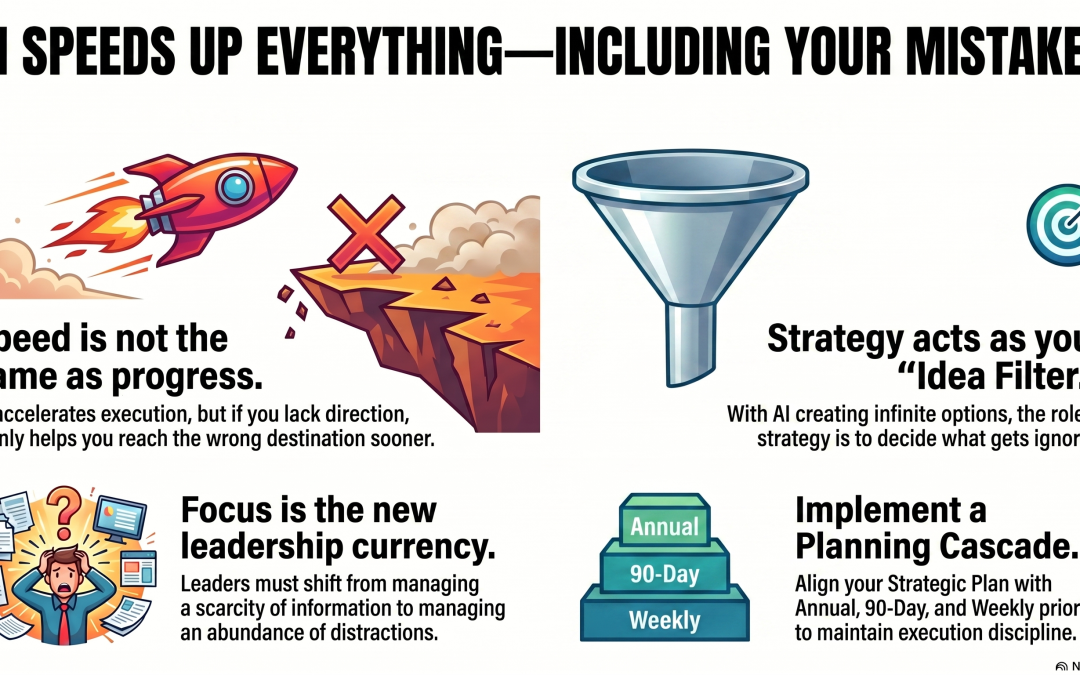
 Let’s start with something most business owners already agree on.

 This is where strategy becomes critical.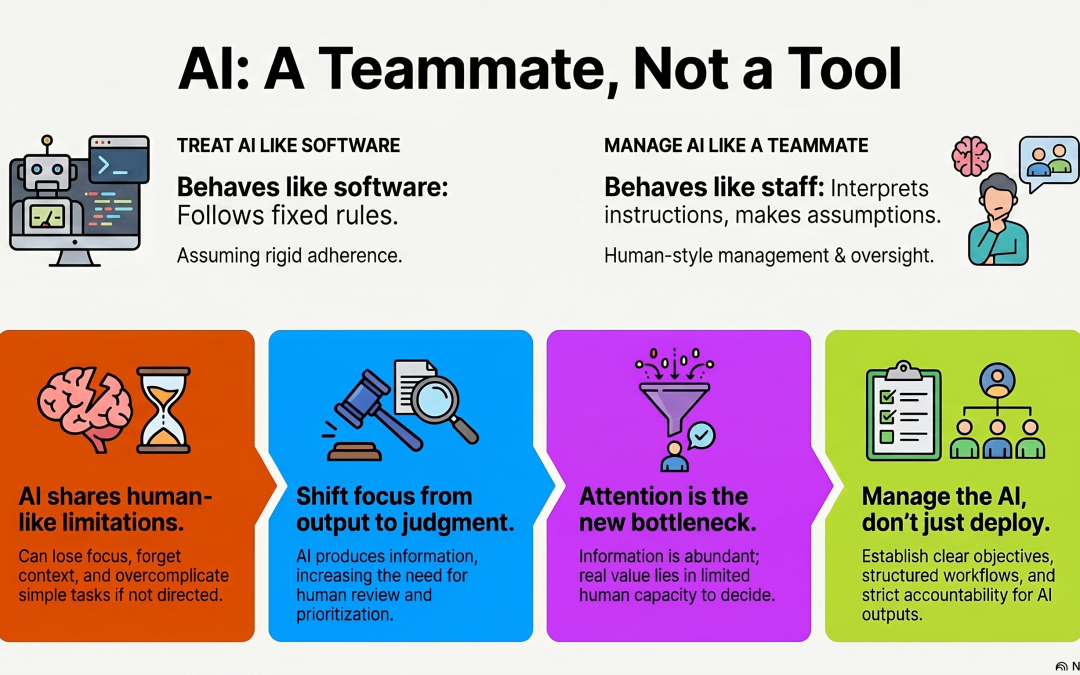
 AI is often portrayed as the perfect employee.
 For decades we’ve become accustomed to software behaving in a predictable way.
 One of the unintended consequences of AI is that it has dramatically reduced the cost of creating information.