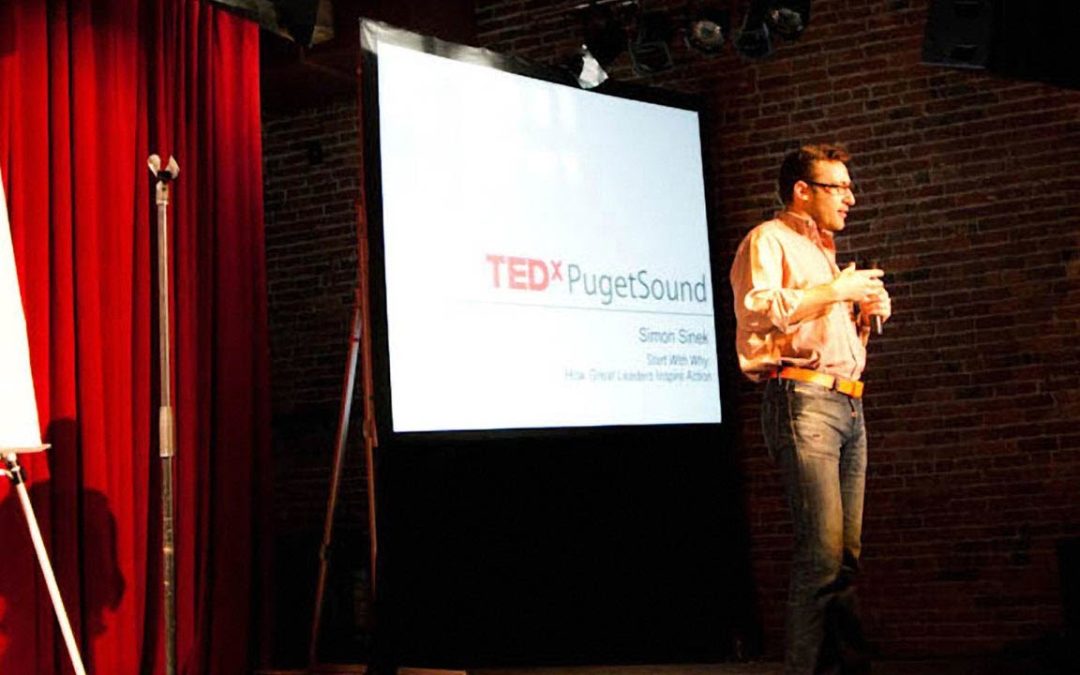
Wonder when you’d get the best results with your marketing strategies? Wonder no more – with a new insight by Simon Sinek called The Golden Circle, you are sure to inspire your consumers and persuade them to make the action you’ve been expecting from them.
But before we expand on the idea of The Golden Circle, here’s a brief background on Simon Sinek. One of the TED Talk speakers, Simon is also known as the author of the book “Start With Why” which was released in 2009. With his works, he has been convincing and motivating people to do what inspires them.
With that said, there is no doubt that this new insight from him will help you get the results you have been dreaming of from your marketing strategies.
The Golden Circle Concept
As its name implies, the concept known as the Golden Circle is made up of 3 circles. The innermost circle is labeled as the WHY, the inner circle as the HOW and the outer circle as the WHAT. These 3 circles represent the 3 things that every company or organisation have in order to exist.
The WHAT circle refers to a company’s objective – what they want to achieve, the HOW circle represents a company’s resources as well as processes that are necessary to achieve their objective, while the WHY circle refers to a company’s purpose – why they exist. Most people perceive profit as a company’s purpose and this is incorrect – it is a result not a purpose.
To further understand how the Golden Circle works, let’s use the same example Simon used in the TED video.
Apple has been around for many years but while it is just like any other computer company, they stand out. What makes them stand out? And what makes people trust them so much that they are willing to buy computers, HDTVs and even MP3 players from them?
The answer can be seen here – Apple, just like some well-known achievers in this world – Martin Luther King and the Wright Brothers, operate in contrast to how the majority of the world’s population operate.
Most people, leaders and companies usually give more importance to the WHAT aspect of their business. They tend to emphasize on their products, their objectives without even stating WHY they sell what they sell, build what they build or do what they do.
If Apple were to operate just like everybody else, a marketing message from them would sound like this:
We make great computers. They’re beautifully-designed, simple to use and user-friendly. Want to buy one?
This kind of marketing pitch is common but uninspiring. And most of the time with this kind of message, companies don’t receive the right response from their customers because they fail to inspire action.
Now, since Apple operates in contrast to the usual uninspiring way, their marketing message sounds like this:
Everything we do, we believe in challenging the status quo, we believe in thinking differently. The way we challenge the status quo is by making our products beautifully-designed, simple to use and user friendly. We just happen to make great computers, want to buy one?
By reversing the order of information and giving emphasis to WHY they do what they do, Apple inspires their customers and everyone else to make the right action based on their message.
This example proves that if you’re looking for amazing results from your marketing strategies, you have to let people understand WHY you do what you do because people who believe your cause will make it their own and do something about it.
So if you’re looking for the best way to inspire action from your customers and get best results, follow The Golden Circle concept.
In Simon’s words
“the goal is not to do business with anybody who needs what you have. But to do business with people who believe what you believe. Because when you talk about what you believe, you will attract those that believe in what you believe and therefore, inspire action.”
You know, I think that over the last few decades that “business” has lost the art of managing their people. (I say “business” because obviously there are some great managers out there – but, in general, management is a lost art!)
We’ve managed to pull through the GFC (“Global Financial Crisis”) and have emerged into a market that is very competitive, with tighter margins and that is far more globalised than ever before.
There are also significant opportunities for businesses that are have the capacity and capability to embrace them. But here lies the challenge…
I am finding that most businesses do not have the necessary “middle- management” skills and personnel to pull it off.
Why is this so?
Well, in an effort to become more efficient, we have “exised the fat” and removed layers of middle-management by pushing more and more responsibility down the “chain of command”.
“Delegation and empowerment” have been the buzz words of the first decade of this century. Now, this was fine when economies and businesses grew at unprecedented rates and that being an effective sales person meant that you were quickest to the fax to collect new orders when they came through.
In the 1980’s and 1990’s, high profile CEO’s (“Chainsaw” Al Dunlap, etal) made a big impact with their “razor gangs” laying off hundreds of thousands of people, mainly middle managers, in the search for improved profits.
I believe this was short-term thinking and that the long-term effects were camouflaged by the huge economic growth from the late 1990’s to 2008.
“Money can paper over a lot of cracks” has been my mantra and since 2008, when the cash vanished, the cracks have been laid bare.
My colleague, Mike Boyle – the Sales Scientist (Mike is a leading sales consultant and if you’re having any issues with sales in your business – you need to contact him at www.banjargroup.com.au ) – has found similar issues in Sales Management and has expressed it beautifully.
Mike says “If managers are seen as by managing by results, they are actually managing by fear.
If they are seen as managing by activities, they are managing by pressure.
Neither of these management strategies will grow the capabilities of the team to meet future challenges.
They should be placing a large proportion of their time in developing and coaching their sales team to lift skills, improve knowledge and change behaviors” and he has the data to prove that this works.
I agree wholeheartedly with Mike. In essence, we have lost the art of coaching and mentoring our team members.
We are often very good at measuring the numbers and “cracking the whip” on activities but not very good at coaching our team to build skills, knowledge and change behaviours.
I believe it will be exacerbated in our changing workforce, as the “experience” of the Baby Boomers leaves the workforce and is replaced by the “enthusiasm” of Gen Y who have not been coached and developed to the same extent.
For me, this raises a couple of fundamental questions:
What are your managers doing to “grow” their people?
How will you move from a management culture based on fear and pressure to one based on mentoring and growth?
Your answers will be critical to your long term business success.
The first list is from Warren Bennis, a professor of Business Administration at the University of Southern California and the best selling author of “On Becoming a Leader” and many other books on leadership.
Warren Bennis’s Ingredients for Leadership
Concept
What it means
Guiding Vision
You have a clear concept of what you want to do —
professionally and personally
Passion
You love what you do
Integrity
You know your strengths and weaknesses and are true to your principles
Trust
You have earned people’s trust
Daring
You are willing to take risks
Curiosity
You want to keep learning
Our experience is that the strongest attribute that a leader can have is a clearly defined vision and the ability to communicate that vision and get your staff and community to be willing followers and allies to you in achieving that vision.
Source: Warren Bennis, On Becoming a Leader.
Henry Ford, Walt Disney, Sir Winston Churchill and Martin Luther King all had the ability to communicate their personal vision.
Martin Luther Kings famous speech expressing his dream is well worth repeating.
1. “I say to you today, my friends, that in spite of the difficulties and frustrations of the moment I still have a dream. It is a dream deeply rooted in the American dream.
2. I have a dream that one day the nation will rise up and live out of the true meaning of its creed: ” We hold these truths to be self-evident: that all men are created equal.”
3. I have a dream that one day on the red hill of Georgia the sons of former slaves and the sons of former slave owners will be able to sit down together at the table of brotherhood.
4. I have a dream that one day even the State of Mississippi, a desert state sweltering in the heat of injustice and oppression, will be transformed into an oasis of freedom and justice.
5. I have a dream that my four children will one day live in a nation where they will not be judged by the colour of their skin but by the content of their character.”
How many of us could articulate our vision to our staff as effectively as that?
Now we will visit Stephen Covey’s list of Leadership characteristics.
Stephen Covey’s Eight Discernable Characteristics of Principal-Centered Leadership
Characteristics
What it means
Continual learning
Seek training, take classes, listen, ask questions
Service orientation
See life as a mission, not as a career
Radiate positive energy
You are cheerful, pleasant, happy, optimistic, positive, enthusiastic and hopeful
Believe in other people
Don’t label, don’t overreact, don’t carry grudges or prejudge people
Synergize
You are productive and “smart working”
Lead a balanced life
You are temperate, wise, sensible, physically active, socially active, and well read
See life as an adventure
You are courageous, unflappable, totally flexible explorer
Balance your physical, mental, emotional, and spiritual characteristics
You engage in exercise, reading, writing, creative problem solving, you pray, meditate, and watch what you eat
Source: “Principle-Centered Leadership” by Stephen Covey.
Now you can rate yourself against the issues that have been highlighted above. As in all these things there are no definitive right or wrong attributes that fit great leaders.
Peter Drucker, known as a great respected authority on leadership and still active in coaching and teaching the subject in his nineties stated that there are no set fundamental traits for great leaders.
We are all individuals, however in my opinion the key issues are to be able to “command and not demand respect” and to be able to listen effectively and have empathy for the other persons point of view. Its all about relationships.
Article written by Bill Winter, Mindshop Facilitator
What makes the difference between a successful business person and one who struggles to get by? Of course there is no single factor as there are many skills that a business owner must possess if they are to realise their goals.
One of these factors is to first have a goal, it may seem obvious, but in order for one to ‘get there’ one must first decide where there is. I am constantly reminded of this simple fact through my consultancy work with businesses of all sizes where I see those who can best define their outcomes are generally the most successful.
However having a vision is not enough, successful people work hard on constant improvement. They know they have influence over their destiny whatever the prevailing conditions. They know that by changing their actions or improving their skills in certain areas they can succeed whatever is happening around them. People who readily accept responsibility for their outcomes can be recognised in the way they speak. For example, you will hear them say things like ‘I misjudged the market and bought more stock than I could handle’ or ‘I found that my skills weren’t sufficient to handle the negotiation’. These people have what I will refer to as an ‘Internal Locus of Control’. They are influenced but not controlled by external factors. They take responsibility for the outcomes.
Conversely, if you hear people say things like ‘I would have been successful but the markets turned sour’ or ‘I got caught by the GST and had to sell the business” they have an ‘External Locus of Control’. Put simply they blame other people for their failures. Of course those who have an external locus are generally the ones who find it difficult to change. It’s always someone else’s fault or responsibility. They tend to be problem focused, while a person with an internal locus is solution focused. It is through their desire for continuous improvement that successful people see opportunity where others see barriers.
In which category would you place yourself? Listen to those around you and see if you can tell if they have and internal or external locus of control. Listen to your own self talk and note how many times a day you blame something or someone else for outcomes in your business.
There is an ancient saying, ‘For a forest to be green each tree must be green’ so why not consider adopting an internal approach to business management and enjoy the satisfaction that comes from knowing that you can influence the outcome whatever the challenges.
Most businesses know that they need to change the way they operate in order to achieve maximum profit and/or revenue growth, however most fail to actually do it.
Most Business Managers know that they need a plan to guide their development process but most fail to develop one despite the fact that there are literally thousands of guides, training programs and advisers available to assist in this development process. WHY?
I believe that one of the primary reasons is that traditional planning processes fail to take advantage of your CHANGE POTENTIAL, which is your ability to implement change in your business and life.
What factors do you need to address if you are wanting to make a change? These are the individual elements of your change potential.
How do you maximise your change potential?
Your ability to change will be influenced by three things. Your level of dissatisfaction or motivation, your Vision for the future and the quality of your plan for achieving your Vision. The combination of these 3 simple things is what drives people to change.
We have developed a simple formula to measure your change potential. There are 4 things you need to do:
You need to know how the change formula works.
You need to know how to create Dissatisfaction (motivation).
You need to know how to create Vision; and
You have to be skilled in developing a Plan that works.
If you can maximise your performance in Dissatisfaction, Vision and Plan, you can maximise your change potential.
Dissatisfaction
Pain is a great motivator in the short term. If you can get your organisation to be dissatisfied with, or motivated by, their current performance, it will create an energy you can use. If you are not dissatisfied with your present situation or are too comfortable, it will be hard to find the motivation or reason to change.
If you had to rate the level of dissatisfaction or motivation in your organisation out of ten what would it be?
A score of 0 would indicate total happiness (low motivation), 5 generally satisfied (average motivation) and 10, total dissatisfaction (highly motivated). If you are extremely dissatisfied then you are most probably highly motivated. If you are highly motivated score yourself higher on the scale.
Vision
In a similar way, rate the level of vision in your Business. Vision is a critical element because it provides a picture of what will be achieved.
Score yourself from 0 to 10 on the quality of Vision in your business.
If you have a well articulated Vision that you have documented and that you can draw a picture of, then rate yourself higher on the scale. Rate yourself higher the longer the time frame covered by your Vision. If you have never really thought about where you want to be in the future and don’t have a clear Vision, then give yourself a low score closer to zero.
Plan
How would you rate the level of commitment, involvement and belief in your business plan? Most businesses don’t score well in this element.
Again use the 0 to 10 score. If you have a well documented plan for achieving your Vision with strategies, priorities, actions, timings and responsibilities then score yourself near the upper end of the scale. If you have a very rough plan stored in your head then score yourself towards the lower end.
Calculate your Change Potential
Once you have scored each item, multiply the scores together to get a total value for your change potential. D x V x P = Change Potential. What is the score for your Business or for you as an individual?
Example
Formula D x V x P = Change Potential
Maximum = 10 x 10 x 10 = 1000
Your Score ___ x ___ x ___.= ____
What scores do you think the best performing businesses (or individuals) would have? Typically they are highly motivated, have a very strong sense of Vision and have great plans. Scores in these businesses are usually in the vicinity of 10, 8 and 8 for D.V and P , respectively, which gives them a total score of 640 out of 1000 (10 x 10 x 10) or they are using 64% of their change potential.
How do you compare to the better performing business? How can you improve your score?
In which area (D,V or P) did you have the lowest score? What can you do to improve this score? What can you do to improve your score in the other areas? Set up some action plans.
Don’t feel discouraged if you scored yourself at the bottom of the range as this means that you have a lot of unused potential. In my experience, most business managers score between 10% and 30% using this methodology. To maximise your change potential, I believe that you need to lift your score to greater than 50%.
But what if I don’t want to change? “Change is inevitable you can drink it as soup now or take it as an enema later! Either way, you will change! “Anon.
In other words, you can embrace change now or have it forced upon you later but there is no escaping it. This is a quote from a good friend of mine (who shall remain nameless) who is a gifted commentator on world events.
Unfortunately, in today’s fast moving business environment avoiding change just isn’t possible. All businesses change even if they don’t know it. Changes in customer expectations, communications technologies, legislation, banking and finance all occur without us even being aware of it! Therefore not changing just isn’t an option!
The key is to be aware of the changing environment and to adjust your plans to include appropriate elements of change. A good planning process will include a process for prioritising the implementation of your plan which will filter out unnecessary changes and include essential developments.