by Russell Cummings | Aug 14, 2010 | Business Tips, Planning, Strategy
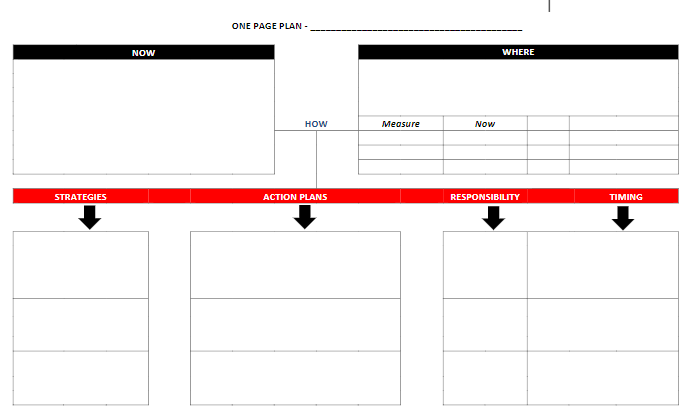
The One Page Plan covers the key elements of a Business Improvement Plan by summarising the NOW, WHERE and HOW.
In the NOW Summary, you need to pull out the key points of your current position, remembering that you only have room for about 10 short points (3 to 4 words per point).
In the WHERE Summary, you need to include a short summary of your Vision, your Business Statement, your Sustainable Competitive Advantage and your Objectives. In the HOW, we need a summary of each of your key strategies and your action plans.
To keep the plan to one page, you can always print on both sides of an A4 sheet. In this way you can have the Plan on one side with the budget (financial projections) or detailed action plans on the other side of the sheet.
It is suggested that elements of the plan are supported with detailed information as required. This may include:
Strategy Documents
Marketing Information
Budgets and Financial Projections
This will mean that your total business plan could be 8 to 10 pages in length (it could be longer) but that it is summarised onto a single page. The ONE PAGE PLAN then becomes your management document and is used to drive the development of your business. It is a great tool for achieving this as it is flexible, short, concise and easily updated.
The One Page Plan concept is so powerful that we use it develop One Page plans for a whole range of activities including:
Marketing
Customer Service
Recruiting
Personal Development
Within the one business you may have different divisions or sections – you can develop a One Page Plan for each Division! Each Team and/or staff member can have their own One Page plan. The Plans can cascade down from a Company level to an individual level with as many levels in between as are appropriate.
There is no end to the uses for the One Page plan concept!

by Russell Cummings | Aug 12, 2010 | Business Tips, Planning, Strategy
There are several other reasons why business managers don’t plan:
- Traditional business plans are too complex
- Traditional business planning fails to address many of the current issues in our business
- They often only focus on the future
- Traditional business planning assumes that management will develop and implement the plan
- Traditional business plans are too inflexible to be of any use
- (How can a 100 page document be reworked quickly to meet changing market conditions?)
- Traditionally business plan usually doesn’t provide a mechanism to prioritise the key issues
- how do you can determine which issues are to be dealt with firts
Are these some of the reasons why you haven’t developed a plan for the future of your business?
For a Business Improvement Plan to be useful, I believe it must:
- Be simple and easy to adjust
- Be flexible
- Maximise our change potential
- Be based on Best Practice tools and techniques
- Allow you to prioritise your activities
- Involve your whole team in development and implementation
- Include problem solving routines to develop action plans
Why don’t traditional plans meet this criteria?
In many cases, the business planning format has been adapted to meet the needs of advisers, financiers (bankers), government agencies providing assistance and accountants. For these external advisers, the Business Plan provides evidence that the Manager/Owner has thought through all the issues and the plan provides a comprehensive overview of the business.
However, a traditional business plan often fails to meet the needs of the Business Manager and his team because it has been designed to meet external rather than internal needs.
Dont get me wrong there are plenty of times when a traditional business plan is required and is warranted. Examples would include: new business start-ups, taking over an existing business, extensive business expansion, introduction of new products lines, major capital expenditure, etc.
Feedback from my clients is that for many businesses, developing a traditional business plan is time consuming and appears to be an insurmountable hurdle that Managers will only attempt when they are pressured to by outside forces like the Bank.
This is a great shame because as we discussed above having a great plan with vision is one of the key elements of maximising your change potential.
So is there a better way? YES! The One Page Plan.

by Russell Cummings | Aug 11, 2010 | Business Tips, People, Planning, Strategy
People: Some people want to change, others resist it. Its sometimes necessary to admit that some team members have become a liability. If such people form the major part of a team, the team is doomed for failure. For this process to work the teams must be formed by the people who want change. In a family owned or small business selecting the right people can often be very difficult.
Products: The Pareto Rule is relevant here. “Twenty” percent of your products provide “eighty” percent of your sales. Twenty percent of our products provide eighty percent of your profit. Removing non performing products is essential if you want the right structure. Flexibility in production systems and an ability to diversify are critical to success in agriculture.
Customers: Again the Pareto Rule applies. Which twenty percent of your customers provide your sales, profit and repeat business? Which twenty percent provide eighty percent of your problems? Why invest time in these? Why not remove them? How many managers actually think about who they sell their products to?
Experience indicates that many businesses sell to customers who are tardy with payment (or even worse are “known” non-payers) or people that change the terms after delivery. Why do we sell to these people ? Select your customers wisely and build strong relationships with good customers that will stick with you in good times and bad. Do you have a customer care program to build relationships with your key customers? If not, then Why not?
Processes: The processes used in most businesses are rarely reviewed. Inefficiencies and waste creep in. To have the right structure, your processes need to be effective. Do you know what the key processes are in your business? How do they interact? Where are the inefficiencies? Where is the waste? Where are you under-utilising labour and resources? Where are you wasting inputs?
Processes also refer to the management processes in your business (not just the sales or production functions). Do you have an effective business planning process? How do you develop your marketing strategies? What are you Human Resource Management policies and strategies? These background or support processes are often more important than your production processes.
Price: A key structural element is pricing. Many businesses know how to cost, most dont price correctly. The wrong price can mean lost sales or lost profit. Correct pricing is a key success factor. How do you determine the correct selling price for your product? What is your selling strategy? How can you maximise the market price for your commodity? These are important questions that need to be answered.
But where to start?
This is a common question from managers and owners. – Where do I start? How do prioritise working on my people, products, prices, processes, etc? Where do I put the most effort?
There is no unique answer to this question although many “consultants” will tell you exactly where you need to apply your focus. In reality, depending on your individual situation, you may need to address all of these issues.
Our recommendation is that you develop a one page strategic plan for your business. YES – ONE PAGE!!
This simple, innovative planning process will help you to take stock of your current situation, work out where you want to be and help you prioritise the actions and strategies that will get you there.
The key to success is in this last step – PRIORITISE THE ACTIONS. The MindShop process that drives the development of the one page plan is unique and so simple to implement.
The one page plan will focus you on the actions you need to take to get your business or organisation moving. It will help determine whether you need to focus on people, prices, products or processes issues. It will also help you easily develop solutions to complex problems by providing you with a logical problem solving process.

by Russell Cummings | Aug 8, 2010 | Business Tips, Finance, Marketing, Planning, Strategy
NEAT Analysis
We have developed a simple methodology for looking at our marketing and business development options and have called it NEAT, which stands for:
- Number of Customers
- Efficiency %
- Average Sale $
- Transaction frequency
Now, N x E x A x T = Profit
You can look at NEAT from a whole business perspective or on a business unit basis, if required. It is usually done on an annual basis.
Number of Customers simply stands for the number of Active Customers in your business. In most businesses active customers will be those that have purchased off you in the last year or two. In high turnover businesses , eg. NewsAgents, active customers could be those that have purchased off you in the last 3 months. In the building industry, it could be people that have purchased off you in the last 5 to 10 years.
In any case, count or estimate the number of active customers in your business. You can usually get this information from your bookkeeping systems although in a retail environment this maybe difficult, so estimate the number.
Efficiency is usually measured as Net Profit/Sales and expressed as a percentage. For example: if you make $100,000 Net profit on $500,000 worth of sales then your E is 20%.
Average Sale. This is an important measure because it looks at the average $ spend per sale. To determine what this is, look to your records eg. bookkeeping systems or cash registers. From a bookkeeping system, simply divide the Total Sales by the number of Invoices and cash sales. From your cash register, record the total sales $ for a period and count up the number of actual sales in the same period and divide. So how much are your customers currently spending each time they do business with you?
Transaction Frequency. Quite simply, how many times do your customers buy from you in a year? To work this out divide the number of invoices or sales calculated above by the number of active Customers. If you are in a high frequency business, this could be a number between 50 and 100 (once or twice a week) or a low frequency business eg. building this transaction figure could be 0.1 (once every 10 years).
Working out the NEAT Values for your Business
As mentioned above, multiplying your NEAT components together should give you a measure of your profit. If we break down the basic components we can see the components of sales and efficiency.
N x E x A x T = Profit
(N x A x T) x E% = Profit
Sales x Efficiency% = Profit
( Customers x Sales x Transactions) x Efficiency % = Profit ( 1 Transaction Customers )
Now, complete the calculation using the figures for your business: For example: if we have: 200 customers, sales of $1,000,000pa.; Net Profit Margin of 15% of sales; 5,000 invoices (transactions) per annum, then your NEAT calculation would look as follows:
N = 200 Active Customers
A = Average Sale
= Sales/Transactions = 1,000,000/5,000 = $200/ Sale
T = Transaction Frequency = Transactions/Customers
= 5,000/200 = 25 per Customer per annum
E % = Efficiency % = 15%
Check that: N x A x T = Total Sales (200 x $200 x 25 = $1,000,000)
Check that: Sales x E% = Profit ($1,000,000 x 15% = $150,000)
This is all very interesting but how do I use it?
Once you have your NEAT components, you can start to analyse your business. There are 6 easy steps:
Step #1: Start with N (Customers). How many active Customers do we have? What proportion of our total customer list are active? For example: if we have 1,000 Customers on file over the last 10 years, but only 200 are active then only 20% of our Customers are active. How can we rejuvenate the 80%? How can we attract more Customers? How do we stop the “churn” in Customers? How many of our active customers are “A Class” customers? How many are “C Class”? How will you find more A Class? Brainstorm your actions and look at the impact you could have on N. Write down the new N number.
Step #2: Improve Efficiency %. Efficiency % is calculated by profit over sales. The difference between sales and profit is composed of costs. What can we do to reduce our costs? How can we become more efficient? How can we reduce our Variable Costs? What can we do about overheads and finance costs? How does your business compare with other businesses in the same industry? Brainstorm your options and calculate the impact these will have on your efficiency %. Write this number down.
Step #3: Increase Average Sale. Look at your average sale. How does this compare with what you thought your average sale was? Most businesses over-estimate their average sale figure. How can we improve this figure? Look at adjusting your pricing? What would have to change about your goods and services for you to command a higher price? How can you package products and services to add value? How can you up-sell to better quality, higher margin goods? Can you cross-sell and introduce additional items with the sale (eg. “Do you want fries with your order?”)? Brainstorm your options and estimate your new average sale figure. Write this down.
Step #4: Increase your Transaction Frequency. How can you increase the number of times your customers will buy from you in a given period? How can you bring them back to your business on a more frequent basis? How can you keep in contact with your clients? Do you have a contact program? Why not – it is the most effective way to ensure that you are in contact with your customer base? Do you collect contact details? Do you have a loyalty program? Again, write down your options and estimate the impact on the number of transactions.
Step #5: Calculate your new NEAT. Simply multiply your new N x E x A x T to get an estimate of your potential new profit. How does it compare to your current profit levels? Is it worth an investment of time and resources to grow to this level?
Step #6: Prioritise and Action Plan. Given that most business have limited resources of capital and labour, you won’t be able to do everything on your NEAT lists. What are the 3 most important things that you need to do based on the NEAT Analysis? Select the 3 that will have the biggest impact and develop action plans to implement the solutions.
Next Steps
Do the NEAT Analysis This is simple to do. Even if you don’t have accurate figures use the NEAT concept as a basis for improving your figures.
Develop a Contact Program for your Customers and prospects as a matter of priority. This is an essential tool for any business and usually has a very quick payback period and develops long term relationships with your customers.
Contact your MindShop facilitator if you need to ask any questions or need some assistance in developing a NEAT view of your business.

by Russell Cummings | Aug 7, 2010 | Business Tips, Marketing, Planning, Strategy
What is Marketing?
Marketing is a term used to define a whole range of functions within a business and is expressed in a whole range of contexts. So exactly what is marketing?
If we pare back the rhetoric, marketing is simply the strategies we employ to move our products/services from us to the client profitably. Marketing is the process of converting prospects to customers.
It is much more than just advertising and promotion. Marketing also includes: understanding who is your target market; what is your competitive advantage; what are your product, pricing and distribution strategies as well as promotion & advertising. It is the combination of these factors that determines the effectiveness of your marketing programs.
If we think in these terms it becomes obvious we need to review and expand effort into these strategies during tough times.
The Sales Conveyor Belt
In order to survive we must maintain momentum with our sales. Think of the sales effort as a long conveyor belt of “prospects” being loaded one end and sales unloading (completed) at the other. There are some losses along the way so that not every prospect becomes a customer.
The more raw material (prospects) we can load the more opportunity we have to create sales. In some cases the more prospects being delivered the more selective we can be about whom we want to convert into a sale.
If we stop loading the conveyor belt with prospects, even for a short period, how long must we wait before the next batch are loaded and arrive to us ready for conversion into sales?
It will vary greatly from one type of industry to another however the research is clear and cites five times as the average number of contacts that need to be made with a prospect before they are likely to be getting close to conversion. And this figure relates to prospects who actually need the service anyway!
A prospect is quick to say “No!” which to the seasoned sales person actually means “not yet”. The industry averages are that the average sales person stops selling after 2 “No’s” and the average customer will buy after 5 offers or contacts.
So the loading of the conveyor must go on, especially in tough times.
This however can be difficult when profit and cash flow figures are constantly moving our focus toward expenditure reductions rather than expansion. This environment provides us the opportunity of being creative with our strategies to maintain volume prospects and therefore sales conversions in tough times.
How diverse is your promotions strategy?
Advertising is expensive and alone is not the most efficient way to secure prospects. So where can we boost our promotional or prospect gathering efforts without necessarily increasing expenditure?
Rule one in business, and therefore marketing, is to attack with an integrated plan.
This means that any promotional activity you plan must leverage off another. For example if you intend running an industry seminar as a means of adding value to your customers while raising your company profile, what support activities will you engage to maximise the effect? Advertising, direct mail, press releases? What will be the next major activity you will use to leverage off the success of the seminar?
Develop a Contract Program
Even a simple contact program woven into your promotional plan will greatly assist in maintaining volume onto the conveyor.
What is a contact program? It is a simple system for maintaining the profile of your company in the mind of the client and prospect. There are 5 simple steps to creating a contact program:
Group your customers into A, B, and C class customers by defining the characteristics that make a great customer and scoring each customer against this criteria. It might include: Spending level, fit with your strategic direction, fit with your Company culture, length of relationship, potential for growth in sales, etc. A Class are your very best customers and is where you should be focusing your internal marketing efforts.
List all the potential contact activities that you could have including: visits, phone calls, mailings, newsletters, special offers, etc.
For each Customer class decide what level of contact you will have for each activity. For example: All customers will get your newsletter. A Class customers will get a visit once per annum. B Class customers will get a Customer Service call once per annum. Only A & B Class customers will get access to special offers. A Class customers will get invited to a special event at your business.
Check that you have met the 90-Day rule. This is a basic business rule that says that each contact needs to be contacted every 90 days at a minimum.
Letting contact lapse later than 90 days will mean that you will disappear from your customers conscious thought. This is a basic rule that should never be broken. At a minimum maintain the 90 day rule with your A class customers.
Systematise your contact program. Lock it into your annual program and plan ahead for items like newsletters, offers and special events.
How do I create a contact system?
You can buy all sorts of Contact Management Software or it might be as simple as creating a client/prospect card with that persons details. By creating a 1 to 12 file each card can be filed according to the month of their next contact. Make sure you record all details and that you set up systems to collect Customer details in your business.
Because you have recorded the type of contact made previously you can easily pickup on what was discussed or send something that hits to previous conversations. This way you are adding value to the client while achieving your goal.
Your type of contact can be as diverse as your imagination and might include such things as birthday cards, industry stats, tender opportunities, client referrals.
Once a contact is made you nominate the time ahead for the next contact and simply file the card into that month.
Every month you can select the cards from the corresponding month and make contact. Its that simple. It can be useful to start a collection of information and ideas that can be used as part of your contact program.
Of course technology allows you speed up this process however for me the manual system is great as my 1 12 card box with Contact Program emblazoned across the front sits on my desk staring at me so I dont forget the importance of continually loading the conveyor.
If you would like to investigate some of the software options for Contact Management or CRM (Customer Relationship Management) then some of the more popular software titles are: ACT!2000, MAUS CRM, and Maximiser.
Conclusions
Marketing is as diverse as the many definition surrounding it suffice to say that no sales equals no business so think creatively about ways to boost your efforts in tough times.
Tough economic times provide the opportunity for the focused to put distance between themselves and their competition. Revisit your strategic plan, crank up your promotional effort and get that conveyor humming with prospects.
by Ross Holding
Next Steps
- Review your Marketing. Convert it to a one Page plan so that you can manage it effectively.
- Develop a Marketing. If you don’t have a Marketing Plan (or you really need to give it a “big rework”) – Develop a plan now! Don’t wait until its too late! Our on-line Marketing & Sales Training program will help you develop and apply a marketing plan to your business in less than 8 weeks. Click here for more information. Alternatively, contact your MindShop Coach.
- Develop a Contact Program to keep feeding your Sales conveyor. This is a relatively simple task. Contact your Mindshop Facilitator for more information or enrol in our on-line Marketing & Sales Training Program.

by Russell Cummings | Aug 2, 2010 | Business Tips, Leadership, People, Planning
Most businesses know that they need to change the way they operate in order to achieve maximum profit and/or revenue growth, however most fail to actually do it.
Most Business Managers know that they need a plan to guide their development process but most fail to develop one despite the fact that there are literally thousands of guides, training programs and advisers available to assist in this development process. WHY?
I believe that one of the primary reasons is that traditional planning processes fail to take advantage of your CHANGE POTENTIAL, which is your ability to implement change in your business and life.
What factors do you need to address if you are wanting to make a change? These are the individual elements of your change potential.
How do you maximise your change potential?
Your ability to change will be influenced by three things. Your level of dissatisfaction or motivation, your Vision for the future and the quality of your plan for achieving your Vision. The combination of these 3 simple things is what drives people to change.
We have developed a simple formula to measure your change potential. There are 4 things you need to do:
- You need to know how the change formula works.
- You need to know how to create Dissatisfaction (motivation).
- You need to know how to create Vision; and
- You have to be skilled in developing a Plan that works.
If you can maximise your performance in Dissatisfaction, Vision and Plan, you can maximise your change potential.
Dissatisfaction
Pain is a great motivator in the short term. If you can get your organisation to be dissatisfied with, or motivated by, their current performance, it will create an energy you can use. If you are not dissatisfied with your present situation or are too comfortable, it will be hard to find the motivation or reason to change.
If you had to rate the level of dissatisfaction or motivation in your organisation out of ten what would it be?
A score of 0 would indicate total happiness (low motivation), 5 generally satisfied (average motivation) and 10, total dissatisfaction (highly motivated). If you are extremely dissatisfied then you are most probably highly motivated. If you are highly motivated score yourself higher on the scale.
Vision
In a similar way, rate the level of vision in your Business. Vision is a critical element because it provides a picture of what will be achieved.
Score yourself from 0 to 10 on the quality of Vision in your business.
If you have a well articulated Vision that you have documented and that you can draw a picture of, then rate yourself higher on the scale. Rate yourself higher the longer the time frame covered by your Vision. If you have never really thought about where you want to be in the future and don’t have a clear Vision, then give yourself a low score closer to zero.
Plan
How would you rate the level of commitment, involvement and belief in your business plan? Most businesses don’t score well in this element.
Again use the 0 to 10 score. If you have a well documented plan for achieving your Vision with strategies, priorities, actions, timings and responsibilities then score yourself near the upper end of the scale. If you have a very rough plan stored in your head then score yourself towards the lower end.
Calculate your Change Potential
Once you have scored each item, multiply the scores together to get a total value for your change potential. D x V x P = Change Potential. What is the score for your Business or for you as an individual?
Example
Formula D x V x P = Change Potential
Maximum = 10 x 10 x 10 = 1000
Your Score ___ x ___ x ___.= ____
What scores do you think the best performing businesses (or individuals) would have? Typically they are highly motivated, have a very strong sense of Vision and have great plans. Scores in these businesses are usually in the vicinity of 10, 8 and 8 for D.V and P , respectively, which gives them a total score of 640 out of 1000 (10 x 10 x 10) or they are using 64% of their change potential.
How do you compare to the better performing business?
How can you improve your score?
In which area (D,V or P) did you have the lowest score? What can you do to improve this score? What can you do to improve your score in the other areas? Set up some action plans.
Don’t feel discouraged if you scored yourself at the bottom of the range as this means that you have a lot of unused potential. In my experience, most business managers score between 10% and 30% using this methodology. To maximise your change potential, I believe that you need to lift your score to greater than 50%.
But what if I don’t want to change?
“Change is inevitable you can drink it as soup now or take it as an enema later! Either way, you will change! “Anon.
In other words, you can embrace change now or have it forced upon you later but there is no escaping it. This is a quote from a good friend of mine (who shall remain nameless) who is a gifted commentator on world events.
Unfortunately, in today’s fast moving business environment avoiding change just isn’t possible. All businesses change even if they don’t know it. Changes in customer expectations, communications technologies, legislation, banking and finance all occur without us even being aware of it! Therefore not changing just isn’t an option!
The key is to be aware of the changing environment and to adjust your plans to include appropriate elements of change. A good planning process will include a process for prioritising the implementation of your plan which will filter out unnecessary changes and include essential developments.