
by Russell Cummings | Apr 18, 2011 | Business Tips, Leadership, Marketing, People, Strategy
You know, I think that over the last few decades that “business” has lost the art of managing their people. (I say “business” because obviously there are some great managers out there – but, in general, management is a lost art!)
We’ve managed to pull through the GFC (“Global Financial Crisis”) and have emerged into a market that is very competitive, with tighter margins and that is far more globalised than ever before.
There are also significant opportunities for businesses that are have the capacity and capability to embrace them. But here lies the challenge…
I am finding that most businesses do not have the necessary “middle- management” skills and personnel to pull it off.
Why is this so?
Well, in an effort to become more efficient, we have “exised the fat” and removed layers of middle-management by pushing more and more responsibility down the “chain of command”.
“Delegation and empowerment” have been the buzz words of the first decade of this century. Now, this was fine when economies and businesses grew at unprecedented rates and that being an effective sales person meant that you were quickest to the fax to collect new orders when they came through.
In the 1980’s and 1990’s, high profile CEO’s (“Chainsaw” Al Dunlap, etal) made a big impact with their “razor gangs” laying off hundreds of thousands of people, mainly middle managers, in the search for improved profits.
I believe this was short-term thinking and that the long-term effects were camouflaged by the huge economic growth from the late 1990’s to 2008.
“Money can paper over a lot of cracks” has been my mantra and since 2008, when the cash vanished, the cracks have been laid bare.
My colleague, Mike Boyle – the Sales Scientist (Mike is a leading sales consultant and if you’re having any issues with sales in your business – you need to contact him at www.banjargroup.com.au ) – has found similar issues in Sales Management and has expressed it beautifully.
Mike says “If managers are seen as by managing by results, they are actually managing by fear.
If they are seen as managing by activities, they are managing by pressure.
Neither of these management strategies will grow the capabilities of the team to meet future challenges.
They should be placing a large proportion of their time in developing and coaching their sales team to lift skills, improve knowledge and change behaviors” and he has the data to prove that this works.
I agree wholeheartedly with Mike. In essence, we have lost the art of coaching and mentoring our team members.
We are often very good at measuring the numbers and “cracking the whip” on activities but not very good at coaching our team to build skills, knowledge and change behaviours.
I believe it will be exacerbated in our changing workforce, as the “experience” of the Baby Boomers leaves the workforce and is replaced by the “enthusiasm” of Gen Y who have not been coached and developed to the same extent.
For me, this raises a couple of fundamental questions:
What are your managers doing to “grow” their people?
How will you move from a management culture based on fear and pressure to one based on mentoring and growth?
Your answers will be critical to your long term business success.

by Russell Cummings | Jan 31, 2011 | Business Tips, Latest News, Marketing, Sales, Strategy, Technology
To Tweet or Not to Tweet
Social networking has indeed changed the world. Since its introduction, this modern phenomenon, which is also referred to as social media, has provided a new and faster way for people to connect, interact and go about with their daily lives.
Social networking may have started out as a fad, but its massive appeal has transformed it to something even bigger. And today, almost 50% of the world’s IT literate population, under 30 years old, is on social networking sites such as Facebook, Twitter, Linkedin and more.
Social networking has affected almost every person in the world in one way or another—good or bad. In fact, many people’s personal lives have changed because of it. Research shows that 1 out of 8 US couples have met through social networking sites. With things like this happening because of social media, the question is, is it only good for personal life? Or are there opportunities that businesses can take advantage of?
Social Media and Business
One of social networking’s strong points is that it gets news across—whatever it is—to millions of people—wherever they are—in real time. Gone are the days when people had to take time to find out about what’s going on in the world. These days, news is fed to people via social networking in minutes! This feature is one of the best opportunities businesses can and should definitely explore and take advantage of.
Another opportunity that social networking presents to businesses is its attractiveness or appeal to people. Aside from having a large proportion of the world’s population on it, studies reveal that social networking sites, especially Facebook, have topped other forms of media such as TV, radio and other popular internet sites like Google. This percentage ensures that business people who invest time and money to market their products and companies in social networking sites are sure to get the exposure and quotas they’re aiming for.
But with so much hype on social networking, many consider that the social media bubble is about to burst. The notion has been formulated by economists who think that all things that reach a peak will soon fall. And with this speculation, business owners ask whether investing in social media is still worth it or not?
Social Media is here to Stay
People might say that the reign of social media will soon end, and although it may be true, businesses should still take the opportunity to use it for marketing purposes because the social networking technology will be here to stay.
Yes, it is possible that Facebook and other popular social networking sites may become obsolete in a few years but it will only be replaced by something much more advanced.
Social networking sites, as the term implies, thrive on people’s natural instinct to socialize, to communicate and to interact with each other. So long as there are people in the world, social media, in whatever form will stay as a powerful tool to reach out, sell and convey a message.
Social Media is Relatively Inexpensive
With the global financial crisis, finding alternative solutions to high costs is essential for businesses to survive. And with that said, another reason why businesses should consider utilizing social networking is because it is inexpensive.
Most social networking sites are free to access by anyone, anywhere in the world. With no financial cost, businesses are able to build a profile in whatever way they want their brand to be introduced and made known to the market. But don’t be fooled. Social networking may be absolutely free, but in order for businesses to excel in this new media, hard work and patience is required.
Social networking makes businesses more vulnerable to the public eye. Just as in the “physical world”, establishing solid customer relationships and providing sincere customer service are important for business growth – they are just as important online. If businesses fail to invest the necessary time and effort in reaching out to their customers – they’re bound to fail in social media, as well.
Anecdotal evidence suggests that businesses that treat their social networking like any other physical networking opportunity are winning work from it. This requires a consistent focus and attention to the network. It will involve participation in the network, communication with other members, responding to posts, joining special interest groups and discussion forums. All things you would do in a physical networking group like a Chamber of Commerce.
Selecting the Right Network for your Business
Obviously, selecting the right social media platform for your business is important. Facebook, although the dominant player in the market, anecdotally appears to be more for Business to Consumer relationships than some other options.
LinkedIn on the other hand is one the larger Professional/Business networking sites and is much more suited to building Business to Business relationships.
Twitter, is a “micro blogging” network that seems to have appeal across both business and social networks. Some of the networks, like LinkedIn, allow you to interact with other social media like blogs, Twitter, etc such that a posting on your blog can automatically feed to LinkedIn which can then on feed a comment to your Twitter account. In this way, one activity can service multiple contact points and networks.
Choose the network that suits your business and concentrate your effort on this. This should give you a greater return for effort than spreading yourself too thin.
Countering the dangers of Social Media for Business
Like all things, social networking also has its disadvantages. One of the dangers of social media for businesses is also one of its strongest points—social networking delivers news, good or bad, in an instant. For this reason, businesses should be wary of what they say about their products and be very careful of their actions.
According to some studies, people are prone to believing what they’re friends say more than what they see on advertisements or press releases. A bad company or product reputation will easily spread via social media.
Another thing that business owners should keep an eye out for when investing in social networking sites is the possibility of having copycats. Competition can encourage anyone to do just about anything, and because social media sites are mostly free, it’s easy to copy and create false and rep-destroying profiles against a competitor. Because of this, social networking as a marketing tool is dangerous by itself.
Integration is the Key
Social Media is not the only platform for your marketing – it is one of many. And it should be integrated into traditional media and other marketing strategies such as word of mouth, relationship building and contact programs.
It is crucial for businesses to integrate social media activities with their existing marketing programs because the objective of using social media is to build relationships via an online community, just as much of your other marketing is about interacting with the physical community.
Overall, the advantages of social networking as a business tool outweigh its disadvantages. With larger proportion s of the business community involved in social media in one way or another, it is a strategy that business owners should definitely take advantage of.
So, TWEET!
by Russell Cummings | Aug 14, 2010 | Business Tips, Planning, Strategy
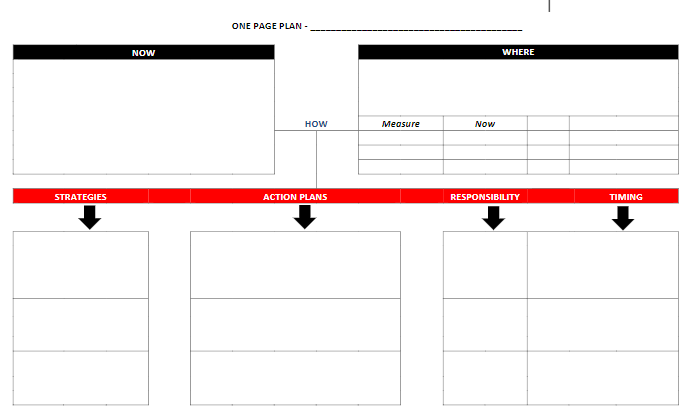
The One Page Plan covers the key elements of a Business Improvement Plan by summarising the NOW, WHERE and HOW.
In the NOW Summary, you need to pull out the key points of your current position, remembering that you only have room for about 10 short points (3 to 4 words per point).
In the WHERE Summary, you need to include a short summary of your Vision, your Business Statement, your Sustainable Competitive Advantage and your Objectives. In the HOW, we need a summary of each of your key strategies and your action plans.
To keep the plan to one page, you can always print on both sides of an A4 sheet. In this way you can have the Plan on one side with the budget (financial projections) or detailed action plans on the other side of the sheet.
It is suggested that elements of the plan are supported with detailed information as required. This may include:
Strategy Documents
Marketing Information
Budgets and Financial Projections
This will mean that your total business plan could be 8 to 10 pages in length (it could be longer) but that it is summarised onto a single page. The ONE PAGE PLAN then becomes your management document and is used to drive the development of your business. It is a great tool for achieving this as it is flexible, short, concise and easily updated.
The One Page Plan concept is so powerful that we use it develop One Page plans for a whole range of activities including:
Marketing
Customer Service
Recruiting
Personal Development
Within the one business you may have different divisions or sections – you can develop a One Page Plan for each Division! Each Team and/or staff member can have their own One Page plan. The Plans can cascade down from a Company level to an individual level with as many levels in between as are appropriate.
There is no end to the uses for the One Page plan concept!

by Russell Cummings | Aug 12, 2010 | Business Tips, Planning, Strategy
There are several other reasons why business managers don’t plan:
- Traditional business plans are too complex
- Traditional business planning fails to address many of the current issues in our business
- They often only focus on the future
- Traditional business planning assumes that management will develop and implement the plan
- Traditional business plans are too inflexible to be of any use
- (How can a 100 page document be reworked quickly to meet changing market conditions?)
- Traditionally business plan usually doesn’t provide a mechanism to prioritise the key issues
- how do you can determine which issues are to be dealt with firts
Are these some of the reasons why you haven’t developed a plan for the future of your business?
For a Business Improvement Plan to be useful, I believe it must:
- Be simple and easy to adjust
- Be flexible
- Maximise our change potential
- Be based on Best Practice tools and techniques
- Allow you to prioritise your activities
- Involve your whole team in development and implementation
- Include problem solving routines to develop action plans
Why don’t traditional plans meet this criteria?
In many cases, the business planning format has been adapted to meet the needs of advisers, financiers (bankers), government agencies providing assistance and accountants. For these external advisers, the Business Plan provides evidence that the Manager/Owner has thought through all the issues and the plan provides a comprehensive overview of the business.
However, a traditional business plan often fails to meet the needs of the Business Manager and his team because it has been designed to meet external rather than internal needs.
Dont get me wrong there are plenty of times when a traditional business plan is required and is warranted. Examples would include: new business start-ups, taking over an existing business, extensive business expansion, introduction of new products lines, major capital expenditure, etc.
Feedback from my clients is that for many businesses, developing a traditional business plan is time consuming and appears to be an insurmountable hurdle that Managers will only attempt when they are pressured to by outside forces like the Bank.
This is a great shame because as we discussed above having a great plan with vision is one of the key elements of maximising your change potential.
So is there a better way? YES! The One Page Plan.

by Russell Cummings | Aug 11, 2010 | Business Tips, Process Improvement, Strategy
Waste in most organisations accounts for between 15% and 30% of the total operating cost of the business and is often higher than this in service industries. Therefore if your business has costs of $1.0 million per annum then you could expect to find between $150,000 and $300,000 of waste and inefficiency in even the best run businesses.
What are your total annual costs? ______________
Multiply your total costs by 0.2 (20%). ____________
This is an estimate of the cost of inefficiency and waste in your business.
Can you afford to leave this waste in your business?
But where does it come from?
In most businesses there is an element of waste that has been designed into the business from the start. It was introduced by the original owners who started up the business and is usually part of the way you do business. This is because most businesses begin life as a small business, where there is a great deal of multi-skilling of staff and where processes are evolved rather than purpose designed.
Waste is often accepted within your business because the employees (and you) have stopped “seeing” the waste around them.
Waste in your business is not a sign of poor management and should not reflect badly upon current and past management as it is a systemic problem of the business that is usually well hidden. However, now that you are aware of the potential waste lurking within your business there is little or no excuse for not addressing this problem immediately!
For example: Porsche, the maker of magnificent motor vehicles, lowered assembly time from six weeks to three days and still cut its level of mistakes by 55%. An incredible increase in productivity and quality! Inventory levels also dropped from 17 days to 3.2 days improving the cash flow of the organisation dramatically. Similar levels of improvement are possible within your business.
THE SEVEN WASTES
The following are the Seven Wastes in a business. These waste areas are based on a process developed by Toyota for improving business efficiency.
- Overproduction: What are you overproducing? Look for a build up in stocks, work in progress and resources
- Waiting: Where do goods and services wait? What activities are adding value ? Which are not?
- Transport: Where do things move? Look at moving goods, paper, people and machines.
- Inappropriate Processing: Are you using the right machine for the job? Are you using the right person for the job?
- Inventory: Where are you storing value? Look for waste in the piles of raw materials, finished goods and services (WIP), bank accounts and debtors.
- Motion: Look for wasted movement. Check the ergonomics.
- Defects: Where are the mistakes occurring? De we have rework or significant levels of product returns?
THE WASTE AUDITS
Mindshop has developed a waste audit process that enables you to identify and prioritise the waste in the organisation. We recommend that you involve Project Teams in the identification and elimination of the waste. The teams need to have involvement and commitment to the selected issues. If this is not in place it is very difficult to maintain the process.
MINDSHOP TEAMS
In removing the waste from your business we recommend that small groups are trained in the basic Mindshop tools of Mindmapping, Pareto, and Force Field Analysis. The teams are asked to formally report to management after an eight week cycle. Key performance indicators are established to measure the success of the process.
SAVINGS ACHIEVED
The experience is that the waste reduction process is self funding right from the start. The savings from the waste reduction more than off set the cost of any training, or a facilitator, if required, and the time required for the team process.
As discussed above, the potential savings will usually be from 15% to 30% of your costs. In many businesses this is enough to double profits! The process is simple and extremely effective.
Regular Training Programs
SBD On-Line conducts regular training programs in how to reduce the level of waste in your business. These seminars are currently delivered in Newcastle, Sydney and Canberra and will teach you how to remove the Waste from your business.

by Russell Cummings | Aug 11, 2010 | Business Tips, People, Planning, Strategy
People: Some people want to change, others resist it. Its sometimes necessary to admit that some team members have become a liability. If such people form the major part of a team, the team is doomed for failure. For this process to work the teams must be formed by the people who want change. In a family owned or small business selecting the right people can often be very difficult.
Products: The Pareto Rule is relevant here. “Twenty” percent of your products provide “eighty” percent of your sales. Twenty percent of our products provide eighty percent of your profit. Removing non performing products is essential if you want the right structure. Flexibility in production systems and an ability to diversify are critical to success in agriculture.
Customers: Again the Pareto Rule applies. Which twenty percent of your customers provide your sales, profit and repeat business? Which twenty percent provide eighty percent of your problems? Why invest time in these? Why not remove them? How many managers actually think about who they sell their products to?
Experience indicates that many businesses sell to customers who are tardy with payment (or even worse are “known” non-payers) or people that change the terms after delivery. Why do we sell to these people ? Select your customers wisely and build strong relationships with good customers that will stick with you in good times and bad. Do you have a customer care program to build relationships with your key customers? If not, then Why not?
Processes: The processes used in most businesses are rarely reviewed. Inefficiencies and waste creep in. To have the right structure, your processes need to be effective. Do you know what the key processes are in your business? How do they interact? Where are the inefficiencies? Where is the waste? Where are you under-utilising labour and resources? Where are you wasting inputs?
Processes also refer to the management processes in your business (not just the sales or production functions). Do you have an effective business planning process? How do you develop your marketing strategies? What are you Human Resource Management policies and strategies? These background or support processes are often more important than your production processes.
Price: A key structural element is pricing. Many businesses know how to cost, most dont price correctly. The wrong price can mean lost sales or lost profit. Correct pricing is a key success factor. How do you determine the correct selling price for your product? What is your selling strategy? How can you maximise the market price for your commodity? These are important questions that need to be answered.
But where to start?
This is a common question from managers and owners. – Where do I start? How do prioritise working on my people, products, prices, processes, etc? Where do I put the most effort?
There is no unique answer to this question although many “consultants” will tell you exactly where you need to apply your focus. In reality, depending on your individual situation, you may need to address all of these issues.
Our recommendation is that you develop a one page strategic plan for your business. YES – ONE PAGE!!
This simple, innovative planning process will help you to take stock of your current situation, work out where you want to be and help you prioritise the actions and strategies that will get you there.
The key to success is in this last step – PRIORITISE THE ACTIONS. The MindShop process that drives the development of the one page plan is unique and so simple to implement.
The one page plan will focus you on the actions you need to take to get your business or organisation moving. It will help determine whether you need to focus on people, prices, products or processes issues. It will also help you easily develop solutions to complex problems by providing you with a logical problem solving process.