by Russell Cummings | Aug 9, 2010 | Business Tips, Process Improvement, Strategy
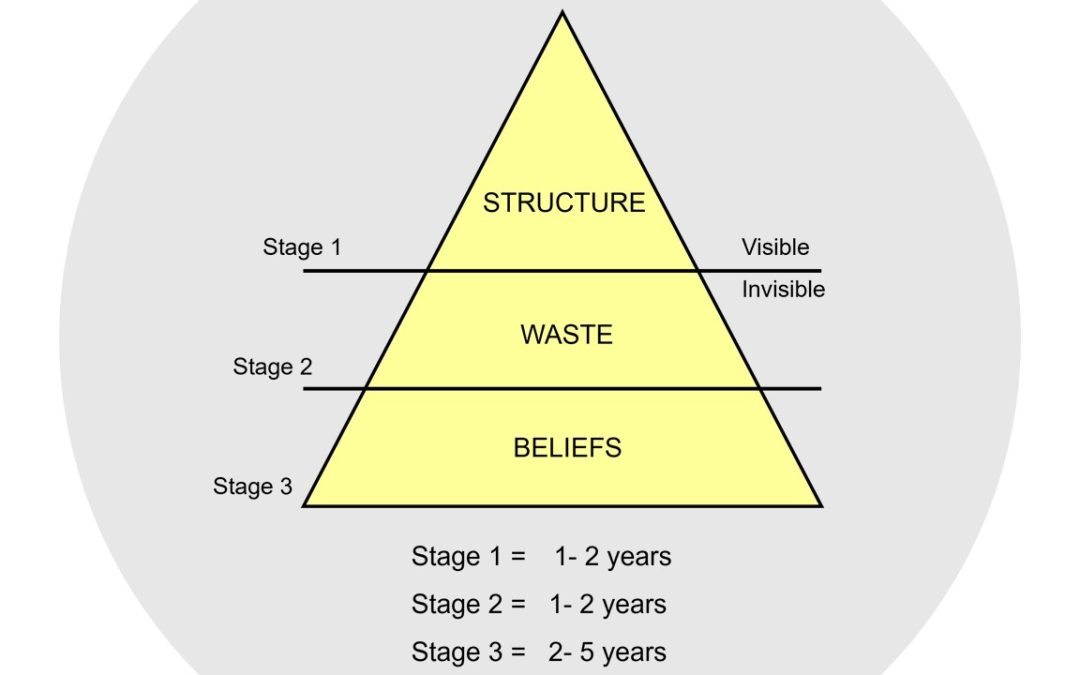
The 3 Stages are illustrated in the diagram below.

Stage 1: Structure Most people are aware the first stage in a business improvement process is to get the business structure right. The right structure means the right customers, the right products, the right prices, the right processes and the right people.
The Structure involves dealing with the “visible” elements of the business. We dont usually look for the hidden wastes, costs and drivers at the structural level. involves dealing with the “visible” elements of the business. We don’t usually look for the hidden wastes, costs and drivers at the structural level. involves dealing with the “visible” elements of the business. We don’t usually look for the hidden wastes, costs and drivers at the structural level. involves dealing with the “visible” elements of the business. We don’t usually look for the hidden wastes, costs and drivers at the structural level.
Most managers don’t realise that once the structure is mostly in place, they should move to Stage Two which is to get the “waste” out of the structure or improve your efficiency. They continue to keep working on structural issues!
In Stage 2 – Waste there are seven key areas of waste or inefficiency: overproduction, waiting, transport, inappropriate processing, inventory, motion and defects. We have developed processes to help you identify these wastes and inefficiencies easily and quickly. Experience indicates that waste usually accounts for 15% to 30% of your total costs. There are huge savings to be made here!!
Once both the structure and the waste (inefficiencies) are largely addressed, the biggest issue in the organisation can be addressed, Stage 3: Belief Systems of the People.
If a person believes that they are not worthy of success then they will prove themselves right. If they are an employee or family member (or you) then they will probably use your business as the vehicle to prove themselves right!
Showing a person how to develop a belief system of being worthy of success will result in them proving themselves right using, again using the organisation as a vehicle. Both the individual and the organisation wins.
It usually takes several years to work through each stage, the last stage requiring the most time.

by Russell Cummings | Aug 8, 2010 | Business Tips, Finance, Marketing, Planning, Strategy
NEAT Analysis
We have developed a simple methodology for looking at our marketing and business development options and have called it NEAT, which stands for:
- Number of Customers
- Efficiency %
- Average Sale $
- Transaction frequency
Now, N x E x A x T = Profit
You can look at NEAT from a whole business perspective or on a business unit basis, if required. It is usually done on an annual basis.
Number of Customers simply stands for the number of Active Customers in your business. In most businesses active customers will be those that have purchased off you in the last year or two. In high turnover businesses , eg. NewsAgents, active customers could be those that have purchased off you in the last 3 months. In the building industry, it could be people that have purchased off you in the last 5 to 10 years.
In any case, count or estimate the number of active customers in your business. You can usually get this information from your bookkeeping systems although in a retail environment this maybe difficult, so estimate the number.
Efficiency is usually measured as Net Profit/Sales and expressed as a percentage. For example: if you make $100,000 Net profit on $500,000 worth of sales then your E is 20%.
Average Sale. This is an important measure because it looks at the average $ spend per sale. To determine what this is, look to your records eg. bookkeeping systems or cash registers. From a bookkeeping system, simply divide the Total Sales by the number of Invoices and cash sales. From your cash register, record the total sales $ for a period and count up the number of actual sales in the same period and divide. So how much are your customers currently spending each time they do business with you?
Transaction Frequency. Quite simply, how many times do your customers buy from you in a year? To work this out divide the number of invoices or sales calculated above by the number of active Customers. If you are in a high frequency business, this could be a number between 50 and 100 (once or twice a week) or a low frequency business eg. building this transaction figure could be 0.1 (once every 10 years).
Working out the NEAT Values for your Business
As mentioned above, multiplying your NEAT components together should give you a measure of your profit. If we break down the basic components we can see the components of sales and efficiency.
N x E x A x T = Profit
(N x A x T) x E% = Profit
Sales x Efficiency% = Profit
( Customers x Sales x Transactions) x Efficiency % = Profit ( 1 Transaction Customers )
Now, complete the calculation using the figures for your business: For example: if we have: 200 customers, sales of $1,000,000pa.; Net Profit Margin of 15% of sales; 5,000 invoices (transactions) per annum, then your NEAT calculation would look as follows:
N = 200 Active Customers
A = Average Sale
= Sales/Transactions = 1,000,000/5,000 = $200/ Sale
T = Transaction Frequency = Transactions/Customers
= 5,000/200 = 25 per Customer per annum
E % = Efficiency % = 15%
Check that: N x A x T = Total Sales (200 x $200 x 25 = $1,000,000)
Check that: Sales x E% = Profit ($1,000,000 x 15% = $150,000)
This is all very interesting but how do I use it?
Once you have your NEAT components, you can start to analyse your business. There are 6 easy steps:
Step #1: Start with N (Customers). How many active Customers do we have? What proportion of our total customer list are active? For example: if we have 1,000 Customers on file over the last 10 years, but only 200 are active then only 20% of our Customers are active. How can we rejuvenate the 80%? How can we attract more Customers? How do we stop the “churn” in Customers? How many of our active customers are “A Class” customers? How many are “C Class”? How will you find more A Class? Brainstorm your actions and look at the impact you could have on N. Write down the new N number.
Step #2: Improve Efficiency %. Efficiency % is calculated by profit over sales. The difference between sales and profit is composed of costs. What can we do to reduce our costs? How can we become more efficient? How can we reduce our Variable Costs? What can we do about overheads and finance costs? How does your business compare with other businesses in the same industry? Brainstorm your options and calculate the impact these will have on your efficiency %. Write this number down.
Step #3: Increase Average Sale. Look at your average sale. How does this compare with what you thought your average sale was? Most businesses over-estimate their average sale figure. How can we improve this figure? Look at adjusting your pricing? What would have to change about your goods and services for you to command a higher price? How can you package products and services to add value? How can you up-sell to better quality, higher margin goods? Can you cross-sell and introduce additional items with the sale (eg. “Do you want fries with your order?”)? Brainstorm your options and estimate your new average sale figure. Write this down.
Step #4: Increase your Transaction Frequency. How can you increase the number of times your customers will buy from you in a given period? How can you bring them back to your business on a more frequent basis? How can you keep in contact with your clients? Do you have a contact program? Why not – it is the most effective way to ensure that you are in contact with your customer base? Do you collect contact details? Do you have a loyalty program? Again, write down your options and estimate the impact on the number of transactions.
Step #5: Calculate your new NEAT. Simply multiply your new N x E x A x T to get an estimate of your potential new profit. How does it compare to your current profit levels? Is it worth an investment of time and resources to grow to this level?
Step #6: Prioritise and Action Plan. Given that most business have limited resources of capital and labour, you won’t be able to do everything on your NEAT lists. What are the 3 most important things that you need to do based on the NEAT Analysis? Select the 3 that will have the biggest impact and develop action plans to implement the solutions.
Next Steps
Do the NEAT Analysis This is simple to do. Even if you don’t have accurate figures use the NEAT concept as a basis for improving your figures.
Develop a Contact Program for your Customers and prospects as a matter of priority. This is an essential tool for any business and usually has a very quick payback period and develops long term relationships with your customers.
Contact your MindShop facilitator if you need to ask any questions or need some assistance in developing a NEAT view of your business.

by Russell Cummings | Aug 7, 2010 | Business Tips, Marketing, Planning, Strategy
What is Marketing?
Marketing is a term used to define a whole range of functions within a business and is expressed in a whole range of contexts. So exactly what is marketing?
If we pare back the rhetoric, marketing is simply the strategies we employ to move our products/services from us to the client profitably. Marketing is the process of converting prospects to customers.
It is much more than just advertising and promotion. Marketing also includes: understanding who is your target market; what is your competitive advantage; what are your product, pricing and distribution strategies as well as promotion & advertising. It is the combination of these factors that determines the effectiveness of your marketing programs.
If we think in these terms it becomes obvious we need to review and expand effort into these strategies during tough times.
The Sales Conveyor Belt
In order to survive we must maintain momentum with our sales. Think of the sales effort as a long conveyor belt of “prospects” being loaded one end and sales unloading (completed) at the other. There are some losses along the way so that not every prospect becomes a customer.
The more raw material (prospects) we can load the more opportunity we have to create sales. In some cases the more prospects being delivered the more selective we can be about whom we want to convert into a sale.
If we stop loading the conveyor belt with prospects, even for a short period, how long must we wait before the next batch are loaded and arrive to us ready for conversion into sales?
It will vary greatly from one type of industry to another however the research is clear and cites five times as the average number of contacts that need to be made with a prospect before they are likely to be getting close to conversion. And this figure relates to prospects who actually need the service anyway!
A prospect is quick to say “No!” which to the seasoned sales person actually means “not yet”. The industry averages are that the average sales person stops selling after 2 “No’s” and the average customer will buy after 5 offers or contacts.
So the loading of the conveyor must go on, especially in tough times.
This however can be difficult when profit and cash flow figures are constantly moving our focus toward expenditure reductions rather than expansion. This environment provides us the opportunity of being creative with our strategies to maintain volume prospects and therefore sales conversions in tough times.
How diverse is your promotions strategy?
Advertising is expensive and alone is not the most efficient way to secure prospects. So where can we boost our promotional or prospect gathering efforts without necessarily increasing expenditure?
Rule one in business, and therefore marketing, is to attack with an integrated plan.
This means that any promotional activity you plan must leverage off another. For example if you intend running an industry seminar as a means of adding value to your customers while raising your company profile, what support activities will you engage to maximise the effect? Advertising, direct mail, press releases? What will be the next major activity you will use to leverage off the success of the seminar?
Develop a Contract Program
Even a simple contact program woven into your promotional plan will greatly assist in maintaining volume onto the conveyor.
What is a contact program? It is a simple system for maintaining the profile of your company in the mind of the client and prospect. There are 5 simple steps to creating a contact program:
Group your customers into A, B, and C class customers by defining the characteristics that make a great customer and scoring each customer against this criteria. It might include: Spending level, fit with your strategic direction, fit with your Company culture, length of relationship, potential for growth in sales, etc. A Class are your very best customers and is where you should be focusing your internal marketing efforts.
List all the potential contact activities that you could have including: visits, phone calls, mailings, newsletters, special offers, etc.
For each Customer class decide what level of contact you will have for each activity. For example: All customers will get your newsletter. A Class customers will get a visit once per annum. B Class customers will get a Customer Service call once per annum. Only A & B Class customers will get access to special offers. A Class customers will get invited to a special event at your business.
Check that you have met the 90-Day rule. This is a basic business rule that says that each contact needs to be contacted every 90 days at a minimum.
Letting contact lapse later than 90 days will mean that you will disappear from your customers conscious thought. This is a basic rule that should never be broken. At a minimum maintain the 90 day rule with your A class customers.
Systematise your contact program. Lock it into your annual program and plan ahead for items like newsletters, offers and special events.
How do I create a contact system?
You can buy all sorts of Contact Management Software or it might be as simple as creating a client/prospect card with that persons details. By creating a 1 to 12 file each card can be filed according to the month of their next contact. Make sure you record all details and that you set up systems to collect Customer details in your business.
Because you have recorded the type of contact made previously you can easily pickup on what was discussed or send something that hits to previous conversations. This way you are adding value to the client while achieving your goal.
Your type of contact can be as diverse as your imagination and might include such things as birthday cards, industry stats, tender opportunities, client referrals.
Once a contact is made you nominate the time ahead for the next contact and simply file the card into that month.
Every month you can select the cards from the corresponding month and make contact. Its that simple. It can be useful to start a collection of information and ideas that can be used as part of your contact program.
Of course technology allows you speed up this process however for me the manual system is great as my 1 12 card box with Contact Program emblazoned across the front sits on my desk staring at me so I dont forget the importance of continually loading the conveyor.
If you would like to investigate some of the software options for Contact Management or CRM (Customer Relationship Management) then some of the more popular software titles are: ACT!2000, MAUS CRM, and Maximiser.
Conclusions
Marketing is as diverse as the many definition surrounding it suffice to say that no sales equals no business so think creatively about ways to boost your efforts in tough times.
Tough economic times provide the opportunity for the focused to put distance between themselves and their competition. Revisit your strategic plan, crank up your promotional effort and get that conveyor humming with prospects.
by Ross Holding
Next Steps
- Review your Marketing. Convert it to a one Page plan so that you can manage it effectively.
- Develop a Marketing. If you don’t have a Marketing Plan (or you really need to give it a “big rework”) – Develop a plan now! Don’t wait until its too late! Our on-line Marketing & Sales Training program will help you develop and apply a marketing plan to your business in less than 8 weeks. Click here for more information. Alternatively, contact your MindShop Coach.
- Develop a Contact Program to keep feeding your Sales conveyor. This is a relatively simple task. Contact your Mindshop Facilitator for more information or enrol in our on-line Marketing & Sales Training Program.

by Russell Cummings | Jun 1, 2010 | Planning, Strategy
Panic now and avoid the rush!
With a pending meltdown of the global financial system, a looming global recession, fuel and interest rate pressures and the day-to-day worries of managing a business – it’s no wonder that a whole heap of people are opting to bury their head in the sand and not look at the potential options and strategies for competing in this environment.
Most people will only start to think strategically about these issues when the pressure is really on – and its often too late.
My advice – panic now and avoid the rush!
Plan now and look for the opportunities and minimize the downturns.
I have approached this issue from 3 perspectives, which are outlined in the sections below:
The Perfect Storm
Understand the Impacts
Develop your responses
The Perfect Storm
Recent developments in the global economy have emerged like a scene from the Hollywood movie “The Perfect Storm”, where many businesses are finding the current economic conditions difficult whilst at the same time others are thriving.
We have had the confluence of a number of events that have led the world towards a global recession. This has been headlined by the worst elements of capitalism: greed, poor financial controls, flawed strategy and lousy decision making.
The bad news is that the impacts are already on their way and the extent to which your business will be impacted will vary widely. I believe that we can expect volatility and uncertainty to be the flavours of the day, especially until the financial and credit markets settle down again. The challenge will be to make sure that you can deal with these challenges.
The good news is that times of fundamental change also produce fantastic opportunities for those that are in position to capitalize on them.
You will have competitors that will not emerge from the storm or who will fail to adjust their strategies and give up valuable market share. There will be good quality employees on the market and, you will have the opportunity to divest yourself of poorly performing staff, products and customers.
So, what can we learn from this, even at this early stage and how will it impact your business?
Start Now
First, bite the bullet and start making plans now.
It is far easier to think clearly and objectively about potentially stressful situations in advance, than it is to make rational decisions while you’re in the midst of the storm – where you will be highly reactive and prone to making on the spot calls that may not be the best option.
The initial step is to make sure that you understand the impacts of globalisation on your business THEN determine the strategies that you can employ to optimise your success in this period of change.
Globalism requires a new paradigm
If nothing else, the current crisis has clearly underlined the global nature of our economy. We are now, more than ever, influenced by the actions and reactions of our international partners. The flow-on effects of the sub-prime mortgage fallout in the United States has swept Europe, Asia, Australia and the Pacific.
It is therefore, critical to understand how your business fits into the global economy. Even if you have no direct trade at a global level, there is a good chance that many of your customers and/or suppliers will be impacted.
Even if the direct global impacts on your business are slight, the indirect impacts via changes in the national economy can be immense – decreases in consumer spending, reduced government spending, higher interest rates, higher unemployment, rising fuel and input costs can all have an impact.
Knowing the extent of your “global exposure” is critical as global changes can change demand for your products from customers and/or increases in input costs from suppliers. This can make your business uncompetitive overnight by driving down revenue and lifting costs.
The good news is that some businesses will be largely unaffected by the changing economic environment. If your business is one of these, what strategies will you employ to take advantage of your position?
Key Questions to ask: What will be the impact on our customers and/or suppliers of a change in the global economy? How will this impact our business?
For 2 models (there are others) that may help you in your analysis, you can use PEST Analysis to summarise the overall impacts on your immediate business environment. (Note: PEST is an acronym that stands for Political, Economic, Social & Technological areas.
Then I would summarise the potential impacts on your business by summarising your thoughts under the following topics: Customers, People, Products (and Services), Prices & Profits, Processes.
Once you have completed this initial analysis – start developing some strategies.
What is your strategy, again? Or You’re selling “what”?
One of the key problems with this current financial crisis is that much of the problem has been created because of flawed strategies.
For example: one of the first regional banks to crash in the USA had made a “killing” by providing 30 year mortgages to owners of trailer homes. The challenge was that trailer homes are typically worth very little of their purchase price after 10 years, and all was rosy until owners started to default on trailer home loans and there was insufficient equity to cover off the large amount of principal left to repay. The resulting snowball effect eventually brought down the bank and several of its regional associates.
Now anyone with even a small amount of common sense could’ve seen that taking a 30 year loan on an asset with a 10 year life was a very risky business and was a flawed strategy in all but the very shortest timeframes.
Too many businesses have similarly flawed strategies for growth or even worse – no strategy. There are a great number of businesses (way too many, in fact) that just keep on doing what they have always done without rhyme nor reason. There is no talk of: business models, marketing strategies, product strategies, pricing strategies. These businesses are essentially reactive, not proactive, to the business environment. They are the “price cutters”, the “layoff kings” and have variable quality and service. We all have competitors (not our businesses, of course!) who fit this description.
The majority of your competitors will see cutting prices (and service) and reducing staff numbers as their only options. These strategies fail to differentiate your business in the market and are largely unsustainable in the medium term. The trick is to have a clear strategy that focuses on building a business model that grows customer value, optimises price points and creates a strong competitive advantage for your business.
If the profitability of your business is under pressure from global recession – what are the strategies that you will employ to emerge from the storm? To use the nautical analogy again (I’m sorry!), “battening down the hatches” will probably not be enough to survive. You will also need to chart a different course (or strategy).
In an increasingly competitive market, there are a number of strategic decisions that you can take to position your business for success. These strategies are outlined in more detail in our webinar presentation “The Perfect Storm” – click here to view this 25 minute webinar (all you need is a computer with broadband access and sound)
Developing a strategy – The key areas to focus on
In developing your strategy for the Perfect Storm, the key areas to focus on are:
Cashflow – this is the lifeblood of your business. Ensure that you have tightened the ship and have sufficient cash buffers to ride out the storm. Look to sales, costs, inventory, debtors and creditors to maximize your cashflow. Tighten financial controls.
Retain your key staff – Ensure that you retain your key staff by looking to job satisfaction, performance management and reward systems in order to do this. Look closely at the real cost of staff turnover in your business and take steps to address the key issues.
Retain your key customers – one of the keys to business success is customer (or client) selection. Take the time to determine the customers that you want to keep working with and what strategies you can employ to retain the in a highly competitive environment. Now is the time to ramp up your training, management and systems in your sales team. This is also a great time to look for new business.
Productivity Improvement – if we are to remain competitive, we can’t just cut prices (if this is your plan – think again, as this is a lazy strategy that does little to differentiate your business) and reduce costs. We need to lift productivity by increasing output at the same cost structure. Applying Lean production techniques to your business is a proven methodology for driving down costs per unit – increased productivity.
Personal Energy – changing times require additional inputs from management. Make sure that you manage your personal energy so that you are in a position to make quality decisions. Regular breaks, delegation and support are important elements. Make sure that you have a good support network.
I obviously believe that engaging an experienced, business consultant (or coach), who is an objective sounding board and who has a depth of experience and strong tools and processes, is an important element of your survival strategy and should provide you with an outstanding ROI. However, you may decide to enlist the services of an external mentor or other professional (accountant, lawyer, adviser) to assist. Either way, I believe that appropriate support will be critical.
If you would like to explore this option further, I am more than happy to spend some time talking with you about we support business owners in any location, using tools like VOIP, GotoMeeting and web-based resources, to ensure that you develop sound strategies and more importantly – implement them . I currently support over 50 businesses across Australia and New Zealand (and until recently the UK) using these resources and methodologies. To discuss these options email me, skype me (russell.cummings) or call 0414 929 585
Ultimately, these 5 areas are areas that you should be focused on irrespective of whether the economy is in disarray, so any planning and thinking that you do here will not be wasted. Just make sure that you do it.
Do it NOW – not tomorrow. Like Nike say “Just do it” –NOW!
Take the time to plan your response – NOW
There is no time like the present for you to sit down and develop your plan to survive the Perfect Storm. It is far easier to think clearly and objectively now than it will be to do this when the pressure is on.
Step 1 Understand the impacts of the changing economy on your business – PEST Analysis, Business Analysis
Step 2 Watch the webinar – click here
Step 3 Develop a One Page Plan – “The Perfect Storm Plan” – for your business. You may need to cascade the plan so that you have individual 1 page plans for different elements of your plan.
Step 4 Get some objective, experienced assistance to develop and review your plans so that you are not building your future on a flawed strategies.
The current economic environment will full of opportunities for those that are well positioned to take advantage of them as they emerge. Good positioning requires planning and strategy to ensure that you are in the “right place” with appropriate resources and support.
I wish you all the best.
Regards
Russell Cummings
