When most people hear the word waste, they picture overflowing bins, scrap materials or excess inventory. In Lean thinking, waste is something much broader.
Waste is anything that consumes time, money or effort without creating value for the customer.
That definition changes everything. Because waste exists in every organisation.
It exists in factories. It exists in offices. It exists in hospitals. It exists in professional services firms. It exists in government departments. It even exists in businesses that believe they’re already highly efficient.
The challenge isn’t whether waste exists. The challenge is whether leaders can see it.
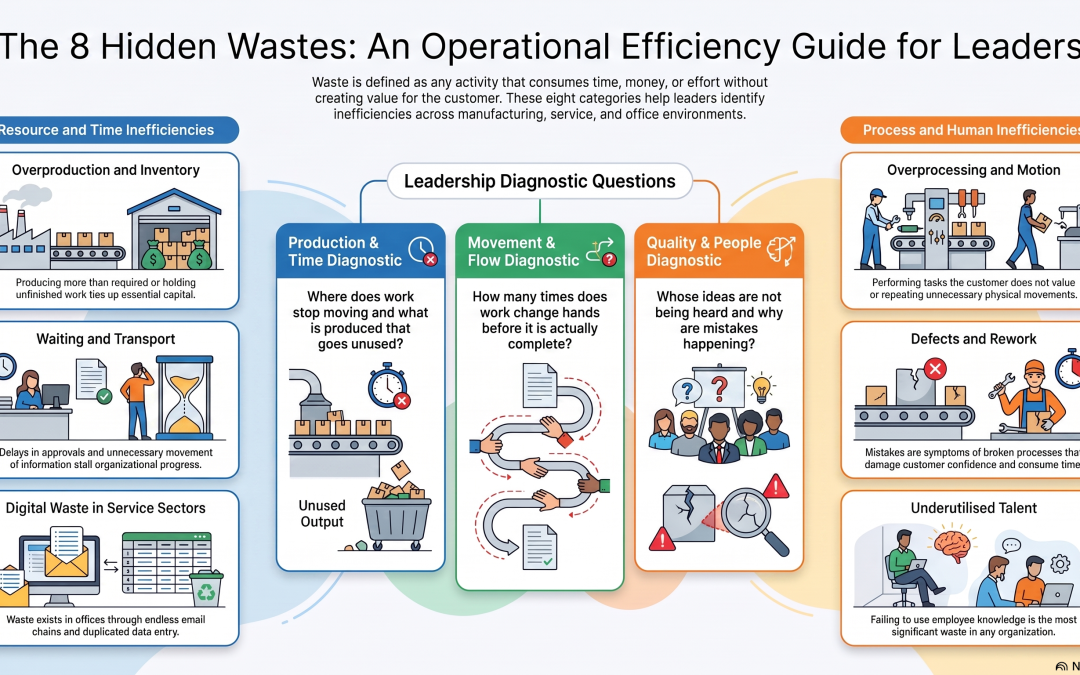
Toyota developed a simple framework known as the Eight Wastes to help organisations identify activities that consume resources without adding value. More than 70 years later, these eight categories remain one of the most powerful tools for improving productivity, profitability and customer experience.
The surprising part? Once you learn to recognise them, you’ll begin seeing them everywhere.
Why Waste Is So Difficult to See
Waste rarely arrives as a major crisis. Instead, it creeps into everyday work.
A five-minute delay. An unnecessary approval. A report nobody reads. A meeting without decisions.
One small frustration seems insignificant. Multiply it by every employee, every day, and the impact becomes enormous.
Businesses often accept these inefficiencies because “that’s the way we’ve always done it.”
Lean challenges that assumption. Every process should earn its place.
Waste #1 – Overproduction
Creating more than the customer needs—or producing it before it’s required.
Manufacturing examples are obvious.
Producing inventory that sits in storage ties up cash and creates additional handling costs.
But overproduction is just as common in offices.
Examples include:
● Preparing reports no one reads.
● Creating presentations “just in case.”
● Producing detailed proposals before understanding client requirements.
● Building features customers never requested.
More isn’t always better.
Producing exactly what is needed, when it is needed, creates greater value with fewer resources.
Leadership Question:
What work are we producing that nobody actually uses?
Waste #2 – Waiting
Waiting is one of the biggest hidden productivity killers.
People waiting. Customers waiting. Projects waiting. Decisions waiting. Every delay slows the entire system.
Examples include:
● Waiting for management approval.
● Delays between departments.
● Equipment downtime.
● Waiting for information from another team.
● Customers waiting for responses.
While no one appears busy during waiting time, the organisation is still paying for it.
Reducing waiting often produces some of the fastest improvements in customer satisfaction.
Leadership Question:
Where does work stop moving?
Waste #3 – Transport
Every unnecessary movement of materials, information or work creates additional cost.
In manufacturing, this might involve moving products across multiple warehouses.
In service businesses, transport often becomes digital.
Examples include:
● Endless email chains.
● Multiple handovers between departments.
● Documents transferred between different systems.
● Information entered repeatedly into separate software platforms.
Every transfer introduces delay and increases the likelihood of mistakes.
The smoother the flow, the better the performance.
Leadership Question:
How many times does work change hands before it’s complete?
Waste #4 – Overprocessing
Doing more work than the customer actually values.
Many businesses mistake complexity for quality.
Examples include:
● Requiring multiple approvals for routine decisions.
● Producing lengthy reports where a dashboard would suffice.
● Collecting information that is never used.
● Entering identical data into multiple systems.
● Excessive documentation created to satisfy internal habits rather than customer needs.
Customers rarely pay for unnecessary complexity. They value outcomes.
Lean encourages businesses to simplify wherever possible.
Leadership Question:
If we started this process today, would we design it this way?
Waste #5 – Inventory
Inventory isn’t limited to warehouses. Any unfinished work represents inventory.
Examples include:
● Unanswered emails.
● Projects waiting to begin.
● Sales proposals sitting in draft form.
● Customer enquiries waiting for allocation.
● Large queues of work between departments.
Inventory hides problems. It masks bottlenecks. It delays feedback.
Reducing work in progress helps businesses respond faster and identify issues sooner.
Leadership Question:
Where is work piling up?
Waste #6 – Motion
Motion refers to unnecessary movement by people.
Unlike transport, which focuses on moving work, motion concerns how people perform their tasks.
Examples include:
● Searching for documents.
● Walking between poorly organised workstations.
● Switching constantly between software applications.
● Looking for tools or equipment.
● Repeating manual administrative tasks.
Every interruption reduces concentration and increases fatigue.
Well-designed workplaces make the right way the easiest way.
Leadership Question:
What unnecessary effort does our team repeat every day?
Waste #7 – Defects
Mistakes are expensive.
Not only because they require correction, but because they damage customer confidence and consume valuable time.
Examples include:
● Incorrect invoices.
● Quotation errors.
● Data entry mistakes.
● Product defects.
● Poor communication requiring clarification.
● Rework caused by incomplete instructions.
Most defects are symptoms of broken processes rather than careless people.
Lean asks leaders to improve the system instead of blaming individuals.
The goal isn’t perfection. The goal is designing processes where mistakes become less likely.
Leadership Question:
Why are these mistakes happening—not who made them?
Waste #8 – Underutilised Talent
This is often considered the most significant waste because it limits every other improvement.
Businesses hire capable people, then fail to use their knowledge.
Employees frequently know:
● where customers become frustrated
● which systems waste time
● what processes could be simplified
● which approvals add no value
Yet many organisations never ask. Or worse, they ask but never act.
Continuous improvement depends on involving the people closest to the work.
Their experience is one of the organisation’s greatest competitive advantages.
Leadership Question:
Whose ideas aren’t we hearing?
Waste Exists Beyond Manufacturing
One reason Lean continues to gain popularity is its universal application.
Consider these examples.
Professional Services
● Preparing proposals clients never request.
● Waiting for partner approval.
● Re-entering client information.
● Excessive reporting.
● Rework after unclear client briefs.
Construction
● Trades waiting for materials.
● Equipment standing idle.
● Design changes causing rework.
● Poor coordination between contractors.
● Excess inventory stored on site.
Healthcare
● Patients waiting for appointments.
● Duplicate paperwork.
● Delayed test results.
● Medication errors.
● Multiple handovers between departments.
Retail
● Overstocked shelves.
● Long checkout queues.
● Incorrect pricing.
● Manual stock counts.
● Staff spending time searching for products.
Different industries. The same categories of waste.
Learning to See Waste
One of the greatest lessons from Toyota is that improvement begins with observation.
Most leaders spend their time reviewing reports. Lean encourages something different.
Go where the work happens. Watch. Ask questions. Remain curious. Observe without judgement.
You will quickly discover opportunities that never appear on dashboards.
Seeing waste is a skill. Like any skill, it improves with practice.
Start Small
Many businesses believe they need a major transformation program before they can improve.
In reality, meaningful progress often begins with one small observation.
One unnecessary approval. One duplicated task. One delay. One repeated
Remove one source of waste today. Tomorrow, remove another.
Small improvements accumulate into significant competitive advantage. That’s the power of continuous improvement.
Final Thoughts
Waste is rarely dramatic. It’s usually hidden inside everyday routines that have become accepted over time.
The organisations that outperform their competitors aren’t necessarily working harder. They’re simply better at recognising and removing activities that don’t create value.
When leaders learn to see waste, they also learn to see opportunity.
Opportunity to improve customer experience. Opportunity to reduce frustration. Opportunity to increase productivity. Opportunity to build a business that performs better every single day.
The eight wastes aren’t just a Lean framework. They’re a different way of seeing your business.
And once you start seeing them, it’s impossible to look away.
Ready to Learn How to Spot Waste Like a Lean Leader?
Join our upcoming Lean Bootcamp Training Course and discover practical techniques for identifying hidden waste, improving business processes and creating a culture of continuous improvement.
You’ll leave with simple tools you can apply immediately—whether you lead a manufacturing business, professional services firm, construction company or growing SME.
Walk into almost any organisation and you’ll find evidence of improvement initiatives.
A Lean project from two years ago. A Continuous Improvement committee that no longer meets. A collection of process maps sitting untouched on a shared drive. A wall covered with sticky notes from a workshop everyone has forgotten.
The intention was good. The results rarely lasted.
According to numerous industry studies, the majority of Lean transformations either stall or fail to deliver sustainable improvements. Not because Lean doesn’t work, but because organisations misunderstand what makes it successful.
Too many businesses treat Lean as a collection of tools. The best businesses treat it as a leadership system. That difference changes everything.
Lean Doesn’t Fail. Implementations Do.
When leaders say, “We tried Lean and it didn’t work,” they’re usually describing something very different from Lean itself.
Perhaps they introduced 5S into the warehouse. Perhaps they ran a Kaizen event. Perhaps consultants redesigned several processes.
These activities may improve isolated areas, but they don’t necessarily change how the organisation thinks or operates.
Lean was never intended to be a short-term project.
It is a management philosophy built around creating value, eliminating waste and continuously improving how work is performed.
When organisations focus only on the tools, they miss the philosophy that makes those tools effective.
Mistake 1: Treating Lean as a Cost-Cutting Exercise
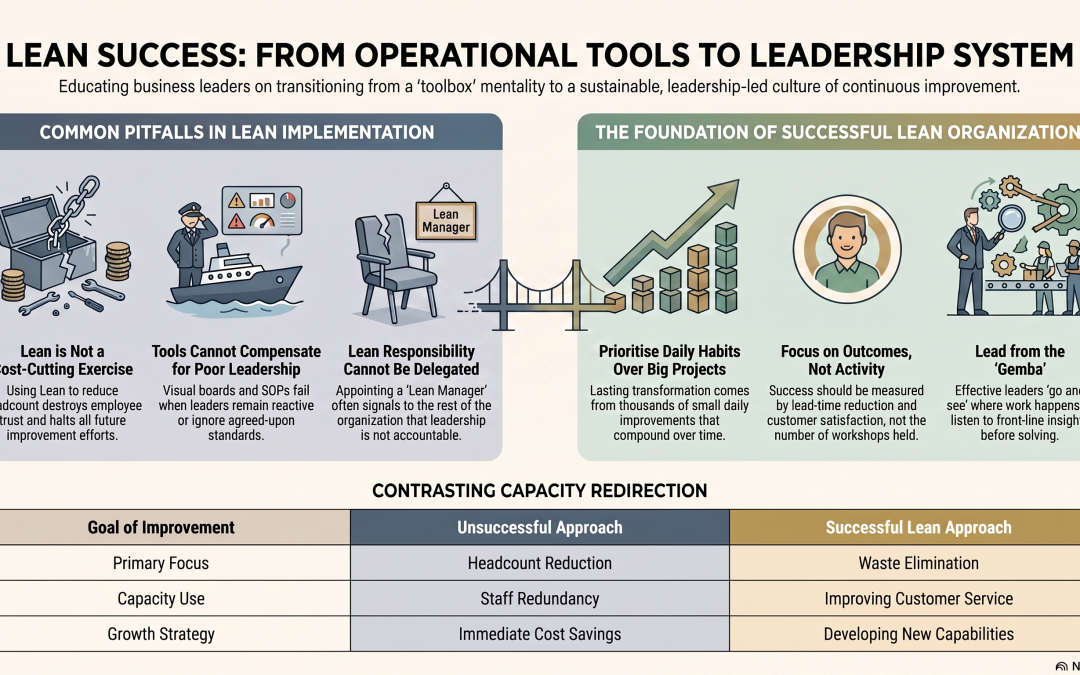
One of the quickest ways to lose employee support is to present Lean as a way to reduce headcount.
People quickly learn an unfortunate lesson.
“If I improve my job, I might eliminate my own position.”
When that belief takes hold, improvement stops.
Successful organisations position Lean very differently.
Their objective is to remove waste, not people.
The capacity created through better processes is redirected towards:
• improving customer service
• increasing output
• reducing lead times
• supporting growth
• developing new capabilities
Employees become partners in improvement rather than victims of it.
Mistake 2: Expecting Tools to Solve Leadership Problems
Many Lean implementations begin with training.
Teams learn about visual management. They explore Value Stream Mapping. They create Standard Operating Procedures.
These are valuable tools. But they cannot compensate for poor leadership.
If priorities constantly change… If managers ignore agreed standards… If leaders spend every day reacting to crises… No Lean tool will fix the underlying culture.
Lean starts with leadership behaviours long before it reaches improvement tools.
Mistake 3: Delegating Lean to Someone Else
Many organisations appoint a Lean Manager and assume the work is done. Unfortunately, this sends an unintended message.
“Lean is their responsibility.”
Successful businesses understand something different. Lean is everyone’s responsibility, but leadership owns the culture. The CEO cannot outsource continuous improvement. Managers cannot delegate accountability for better processes.
The most successful Lean organisations have leaders who actively participate in improvement activities, ask questions, remove barriers and model the behaviours they expect from others.
Mistake 4: Chasing Big Projects Instead of Daily Improvement
Large transformation programs often generate excitement. They also generate complexity.
Months of planning. Consultants. Workshops. Reports. Project teams.
Meanwhile, dozens of smaller opportunities remain untouched.
Toyota became famous not because of occasional breakthrough projects but because thousands of small improvements occurred every year.
Continuous improvement compounds. Fixing one small frustration each day may appear insignificant. Across an entire organisation, it becomes transformational.
The businesses that improve consistently don’t wait for major change initiatives. They improve
every day.
Mistake 5: Ignoring the Front Line
Senior leaders often believe they understand where problems exist. Sometimes they do.
More often, the people performing the work have a much clearer view.
They know:
• where delays occur
• which systems create frustration
• what customers complain about
• where rework happens
• which approvals create bottlenecks
Successful Lean organisations spend time listening before they start solving.
The Japanese concept of Gemba encourages leaders to “go and see” the work where it actually happens.
Real improvement begins with observation rather than assumption.
Mistake 6: Measuring Activity Instead of Outcomes
Many organisations proudly report:
• number of improvement ideas submitted
• workshops completed
• people trained
• projects launched
While these measures indicate effort, they don’t necessarily demonstrate value.
Successful organisations focus on outcomes.
• Has customer satisfaction improved?
• Has lead time reduced?
• Have defects decreased?
• Has productivity increased?
• Has work become easier for employees?
Improvement should always be visible in business performance, not simply in project statistics.
What Successful Businesses Do Differently
High-performing Lean organisations share several common characteristics.
They Lead with Purpose
Everyone understands why improvement matters. It’s connected to customer value, business performance and organisational strategy—not simply operational efficiency.
They Build Stability First
Before chasing optimisation, they establish consistent processes. Stable processes make problems visible. Unstable processes hide them. Consistency creates the foundation for continuous improvement.
They Develop Problem Solvers
Instead of managers solving every issue, employees are taught structured problem-solving techniques.
People closest to the work become confident identifying root causes and implementing practical improvements. Capability grows throughout the organisation.
They Create Daily Improvement Habits
Continuous improvement isn’t reserved for quarterly workshops. It’s embedded into daily management.
Short team meetings. Visual performance boards. Regular reviews. Small experiments. Ongoing learning. Improvement becomes part of normal work rather than an additional task.
They Never Stop Learning
The best Lean organisations remain curious.
Every mistake becomes a lesson. Every success becomes a new standard. Every process can still improve.
Perfection may never be achieved, but the pursuit of it drives extraordinary performance.
Lean Is a Leadership System
One of the biggest misconceptions about Lean is that it’s an operational methodology. In reality, it is a leadership system.
Without leadership commitment, Lean becomes another improvement program.
With leadership commitment, Lean becomes the way the organisation thinks.
That distinction determines whether improvement lasts for months or decades.
Five Questions Every Leader Should Ask
Before launching another improvement initiative, consider these questions.
1. Are we trying to improve processes or simply reduce costs?
The objective matters because it influences every decision that follows.
2. Are our leaders modelling continuous improvement?
Employees observe behaviour far more closely than they listen to presentations.
3. Do our people feel safe identifying problems?
If raising issues attracts criticism, problems remain hidden.
4. Are we solving root causes or repeatedly fixing symptoms?
Recurring problems usually indicate deeper systemic issues.
5. Are improvements becoming part of everyday work?
Sustainable change happens through habits, not projects.
Final Thoughts
Lean has transformed organisations around the world for one simple reason. It works.
But only when businesses understand what Lean really is.
It’s not a toolbox. It’s not a project. It’s not a cost-cutting exercise.
It’s a leadership philosophy built around creating better systems, developing capable people and continuously improving the way work is done.
The organisations that achieve lasting success don’t ask, “Which Lean tools should we implement?”
They ask a far more important question:
“How do we build a culture where improvement becomes everyone’s responsibility?”
That’s the difference between organisations that experiment with Lean and those that build lasting competitive advantage.
Ready to Move Beyond Lean Tools?
If you’re serious about creating a culture of continuous improvement, join our upcoming Lean Bootcamp Training Course and discover why successful Lean transformations start with leadership, not tools.
You’ll learn practical frameworks for engaging your team, identifying hidden waste and embedding continuous improvement into the way your business operates every day.
Because Lean isn’t something you implement. It’s something you lead.
If I looked at your calendar, I could probably tell you a lot about your business. I’d see client meetings, project work, phone calls, staff catch-ups, supplier conversations and a steady stream of operational tasks. I’d also have a fair idea where your priorities sit because your calendar reflects what you choose to protect.
What I often don’t see is dedicated time to work on the business.
Not because business owners don’t value strategic planning. Quite the opposite. Every owner I speak with has a list of improvements they want to make. They want better systems, stronger marketing, more consistent sales, clearer processes, improved profitability, better reporting and more capable leaders.
They know these things matter. The problem is they rarely make it into the calendar, and if they do, they’re usually the first appointments to disappear when the business gets busy.
That’s understandable, but it’s also one of the biggest reasons businesses become trapped in a cycle of constant reaction. If you never make time to improve the business, you’ll spend all your time managing the consequences of not improving it.
So let me ask you a simple question.
If your business was your biggest client, would you keep cancelling the meeting?
Your Business Deserves the Same Respect as Your Best Client
Think about how you prepare for an important client meeting.
You arrive on time. You do the preparation. You give the conversation your full attention. You don’t spend the meeting replying to emails or answering unrelated phone calls because your client deserves your focus.
If something unexpected comes up, you work hard to avoid rescheduling because you know the relationship matters.
Now compare that with the appointment you’ve set aside to improve your own business.
How often does it get pushed back because a customer needs something?
How often do you answer emails “just for a minute”?
How often does a two-hour strategic planning session become twenty minutes before you’re dragged back into operations?
The message is subtle but powerful. Every time you cancel time you’ve committed to improving your business, you’re reinforcing the belief that everyone else’s priorities matter more than your own.
I’ve found that treating my own business this way has had a couple of unexpected benefits.
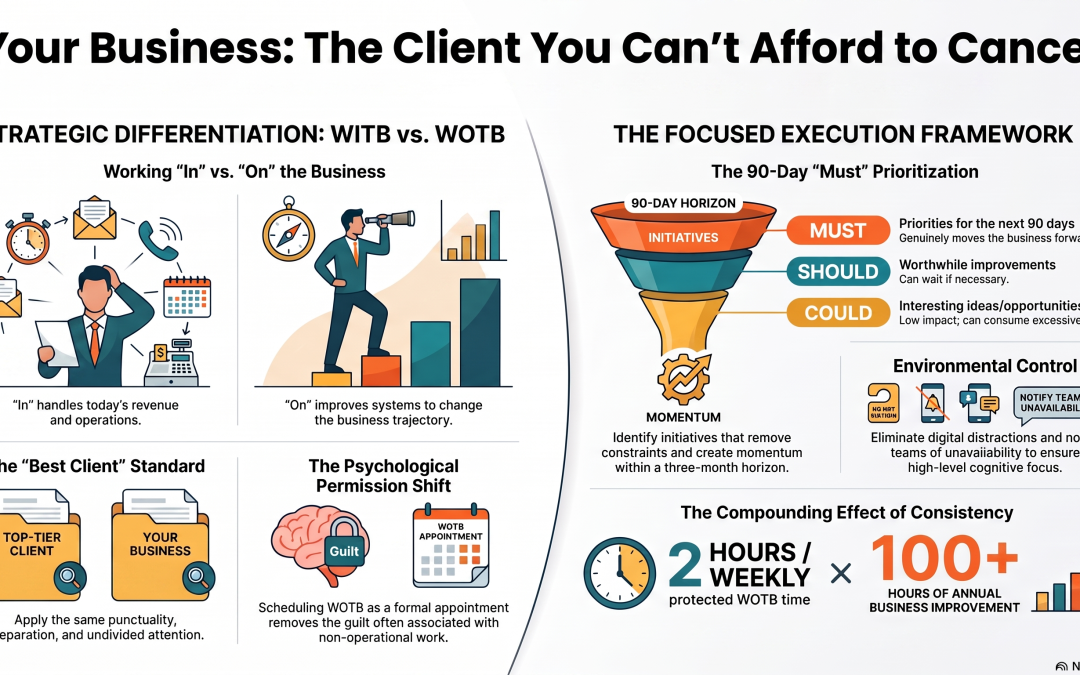
The first is psychological. By putting Work On The Business (WOTB) time in my calendar and treating it exactly like a client appointment, it gives me permission to spend time on it. It sounds simple, but it changes the way my brain sees that block of time.
Instead of feeling guilty that I’m not answering emails or responding to clients, I’m keeping an important commitment. It’s a subtle shift, but it’s incredibly powerful because it removes the feeling that strategic work is somehow less valuable than client work.
The second benefit is focus. When I’ve decided that this appointment is just as important as meeting with a client, I naturally protect it. I’m less likely to get distracted, less likely to check emails and far more likely to stay with the task until I’ve made genuine progress. That level of focus means I get better thinking, better decisions and, ultimately, better outcomes for the business.
Your business is the engine that supports your customers, your team, your family and your future. If it’s important enough to build, it’s important enough to receive your undivided attention.
Working
In the Business Isn’t the Same as Working On It
One of the biggest misconceptions in small business is that staying busy automatically means making progress.
Working in the business is essential. It’s where you deliver products and services, support customers, solve problems and generate today’s revenue. Without operational work, the business doesn’t function.
Working on the business serves a different purpose. It’s where you improve the way the business operates so that tomorrow is better than today. It’s where you refine systems, strengthen leadership, improve cash flow, review financial performance, develop new services, build your sales pipeline, document processes, invest in your people and make decisions that create long-term value.
Both are important, but only one changes the trajectory of the business.
This is why, at SHIFFT, we encourage business owners to schedule regular Work On The Business (WOTB) sessions. They’re not spare time if it happens to appear. They’re planned appointments that deserve the same level of commitment as any client meeting.
That’s what Focused Execution looks like in practice. You deliberately create space to improve the business instead of hoping you’ll find time one day.
Focus Starts with Knowing What Really Matters
Protecting time is only valuable if you’re protecting it for the right work.
Many business owners have a long list of projects they’d like to complete, but not all of those projects deserve the same attention. One of the simplest ways to create clarity is to separate your priorities into Must, Should and Could.
Your Musts are the priorities that will genuinely move the business forward over the next 90 days. They might include improving lead generation, increasing gross margin, recruiting a key team member, implementing a CRM, documenting operational processes or strengthening your pricing strategy. These are the initiatives that remove constraints and create momentum.
Your Shoulds are worthwhile improvements that can wait if necessary, while your Coulds are often the interesting ideas, opportunities or “nice to have” projects that can easily consume time without creating significant impact.
The discipline is choosing the Must before the Could.
This is one of the reasons we use a 90-day planning horizon. Looking three months ahead forces you to ask a simple question: What absolutely has to happen during the next quarter to make the business stronger?
Once those priorities are clear, your Work On The Business sessions have purpose instead of becoming another item on the to-do list.
Discipline Is Turning Intentions into Action
Knowing what matters is only the first step. The next challenge is consistently making progress. Protect your Work On The Business sessions as though they’re meetings with your best client. Once they’re in your calendar, they’re no longer optional. They become commitments you’ve made to the future of your business.
One technique I’ve found particularly useful is the Pomodoro Technique. Rather than looking at a strategic project as one large piece of work, estimate how many focused 30-minute Pomodoros it’s likely to take.
If you think reviewing your sales process will take four Pomodoros, schedule those four Pomodoros across two or three Work On The Business sessions during the week. If documenting a key process will take another four, plan those sessions before the week begins.
Breaking work into manageable blocks removes much of the resistance that comes with large projects. More importantly, it creates momentum because you’ve already decided when the work will happen.
Discipline isn’t about working longer hours. It’s about making deliberate commitments, protecting them and following through.
Control Your Environment, Not Just Your Calendar
Even the best plan won’t deliver results if you’re constantly interrupted.
When it’s time for a Work On The Business session, create an environment that allows you to think clearly. Put your phone on Do
Not Disturb. Close your email. Turn off Teams or Slack notifications. Shut down the browser tabs that tempt you into “just checking one thing”. If you’re working from the office, let your team know you’re unavailable unless it’s genuinely urgent.
Control isn’t about eliminating every interruption – that’s impossible. It’s about controlling the things you can so your attention stays exactly where it needs to be.
Focused work requires a focused environment.
Small Investments Create Significant Change
Business owners often believe they need uninterrupted days away from the office before they can think strategically. While dedicated planning days certainly have their place, lasting improvement rarely comes from occasional bursts of effort.
It comes from consistency.
Two or three hours of protected Work On The Business time each week might not feel like much, but over a year it represents more than one hundred hours invested in improving your business. Imagine what those hours could achieve if they were consistently directed towards your highest-priority improvements instead of being absorbed by reactive work.
None of those outcomes happen by accident. They happen because the owner deliberately chose to invest time in building a better business.
The Most Important Meeting in Your Calendar
Every business owner wants to serve customers well. That’s what creates revenue, builds reputation and earns loyalty.
The businesses that continue to grow, however, understand something equally important. Looking after customers and looking after the business are not competing priorities. In fact, they’re deeply connected. Every improvement you make to your systems, your people, your planning and your leadership ultimately improves the experience your customers receive.
The SHIFFT 90-Day Planning Journal was designed around this philosophy. It helps you identify your Must priorities, plan your next 90 days and create dedicated Work On The Business time that doesn’t get pushed aside by the next urgent issue. Combined with the principles of Focused Execution – Focus, Discipline and Control – it provides a practical framework for consistently moving your business forward.
So the next time you schedule Work On The Business time, don’t think of it as time away from your customers.
Think of it as one of the most valuable investments you can make for them – and for the future of your business.
Because if your business really was your biggest client, you wouldn’t keep cancelling the meeting.
Three Key Takeaways
Treat your Work On The Business (WOTB) sessions like meetings with your most important client. Protect them, prepare for them and give them your full attention.
Focus on your Must priorities first. A clear 90-day plan helps you invest your time in the activities that will make the biggest difference to your business.
Build discipline through time blocking and the Pomodoro Technique, then create control by removing distractions and protecting your environment while you work.
Ready to Start Working on Your Business?
If you’re ready to stop reacting to your business and start leading it, the SHIFFT 90-Day Planning Journal provides a practical framework to identify your priorities, schedule meaningful Work On The Business time and execute with Focus, Discipline and Control.
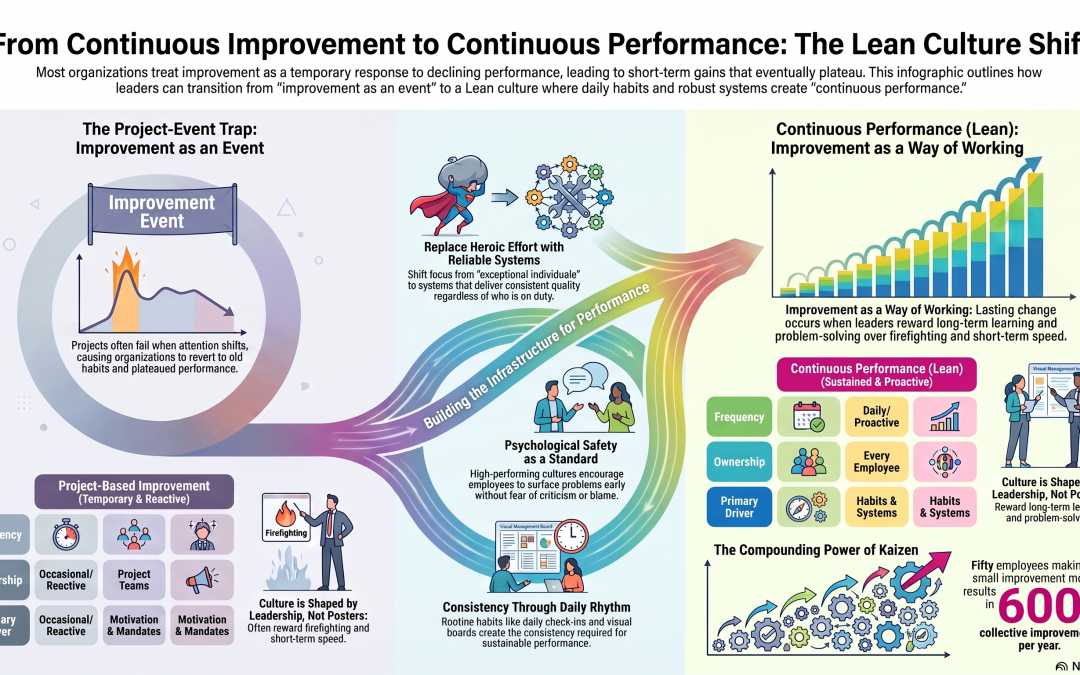
Most businesses improve. The best businesses never stop improving. There’s an important difference.
Many organisations launch improvement projects when performance declines, costs increase or customer complaints begin to rise. Teams work hard, processes are reviewed and short-term gains are achieved.
Then attention shifts elsewhere.
Six months later, many of the improvements have disappeared. Old habits return. Performance plateaus.
The cycle starts again.
This is one of the biggest challenges facing organisations today. Improvement has become an event rather than a way of working.
Lean takes a very different approach.
Rather than treating improvement as an occasional initiative, Lean builds a culture where improvement happens every day.
That is the difference between continuous improvement and continuous performance.
Why Improvement Initiatives Lose Momentum
Most improvement programs don’t fail because of poor ideas. They fail because organisations expect projects to change culture.
Projects can improve processes. Only leadership can change culture.
When an improvement initiative finishes, employees naturally return to the behaviours they are rewarded for every day.
If leaders continue rewarding speed over quality, short-term thinking over long-term learning, or firefighting over prevention, the old culture quickly reappears.
Lasting improvement isn’t created by launching another program. It is created by changing daily habits.
Culture Is Built Through Everyday Behaviour
Culture is often described as “the way we do things around here.”
In reality, culture is much more practical. It is the collection of behaviours that leaders encourage, reinforce and repeat.
If teams are encouraged to raise problems without blame, openness becomes part of the culture. If employees are recognised for identifying improvements, curiosity becomes normal. If learning is valued more than blame, people become more willing to experiment.
Culture isn’t built through posters on the wall. It’s built through thousands of everyday interactions.
Lean leaders understand this. They shape behaviour first. Performance follows.
Kaizen: Small Improvements, Big Results
One of the most recognised Lean concepts is Kaizen, which simply means continuous improvement.
Many people assume Kaizen refers to major transformation projects. It doesn’t.
Kaizen is built on a simple belief. Small improvements made consistently create extraordinary results over time.
Consider an organisation with 50 employees.
If every person identifies just one worthwhile improvement each month, that’s 600 improvements each year.
Most will be small.
Removing an unnecessary approval. Improving a customer email. Simplifying a report.
Reducing waiting time. Making information easier to find.
Individually, these changes may seem insignificant.
Collectively, they transform how the business performs.
That’s the power of compounding.
People Improve What They Help Create
One of Lean’s greatest strengths is its respect for people.
The employees performing the work every day understand where frustration exists.
They know:
• where delays occur
• which systems create unnecessary effort
• what customers complain about
• which tasks add little value
• what could be simplified
Yet many organisations rarely ask for their input. Or worse, they ask but never act on the
suggestions. Eventually, people stop offering ideas altogether.
Successful Lean organisations do the opposite. They actively involve employees in improving their own work. This creates ownership. People naturally support improvements they have helped design.
Continuous Performance Requires Daily Habits
Many organisations believe culture changes through major announcements. Lean suggests otherwise.
Culture changes through routines.
Daily team meetings. Visual performance boards. Regular coaching. Structured problem solving. Weekly reviews. Recognition of improvement ideas. These habits create rhythm.
Improvement depends on honesty. People must feel comfortable saying:
“This process doesn’t work.” “We made a mistake.” “I think there’s a better way.”
If employees fear criticism or blame, problems remain hidden. The organisation loses valuable opportunities to improve.
Lean cultures encourage respectful challenge. Mistakes become learning opportunities.
Questions become encouraged. Ideas become welcomed.
Psychological safety isn’t about lowering standards. It’s about creating an environment where people are confident enough to raise standards themselves.
Continuous Performance Is About Systems
Many organisations celebrate exceptional individuals.
The employee who saves the project. The manager who works every weekend. The leader who solves every crisis.
While these efforts deserve recognition, they often hide a deeper issue. The system still depends on heroic effort.
Lean organisations pursue something different. They build systems that deliver consistent performance regardless of who is on duty.
Reliable systems reduce variation. Reliable systems improve quality. Reliable systems reduce stress. Reliable systems allow people to perform at their best.
Sustainable performance comes from excellent systems supported by capable people. Not exhausted heroes.
Measuring What Really Matters
If culture matters, it should be measured. Not only through financial results, but through behaviours that sustain improvement.
Useful indicators include:
• employee improvement suggestions
• implementation rate of ideas
• customer satisfaction
• lead times
• first-time quality
• recurring problem frequency
• employee engagement
• process stability
These measures provide insight into whether continuous improvement is becoming continuous performance.
Five Habits of High-Performing Lean Cultures
Across industries, successful Lean organisations share common habits.
1. Improvement Happens Every Day
People don’t wait for formal projects. They improve the work in front of them.
Issues are surfaced early rather than hidden. Visibility accelerates improvement.
4. Teams Learn Together
Successes are shared. Mistakes are discussed openly. Knowledge spreads quickly.
5. Customer Value Guides Decisions
Every improvement begins with a simple question.
“Will this create greater value for the customer?”
If the answer is yes, it’s worth exploring.
Building Your Lean Culture
Creating a culture of continuous improvement doesn’t require a major transformation program.
Start with a few practical actions. Hold short daily team check-ins. Ask every employee for one improvement idea each month. Celebrate implemented ideas, not just completed projects. Investigate recurring problems instead of repeatedly fixing them. Spend time where work actually happens. Listen more than you speak. Improve one process every week.
None of these actions are revolutionary. Together, they change how an organisation thinks. And that’s how culture changes.
Final Thoughts
Continuous improvement is not the destination. It is the discipline that creates continuous performance.
Businesses that improve only when problems become obvious will always struggle to maintain momentum.
The organisations that consistently outperform their competitors have embedded improvement into everyday work.
Their leaders remain curious. Their people remain engaged. Their systems continue evolving.
Their performance keeps improving.
That’s the true promise of Lean. Not a collection of tools. Not another management initiative.
A culture where everyone, every day, looks for a better way. Because the businesses that never stop improving rarely stop growing.
Ready to Build a Culture of Continuous Improvement?
Join our upcoming Lean Bootcamp Training Course and discover how to build a culture where improvement becomes part of everyday work—not just another project.
You’ll learn practical strategies for developing engaged teams, embedding Daily Management, encouraging Kaizen and creating systems that deliver sustainable performance long after improvement initiatives have ended.
Because continuous improvement isn’t the goal. Continuous performance is.
For many business owners, the word Lean immediately brings one thought to mind: cutting costs.
Reduce staff. Cut inventory. Trim budgets. Do more with less.
It’s hardly surprising. For years, Lean has often been portrayed as a cost-reduction exercise or something reserved for large manufacturing businesses trying to squeeze a few extra percentage points from their margins.
That perception couldn’t be further from the truth.
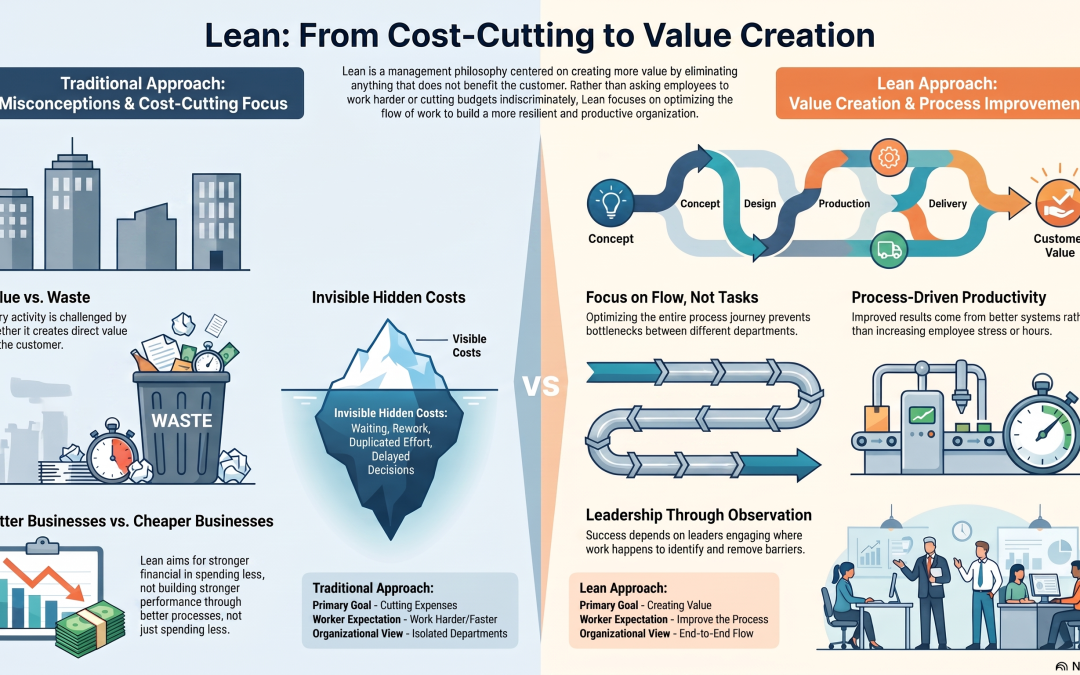
At its heart, Lean is not about spending less. It is about creating more value.
It’s about designing businesses that consistently deliver better outcomes for customers, create more engaging workplaces for employees and generate stronger financial performance through better processes – not by asking people to simply work harder.
The organisations that truly embrace Lean don’t become cheaper businesses. They become better businesses.
The Real Purpose of Lean
Lean originated within the Toyota Production System after the Second World War. Toyota faced significant constraints. It didn’t have the financial resources, production capacity or economies of scale enjoyed by larger global competitors.
Rather than trying to compete through size, Toyota focused on something far more powerful – eliminating anything that didn’t add value.
Every activity was challenged with one simple question:
Does this create value for the customer?
If the answer was no, it became an opportunity for improvement.
Over time, this relentless focus transformed Toyota into one of the most respected manufacturers in the world – not because it cut costs indiscriminately, but because it built systems that consistently delivered quality, reliability and continuous improvement.
The lesson remains just as relevant today. Lean is a philosophy of creating value by removing waste.
Value and Waste Exist in Every Business
Many leaders mistakenly believe Lean only applies to manufacturing. In reality, every organisation has processes, and every process contains waste.
Consider a professional services firm.
How much time is lost:
• searching for documents?
• waiting for approvals?
• correcting mistakes?
• attending unnecessary meetings?
• responding to avoidable customer enquiries?
Now consider a construction company.
How often do projects experience delays because materials weren’t available, information was incomplete or decisions were made too late?
Or a healthcare provider.
How much frustration do patients experience because of duplicated paperwork, unnecessary waiting or poor communication?
None of these examples are manufacturing issues. They’re business issues. Wherever work exists, waste exists. And wherever waste exists, there is an opportunity to improve performance.
Lean Focuses on Flow
One of the biggest shifts Lean introduces is moving from thinking about individual tasks to thinking about the entire flow of work.
Most organisations optimise departments. Lean optimises processes. Imagine a relay race.
Each runner may be incredibly fast, but if the baton is dropped between runners, the team loses.
Businesses operate the same way.
Sales may perform well. Operations may perform well. Finance may perform well.
But if work slows down between departments, customers experience delays and employees become frustrated.
Lean asks leaders to improve the entire journey, not just isolated activities.
Better Processes Create Better Results
Many organisations attempt to improve results by pushing people harder.
Work longer. Move faster. Increase activity.
Unfortunately, this usually creates more stress rather than better performance.
Lean takes a different approach.
Instead of asking: “How can people work harder?”
It asks: “How can the process work better?”
When processes improve:
• quality improves
• customer satisfaction increases
• errors decrease
• lead times reduce
• employees experience less frustration
• profitability improves naturally
People haven’t become more productive because they’re working harder. They’re more productive because the system allows them to do their best work.
Lean Is About Respect for People
One of the least understood principles of Lean is its emphasis on people.
Many assume Lean is about removing jobs. In reality, Lean is about removing obstacles.
The philosophy recognises that the people closest to the work often have the best understanding of what needs improving.
Rather than imposing solutions from the boardroom, Lean encourages leaders to involve employees in identifying problems and developing better ways of working.
This creates something incredibly powerful. Ownership.
When people contribute to improving their workplace, they become invested in its success.
Continuous improvement becomes part of the culture rather than another management initiative.
The Hidden Cost of Waste
Most businesses measure obvious costs – payroll, rent, utilities and equipment.
Individually, these issues may seem insignificant.
Collectively, they consume thousands of hours every year.
More importantly, they drain energy from the organisation.
Employees become frustrated. Managers spend their days firefighting. Customers experience inconsistent service. Growth becomes harder than it needs to be.
Lean shines a light on these hidden costs.
Leadership Determines Whether Lean Succeeds
Many organisations invest heavily in Lean tools while ignoring leadership behaviours.
The result?
Short-term improvements followed by a return to old habits.
Successful Lean organisations understand that sustainable improvement starts with leaders.
Leaders create clarity. Leaders remove barriers. Leaders ask better questions. Leaders encourage experimentation. Leaders develop people rather than simply directing them. Most importantly, Lean leaders spend time where value is created.
Instead of relying solely on reports and dashboards, they observe work directly, engage with employees and seek to understand problems before proposing solutions.
This disciplined curiosity is one of the defining characteristics of successful Lean organisations.
Continuous Improvement Is Never Finished
Lean isn’t a project with a finish date. It’s a way of thinking.
Businesses that stop improving inevitably fall behind.
The organisations that continue to grow are those that embed continuous improvement into everyday work.
Small improvements made consistently produce extraordinary results over time.
Rather than waiting for major transformation projects, Lean organisations build momentum through hundreds of incremental improvements.
These gains compound.
Three Questions Every Leader Should Ask
If you’re wondering where to begin, start with three simple questions.
1. Where do our customers experience unnecessary frustration?
Every complaint, delay or inconvenience represents an opportunity for improvement.
2. Where do our people spend time that adds little or no value?
Look for repetition, duplication, waiting and rework.
3. What have we simply accepted as “the way things are”?
Many forms of waste survive because nobody questions them anymore. The willingness to challenge accepted practices is often where the biggest improvements begin.
Final Thoughts
Lean isn’t about cutting costs. It’s about creating organisations that consistently deliver greater value.
It replaces complexity with simplicity. It replaces firefighting with disciplined improvement. It replaces blame with learning.
The financial benefits are real, but they are the outcome – not the objective.
Businesses that embrace Lean don’t simply become more efficient. They become more resilient. More productive. More innovative. And ultimately, more valuable to their customers, employees and owners.
In today’s increasingly competitive environment, that may be the greatest advantage of all.
Ready to Build a Better Business?
If you’re interested in learning how Lean principles can improve performance, strengthen leadership and create a culture of continuous improvement, join our upcoming Lean Bootcamp Training Course.
You’ll discover practical strategies for identifying waste, improving business processes and building a business that performs better – not simply costs less.
Because the goal of Lean isn’t to create a cheaper business. It’s to create a better one.