
by Russell Cummings | Aug 12, 2010 | Business Tips, Planning, Strategy
There are several other reasons why business managers don’t plan:
- Traditional business plans are too complex
- Traditional business planning fails to address many of the current issues in our business
- They often only focus on the future
- Traditional business planning assumes that management will develop and implement the plan
- Traditional business plans are too inflexible to be of any use
- (How can a 100 page document be reworked quickly to meet changing market conditions?)
- Traditionally business plan usually doesn’t provide a mechanism to prioritise the key issues
- how do you can determine which issues are to be dealt with firts
Are these some of the reasons why you haven’t developed a plan for the future of your business?
For a Business Improvement Plan to be useful, I believe it must:
- Be simple and easy to adjust
- Be flexible
- Maximise our change potential
- Be based on Best Practice tools and techniques
- Allow you to prioritise your activities
- Involve your whole team in development and implementation
- Include problem solving routines to develop action plans
Why don’t traditional plans meet this criteria?
In many cases, the business planning format has been adapted to meet the needs of advisers, financiers (bankers), government agencies providing assistance and accountants. For these external advisers, the Business Plan provides evidence that the Manager/Owner has thought through all the issues and the plan provides a comprehensive overview of the business.
However, a traditional business plan often fails to meet the needs of the Business Manager and his team because it has been designed to meet external rather than internal needs.
Dont get me wrong there are plenty of times when a traditional business plan is required and is warranted. Examples would include: new business start-ups, taking over an existing business, extensive business expansion, introduction of new products lines, major capital expenditure, etc.
Feedback from my clients is that for many businesses, developing a traditional business plan is time consuming and appears to be an insurmountable hurdle that Managers will only attempt when they are pressured to by outside forces like the Bank.
This is a great shame because as we discussed above having a great plan with vision is one of the key elements of maximising your change potential.
So is there a better way? YES! The One Page Plan.

by Russell Cummings | Aug 12, 2010 | Business Tips, People
Like so many other areas of good business management getting the right plan in place for management of your human resources can increase profits dramatically if implemented correctly. Getting the right equipment for the job is accepted as essential if consistent quality production is to be maintained and it is with this same philosophy recruiting the right people into your organisation should be viewed.
This applies particularly to business sectors where we often hire fewer permanent employees but seem to have an endless parade of casual employees. Can we improve this situation by having a better plan? Yes!
The Mindshop recruitment process has been tested over many years, in a variety of industries and companies. It provides a simple yet comprehensive system for farm businesses to get the right people the first time. Consider the following: –
Person Specification
What type of person are you seeking? Do they need to be innovative, responsible, good with machinery or stock, or self-motivated? How will you test this at the interview?
Advertise
How are you going to attract the best applicants and discourage inappropriate ones? How can you use the advertisement to encourage your existing employees rather than de-motivate them? If you are not formally advertising then develop a statement that explains the sort of person you require and the qualities they must have. This is better then asking around the pub if anyone knows of anyone looking for work!
Interview Project
A way of minimising the risk of a recruitment mistake is to get the final applicants to undertake a project. An applicant for a storeman’s position can demonstrate their skills in the loading docks.
Reference Check
No one produces a reference or a referee that does not say what the applicant wants it/them to say. How can you use the reference check to find out the truth about the applicant?
Induction
Don’t throw your new employee into the deep end. Induction maximises the start up performance of a new employee. A little planning and a simple checklist is all that is needed.
The key to finding the best person is locating the person with the most appropriate core values. An advertisement in a USA paper for hotel said we don’t train our people to be nice we just hire nice people.
There is an imperative to bring out the core values of an applicant however in doing this through the normal recruitment process’s can create a number of traps
Solo Recruiting
Too often people recruit on their own. It’s very difficult to manage your own performance, plus, watch the reactions of the person you are interviewing. Never recruit on your own.
Lack of Preparation
People never make the time to effectively prepare for their recruitment interview. Part of the reason for this, is that they have done so many before, they have tricked themselves into believing they are good at it. Preparation is the key to success in any business activity, particularly recruitment.
Halo Effect
This occurs when your applicant makes mention of something you feel good about. Perhaps they are a member of a similar sporting club or group to you. As soon as you hear this common ground, then everything they say is biased in your mind. Be careful about the halo effect, it can lead you astray!
Lack of Follow Up
Too often, people ignore some of the basic business requirements of reference checking, offer letters and induction. The follow up in a recruitment process is as important as the initial planning and interviewing phase.
People assume that recruitment is an easy process, when in fact, it’s quite difficult to develop the key skills required to be effective in the recruitment process. This is especially hard when you only recruit once in a blue moon. Consider engaging the assistance of a professional to assist you in the process. They will charge a fee but it is usually money well spent.
However, a good system for recruitment coupled with sound implementation will go a long way to giving you the competitive edge that comes with having the right staff.

by Russell Cummings | Aug 11, 2010 | Business Tips, Process Improvement, Strategy
Waste in most organisations accounts for between 15% and 30% of the total operating cost of the business and is often higher than this in service industries. Therefore if your business has costs of $1.0 million per annum then you could expect to find between $150,000 and $300,000 of waste and inefficiency in even the best run businesses.
What are your total annual costs? ______________
Multiply your total costs by 0.2 (20%). ____________
This is an estimate of the cost of inefficiency and waste in your business.
Can you afford to leave this waste in your business?
But where does it come from?
In most businesses there is an element of waste that has been designed into the business from the start. It was introduced by the original owners who started up the business and is usually part of the way you do business. This is because most businesses begin life as a small business, where there is a great deal of multi-skilling of staff and where processes are evolved rather than purpose designed.
Waste is often accepted within your business because the employees (and you) have stopped “seeing” the waste around them.
Waste in your business is not a sign of poor management and should not reflect badly upon current and past management as it is a systemic problem of the business that is usually well hidden. However, now that you are aware of the potential waste lurking within your business there is little or no excuse for not addressing this problem immediately!
For example: Porsche, the maker of magnificent motor vehicles, lowered assembly time from six weeks to three days and still cut its level of mistakes by 55%. An incredible increase in productivity and quality! Inventory levels also dropped from 17 days to 3.2 days improving the cash flow of the organisation dramatically. Similar levels of improvement are possible within your business.
THE SEVEN WASTES
The following are the Seven Wastes in a business. These waste areas are based on a process developed by Toyota for improving business efficiency.
- Overproduction: What are you overproducing? Look for a build up in stocks, work in progress and resources
- Waiting: Where do goods and services wait? What activities are adding value ? Which are not?
- Transport: Where do things move? Look at moving goods, paper, people and machines.
- Inappropriate Processing: Are you using the right machine for the job? Are you using the right person for the job?
- Inventory: Where are you storing value? Look for waste in the piles of raw materials, finished goods and services (WIP), bank accounts and debtors.
- Motion: Look for wasted movement. Check the ergonomics.
- Defects: Where are the mistakes occurring? De we have rework or significant levels of product returns?
THE WASTE AUDITS
Mindshop has developed a waste audit process that enables you to identify and prioritise the waste in the organisation. We recommend that you involve Project Teams in the identification and elimination of the waste. The teams need to have involvement and commitment to the selected issues. If this is not in place it is very difficult to maintain the process.
MINDSHOP TEAMS
In removing the waste from your business we recommend that small groups are trained in the basic Mindshop tools of Mindmapping, Pareto, and Force Field Analysis. The teams are asked to formally report to management after an eight week cycle. Key performance indicators are established to measure the success of the process.
SAVINGS ACHIEVED
The experience is that the waste reduction process is self funding right from the start. The savings from the waste reduction more than off set the cost of any training, or a facilitator, if required, and the time required for the team process.
As discussed above, the potential savings will usually be from 15% to 30% of your costs. In many businesses this is enough to double profits! The process is simple and extremely effective.
Regular Training Programs
SBD On-Line conducts regular training programs in how to reduce the level of waste in your business. These seminars are currently delivered in Newcastle, Sydney and Canberra and will teach you how to remove the Waste from your business.

by Russell Cummings | Aug 11, 2010 | Business Tips, People, Planning, Strategy
People: Some people want to change, others resist it. Its sometimes necessary to admit that some team members have become a liability. If such people form the major part of a team, the team is doomed for failure. For this process to work the teams must be formed by the people who want change. In a family owned or small business selecting the right people can often be very difficult.
Products: The Pareto Rule is relevant here. “Twenty” percent of your products provide “eighty” percent of your sales. Twenty percent of our products provide eighty percent of your profit. Removing non performing products is essential if you want the right structure. Flexibility in production systems and an ability to diversify are critical to success in agriculture.
Customers: Again the Pareto Rule applies. Which twenty percent of your customers provide your sales, profit and repeat business? Which twenty percent provide eighty percent of your problems? Why invest time in these? Why not remove them? How many managers actually think about who they sell their products to?
Experience indicates that many businesses sell to customers who are tardy with payment (or even worse are “known” non-payers) or people that change the terms after delivery. Why do we sell to these people ? Select your customers wisely and build strong relationships with good customers that will stick with you in good times and bad. Do you have a customer care program to build relationships with your key customers? If not, then Why not?
Processes: The processes used in most businesses are rarely reviewed. Inefficiencies and waste creep in. To have the right structure, your processes need to be effective. Do you know what the key processes are in your business? How do they interact? Where are the inefficiencies? Where is the waste? Where are you under-utilising labour and resources? Where are you wasting inputs?
Processes also refer to the management processes in your business (not just the sales or production functions). Do you have an effective business planning process? How do you develop your marketing strategies? What are you Human Resource Management policies and strategies? These background or support processes are often more important than your production processes.
Price: A key structural element is pricing. Many businesses know how to cost, most dont price correctly. The wrong price can mean lost sales or lost profit. Correct pricing is a key success factor. How do you determine the correct selling price for your product? What is your selling strategy? How can you maximise the market price for your commodity? These are important questions that need to be answered.
But where to start?
This is a common question from managers and owners. – Where do I start? How do prioritise working on my people, products, prices, processes, etc? Where do I put the most effort?
There is no unique answer to this question although many “consultants” will tell you exactly where you need to apply your focus. In reality, depending on your individual situation, you may need to address all of these issues.
Our recommendation is that you develop a one page strategic plan for your business. YES – ONE PAGE!!
This simple, innovative planning process will help you to take stock of your current situation, work out where you want to be and help you prioritise the actions and strategies that will get you there.
The key to success is in this last step – PRIORITISE THE ACTIONS. The MindShop process that drives the development of the one page plan is unique and so simple to implement.
The one page plan will focus you on the actions you need to take to get your business or organisation moving. It will help determine whether you need to focus on people, prices, products or processes issues. It will also help you easily develop solutions to complex problems by providing you with a logical problem solving process.
by Russell Cummings | Aug 9, 2010 | Business Tips, Process Improvement, Strategy
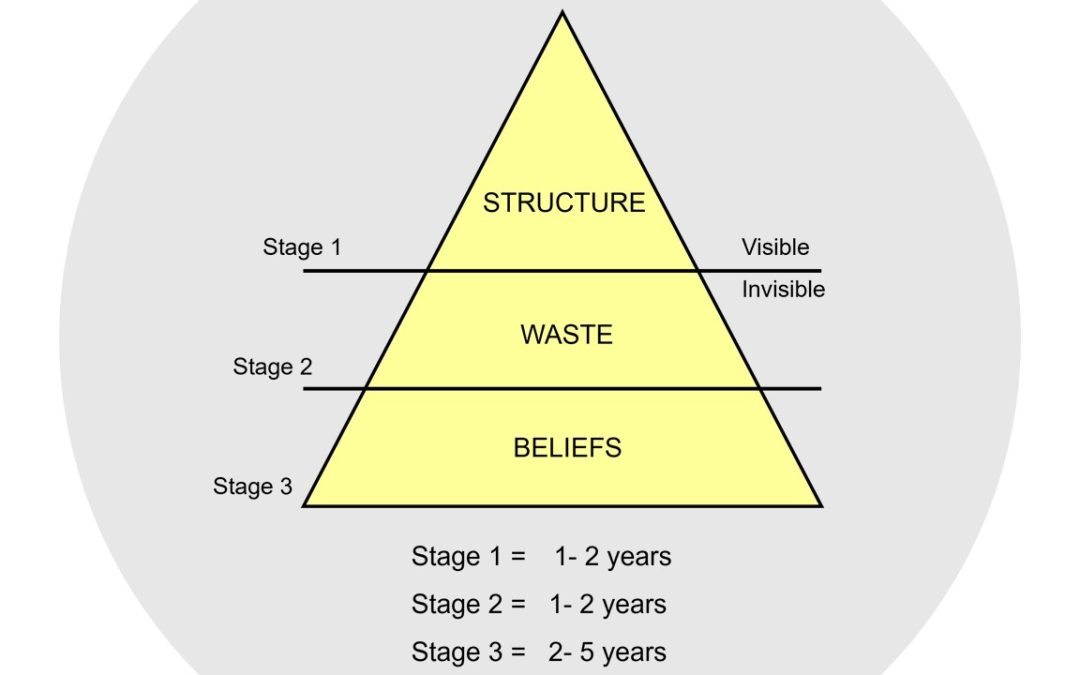
The 3 Stages are illustrated in the diagram below.

Stage 1: Structure Most people are aware the first stage in a business improvement process is to get the business structure right. The right structure means the right customers, the right products, the right prices, the right processes and the right people.
The Structure involves dealing with the “visible” elements of the business. We dont usually look for the hidden wastes, costs and drivers at the structural level. involves dealing with the “visible” elements of the business. We don’t usually look for the hidden wastes, costs and drivers at the structural level. involves dealing with the “visible” elements of the business. We don’t usually look for the hidden wastes, costs and drivers at the structural level. involves dealing with the “visible” elements of the business. We don’t usually look for the hidden wastes, costs and drivers at the structural level.
Most managers don’t realise that once the structure is mostly in place, they should move to Stage Two which is to get the “waste” out of the structure or improve your efficiency. They continue to keep working on structural issues!
In Stage 2 – Waste there are seven key areas of waste or inefficiency: overproduction, waiting, transport, inappropriate processing, inventory, motion and defects. We have developed processes to help you identify these wastes and inefficiencies easily and quickly. Experience indicates that waste usually accounts for 15% to 30% of your total costs. There are huge savings to be made here!!
Once both the structure and the waste (inefficiencies) are largely addressed, the biggest issue in the organisation can be addressed, Stage 3: Belief Systems of the People.
If a person believes that they are not worthy of success then they will prove themselves right. If they are an employee or family member (or you) then they will probably use your business as the vehicle to prove themselves right!
Showing a person how to develop a belief system of being worthy of success will result in them proving themselves right using, again using the organisation as a vehicle. Both the individual and the organisation wins.
It usually takes several years to work through each stage, the last stage requiring the most time.
