
by Russell Cummings | Apr 6, 2011 | Business Tips
The Apple App Store is an amazing marketplace that has changed the way we interact with technology and how we purchase and deliver software solutions. It is a great business model. The strength of this model is in the way Apple has encouraged others to build product specifically for their devices.
As many of you know, I have recently developed a couple of iPhone apps for business users (Force Field Analysisand Competitor Analysis) and have become intrigued by the concept. The exercise is going well (I could always do with a few more sales!) but I’m not going to give up my day job just yet!
When I released my first app, I had so many enquiries asking “How do you develop an app as I have some ideas?” that I decided to write an e-book about my experiences and the knowledge I picked up along the way. The book is 75% complete.
I can honestly say that building an app “blind” (no knowledge or skills) was really challenging but I have learnt a lot along the way. The internet is full of resources that are applicable if you have some programming (coding) knowledge but pretty light on if you are technologically inept like me.
However, what I’m interested in is if so many people have so many ideas for apps – why don’t they just dive in and make it happen?
What are the barriers that are stopping you from developing a smartphone app?
You can comment below or send me an email or respond to my posting directly. I’d love to hear from you.
Russell

by Russell Cummings | Feb 9, 2011 | Business Tips, Latest News, Technology
RSS Feeds – What are they? How can I use them in my business?
In this day and age, internet and mobile technology play a big role in everyday life. This is especially true for those of us who constantly search for new and efficient ways to disseminate information to our network of friends, customers and clients. Aside from the usual web tactics, RSS feeds make this possible.
What are RSS Feeds?
RSS (“Really Simple Syndication”) is a group of standardised data formats for news and headlines, blogs, audio and video. It is identified by name or symbols like this: 
These formats, also known as “feeds,” allow publishers to publish content automatically via web, desktop and mobile RSS readers. Once published then content can be easily and automatically accessed by groups or individuals.
RSS also allows those who are interested to subscribe to the feeds that they like. These feeds are then delivered automatically to your RSS reader. There are stand alone RSS Readers but they are now built into the main email programs like Outlook, Netscape and Apple Mail.
The main benefit of using RSS to access the content that you like is that it is aggregated for you in one place – you do not need to visit a heap of websites to view the content that you like.
How can I use RSS in my business?
RSS is usually integrated as one of the basic functions of a website. It helps fuel traffic. And although it isn’t the only function that can generate traffic for your site, reaching as many people and getting them to subscribe to your feeds is one of the top ways to produce buzz and increase your site’s ranking and authority on the web. At the same time, you can connect and gather related info from people who think the same as you.
RSS feeds help spread the word about anything – for free. And it is for this reason, that a business owner—especially one who has taken his business online—should take advantage of it. Compared to sending emails or regular newsletters to clients or customers, RSS feeds are more effective as they are customized and specific. RSS subscription ensures that people get a hold of feeds that are only of their interest.
For businesses, RSS feeds are efficient forms of promotion and marketing that works in two ways. Aside from being a quick-share tool by supplying credible content to your subscribers on their computers and mobile phones in seconds, it also helps when business owners subscribe to or exchange feeds and gather info from related sites.
How do I subscribe to RSS feeds?
To subscribe to an RSS feed, you should have two things—an RSS reader and the URL of the feed’s website you wish to subscribe to.
RSS readers also known as “news aggregators” are free to download and easy to use. Almost all sites with RSS feeds offer links to where you can get one. But you can also choose to use a free web-based reader like Google Reader, My Yahoo or My MSN that features feeds that you’ve subscribed to in your browser’s homepage.
As mentioned above, most mail programs also include RSS Reader capabilities. There are plenty of RSS Reader apps for your iPhone, iPad, Blackberry or Android smartphone as well.
After downloading an RSS Reader, click on “Add RSS Feed” and copy the URL of the RSS then paste and add it into your reader. RSS readers allow users to customize the frequency of updates for feeds—daily, weekly or monthly.
Alternatively you can just click on the RSS icon on the blog or website that you would like to follow.
In summary, RSS feeds are truly effective info-sharing tools for businesses that will thrive and continue to find opportunities in the Internet era. They are also great tools for keeping up to date with blogs and websites that you are interested in.
Russell
_______________________________
The RSS Feed URL for this blog is http://feeds.feedburner.com/com/sbd-blog-rss

by Russell Cummings | Jan 31, 2011 | Business Tips, Latest News, Marketing, Sales, Strategy, Technology
To Tweet or Not to Tweet
Social networking has indeed changed the world. Since its introduction, this modern phenomenon, which is also referred to as social media, has provided a new and faster way for people to connect, interact and go about with their daily lives.
Social networking may have started out as a fad, but its massive appeal has transformed it to something even bigger. And today, almost 50% of the world’s IT literate population, under 30 years old, is on social networking sites such as Facebook, Twitter, Linkedin and more.
Social networking has affected almost every person in the world in one way or another—good or bad. In fact, many people’s personal lives have changed because of it. Research shows that 1 out of 8 US couples have met through social networking sites. With things like this happening because of social media, the question is, is it only good for personal life? Or are there opportunities that businesses can take advantage of?
Social Media and Business
One of social networking’s strong points is that it gets news across—whatever it is—to millions of people—wherever they are—in real time. Gone are the days when people had to take time to find out about what’s going on in the world. These days, news is fed to people via social networking in minutes! This feature is one of the best opportunities businesses can and should definitely explore and take advantage of.
Another opportunity that social networking presents to businesses is its attractiveness or appeal to people. Aside from having a large proportion of the world’s population on it, studies reveal that social networking sites, especially Facebook, have topped other forms of media such as TV, radio and other popular internet sites like Google. This percentage ensures that business people who invest time and money to market their products and companies in social networking sites are sure to get the exposure and quotas they’re aiming for.
But with so much hype on social networking, many consider that the social media bubble is about to burst. The notion has been formulated by economists who think that all things that reach a peak will soon fall. And with this speculation, business owners ask whether investing in social media is still worth it or not?
Social Media is here to Stay
People might say that the reign of social media will soon end, and although it may be true, businesses should still take the opportunity to use it for marketing purposes because the social networking technology will be here to stay.
Yes, it is possible that Facebook and other popular social networking sites may become obsolete in a few years but it will only be replaced by something much more advanced.
Social networking sites, as the term implies, thrive on people’s natural instinct to socialize, to communicate and to interact with each other. So long as there are people in the world, social media, in whatever form will stay as a powerful tool to reach out, sell and convey a message.
Social Media is Relatively Inexpensive
With the global financial crisis, finding alternative solutions to high costs is essential for businesses to survive. And with that said, another reason why businesses should consider utilizing social networking is because it is inexpensive.
Most social networking sites are free to access by anyone, anywhere in the world. With no financial cost, businesses are able to build a profile in whatever way they want their brand to be introduced and made known to the market. But don’t be fooled. Social networking may be absolutely free, but in order for businesses to excel in this new media, hard work and patience is required.
Social networking makes businesses more vulnerable to the public eye. Just as in the “physical world”, establishing solid customer relationships and providing sincere customer service are important for business growth – they are just as important online. If businesses fail to invest the necessary time and effort in reaching out to their customers – they’re bound to fail in social media, as well.
Anecdotal evidence suggests that businesses that treat their social networking like any other physical networking opportunity are winning work from it. This requires a consistent focus and attention to the network. It will involve participation in the network, communication with other members, responding to posts, joining special interest groups and discussion forums. All things you would do in a physical networking group like a Chamber of Commerce.
Selecting the Right Network for your Business
Obviously, selecting the right social media platform for your business is important. Facebook, although the dominant player in the market, anecdotally appears to be more for Business to Consumer relationships than some other options.
LinkedIn on the other hand is one the larger Professional/Business networking sites and is much more suited to building Business to Business relationships.
Twitter, is a “micro blogging” network that seems to have appeal across both business and social networks. Some of the networks, like LinkedIn, allow you to interact with other social media like blogs, Twitter, etc such that a posting on your blog can automatically feed to LinkedIn which can then on feed a comment to your Twitter account. In this way, one activity can service multiple contact points and networks.
Choose the network that suits your business and concentrate your effort on this. This should give you a greater return for effort than spreading yourself too thin.
Countering the dangers of Social Media for Business
Like all things, social networking also has its disadvantages. One of the dangers of social media for businesses is also one of its strongest points—social networking delivers news, good or bad, in an instant. For this reason, businesses should be wary of what they say about their products and be very careful of their actions.
According to some studies, people are prone to believing what they’re friends say more than what they see on advertisements or press releases. A bad company or product reputation will easily spread via social media.
Another thing that business owners should keep an eye out for when investing in social networking sites is the possibility of having copycats. Competition can encourage anyone to do just about anything, and because social media sites are mostly free, it’s easy to copy and create false and rep-destroying profiles against a competitor. Because of this, social networking as a marketing tool is dangerous by itself.
Integration is the Key
Social Media is not the only platform for your marketing – it is one of many. And it should be integrated into traditional media and other marketing strategies such as word of mouth, relationship building and contact programs.
It is crucial for businesses to integrate social media activities with their existing marketing programs because the objective of using social media is to build relationships via an online community, just as much of your other marketing is about interacting with the physical community.
Overall, the advantages of social networking as a business tool outweigh its disadvantages. With larger proportion s of the business community involved in social media in one way or another, it is a strategy that business owners should definitely take advantage of.
So, TWEET!

by Russell Cummings | Sep 2, 2010 | Business Tips, Planning
One of the key issues that impacts on most business owners and managers is the issue of Life Balance.
This issue is relevant at all times in our lives and if the area has not been reviewed recently, is an invaluable exercise to undertake when life-changing events such as retirement are contemplated.
One of the tools that can be used to assist us to answer the question “How do I know if I am successful?” is to undertake a review of Life Balance. There is no definitive answer as to what constitutes success and each person needs to define the key elements for themselves however the model that we use contains 6 key areas:
- Family
- Health
- Social Life
- Money
- Mental
- Personal Philosophy
Success in each of these area is important however is more important that success be balanced between all areas. If these are considered to be segments of a wheel, that wheel won’t be able to turn unless that balance exists.
You will note that we dont include Work as one of the elements but consider it the road that this Wheel travels along, and which can provide many of the Life Balance elements.
Imagine a zero at the centre and a ten on the circumference and then subjectively score where you stand in each segment.
If you score very well in some segments but low in others it indicates a need to develop strategies to lift your score in those areas to bring the wheel into balance.
Don’t score yourself based on the time involved but rather the quality of each area. If for example you did not score well in the area of Health, what action plans can you put in place?
- A Medical Checkup
- Sign Up With The Local Gym
- Commence A Diet
- Regular Walking Program
- A Combination Of Any Of The Above
It is up to you to select something that you are comfortable with. Why not involve a friend or family member? Not only does it provide a wonderful support mechanism, it also means that you can work on two Life Balance areas at the one time.
It is important though that specific measurable targets be set. Deciding that I will exercise more is likely to be of little help. Set a specific measurable target. I will walk for 40 minutes at least 4 times per week. At the end of the week it is easy to know whether or not you have achieved your objective. Why not chart your progress? Remember it takes about 12 weeks to form a habit.
by Russell Cummings | Aug 14, 2010 | Business Tips, Planning, Strategy
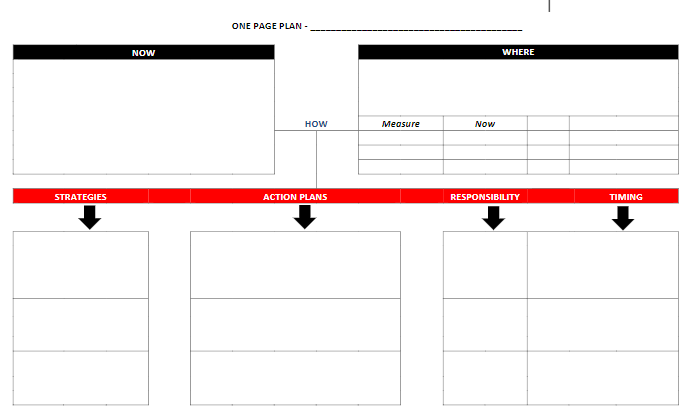
The One Page Plan covers the key elements of a Business Improvement Plan by summarising the NOW, WHERE and HOW.
In the NOW Summary, you need to pull out the key points of your current position, remembering that you only have room for about 10 short points (3 to 4 words per point).
In the WHERE Summary, you need to include a short summary of your Vision, your Business Statement, your Sustainable Competitive Advantage and your Objectives. In the HOW, we need a summary of each of your key strategies and your action plans.
To keep the plan to one page, you can always print on both sides of an A4 sheet. In this way you can have the Plan on one side with the budget (financial projections) or detailed action plans on the other side of the sheet.
It is suggested that elements of the plan are supported with detailed information as required. This may include:
Strategy Documents
Marketing Information
Budgets and Financial Projections
This will mean that your total business plan could be 8 to 10 pages in length (it could be longer) but that it is summarised onto a single page. The ONE PAGE PLAN then becomes your management document and is used to drive the development of your business. It is a great tool for achieving this as it is flexible, short, concise and easily updated.
The One Page Plan concept is so powerful that we use it develop One Page plans for a whole range of activities including:
Marketing
Customer Service
Recruiting
Personal Development
Within the one business you may have different divisions or sections – you can develop a One Page Plan for each Division! Each Team and/or staff member can have their own One Page plan. The Plans can cascade down from a Company level to an individual level with as many levels in between as are appropriate.
There is no end to the uses for the One Page plan concept!