In the intricate tapestry of personal productivity, the third pivotal element is control – the mastery over one’s environment and the adept use of strategic tools. This article delves into the significance of leveraging control to enhance productivity, exploring the potency of the Pomodoro Technique and the necessity of taking charge of the surrounding environment.
At the forefront of effective control lies the Pomodoro Technique, a time management method that advocates breaking work into intervals, traditionally 25 minutes in length, separated by short breaks. This technique not only capitalises on the human brain’s natural inclination for focused bursts of activity but also mitigates the risk of burnout associated with prolonged periods of uninterrupted work.
By implementing the Pomodoro Technique, individuals gain a heightened awareness of time, fostering a sense of urgency that propels them towards efficient task completion. Furthermore, the structured intervals provide a built in mechanism for rejuvenation, enhancing overall concentration and preventing the onset of mental fatigue.
However, the mastery of control extends beyond time management techniques to encompass the shaping of one’s physical and digital environment. The ubiquitous nature of smartphones and constant connectivity poses a significant challenge to focused work. Thus, exercising control over the use of phones—implementing designated periods for checking messages and calls—proves instrumental in preventing distractions.
Email, while a vital communication tool, can also disrupt workflow if not managed judiciously. Controlling the influx of emails by establishing specific times for checking and responding ensures that this essential tool serves its purpose without becoming a constant source of interruption.
The workplace environment itself requires careful control to foster productivity. Open-plan offices, though designed for collaboration, can sometimes lead to increased distractions.
“The key is not to prioritise what’s on your schedule but to schedule your priorities.” ~Stephen R. Covey
Here, control involves creating designated spaces or employing noise cancelling measures to carve out islands of focus amid the collaborative landscape.
Meetings, another potential productivity hindrance, necessitate a strategic approach to control. By adopting a disciplined meeting schedule, with well defined objectives and timeframes, individuals can ensure that these gatherings contribute positively to overall productivity rather than becoming time-consuming detours.
In conclusion, commanding control over both time and environment is paramount to unlocking peak productivity. The Pomodoro Technique stands as a testament to the efficacy of structured time intervals, while strategic control over digital devices, emails, interruptions, and meetings forms the bedrock of a disciplined and focused work environment. By embracing these elements of control, individuals can elevate their productivity and contribute to the success of their businesses.
Here’s part 2 of the Lessons Learnt series we kicked off recently. In this video are my 3 tips on Sales and Networking, which I’ve learned over 37 years in the industry.
First one is that “Everybody needs to work on their Sales Skills.” The vast majority of business owners and salespeople have lousy sales skills. They assume they’re good at sales but often have little or no sales training, or they actually don’t apply the sales training they have had, or they have poor sales processes, and as a result get poor results.
We assume we’re good but we never measure and focus on improvement, and as a result, we accept mediocrity.
In my business, over the last 30 odd years, I’ve been able to lift my closing rate from 20% to 90% of qualified leads by doing some training, putting a good sales process in place and having a good conversation with people and understanding their needs. So what’s the impact on your business if you can do that same thing?
The second sales tip is “Don’t write proposals.” Have the conversation, ask for the business, talk about the money so that you actually get the chance to overcome people’s objections.
And the last point is to “Pick a networking group and infiltrate it.” I think people make a lot of mistakes of going to lots of different networking groups. My advice is, pick a group that fits with you and your business. You’re going to have to kiss a few frogs to find a group that you get a good fit with and that you feel comfortable in, and that has a good collection of target market clients for you.
Once you get a group that you like and you fit well in then my advice is inflitrate it. Ask to take on a position on a working committee. A couple of groups I’ve joined simply because I asked if they need any help and they said, “we’d love to have someone on the board, would you like to join us?” What it makes you then is part of the inner circle. It also helps you have deeper relationships with people that can help you grow your business.
So in summary, my top 3 sales and networking tips are to improve your sales skills, don’t write proposals but instead think about how you can have smart discussions around the business and money, and then pick a networking group and infiltrate.
For a range of free resources to help you grow your business, visit https://shifft.com.au/.
Hey there! I’m excited to kick off the Lessons Learnt series with you, where I’ll be sharing insights gained over my 37 years as a business advisor.
Each video will be short and sweet, focusing on three or four key takeaways about a particular topic.
Today, we’re diving into Marketing and Promotion. I want to share with you three key insights that may change your perspective.
If you find that you want to dive deeper into a particular insight, please let me know! I’m always happy to help.
And, as a bonus, please feel free to explore the free resources we offer on our website, ww.shifft.com.au. We have a wealth of blogs, videos, templates, courses, and more available for you to explore.
Of course, if you ever need any one-on-one support, I’m always here to assist you.
Thanks for tuning in, and I hope you have a great day!
In the 2024 landscape, Mindshop’s Business Leader Success Insights Report emerges as a vital beacon for leaders navigating through the tumult of modern business challenges. This article synthesises the report’s essential messages, distilling actionable insights and strategic directives aimed at enhancing leadership effectiveness and organisational performance.
Embrace Change and Innovation
The report commences by urging leaders to adopt a contrarian mindset, challenging conventional wisdom to foster innovation. It highlights the importance of ‘Timeboxing’ for enhanced productivity and underscores the critical role of operational excellence in achieving superior organisational efficiency.
Leadership and Team Dynamics
A significant emphasis is placed on ‘Modelling the Way and Being the Coach,’ advocating for leadership through example and the cultivation of a coaching culture within teams. The report also advises leaders to ‘Learn from the Right Peers,’ stressing the value of mentorship and peer learning in personal and professional development.
Sustainable Growth Strategies
The insights further delve into ‘Profitable Growth,’ promoting strategies that ensure revenue growth aligns with profitability. ‘Customer Centricity’ is highlighted as pivotal, with a focus on aligning products and services with customer expectations to drive business success.
Technological Advancement
An important aspect of the report is the encouragement to ‘Leverage AI & Technology,’ recognising the transformative potential of technology in operational efficiency and competitive differentiation.
Strategic Simplification
Leaders are encouraged to create a ‘Stop Doing List,’ identifying low-value activities to eliminate, thereby focusing on what truly matters. Building a ‘Higher Quality Team’ is identified as essential, advocating for diversity in skills and expeditious management of underperformance.
The Mindshop Way
Lastly, the report champions the ‘Mindshop Way,’ advocating for the adoption of streamlined business methodologies that simplify complexity, supporting growth and development.
Action Steps to Abandon Outdated Practices
In parallel, the report advises leaders to abandon counterproductive practices such as the endless pursuit of ‘Unicorn Team Members,’ a ‘Fixed Mindset,’ and the sustenance of ‘Loss Making Products & Services.’ It also warns against tolerating ‘Toxic Team Members,’ neglecting ‘Work/Life Balance,’ and the pitfalls of ‘Living on Social Media.’
Strategic and Emotional Intelligence
Abandoning ‘Echo Chambers’ and ‘Strategic Planning with No Implementation’ are highlighted, alongside the importance of addressing ‘Emotional Intelligence Blind Spots’ and the risks of engaging with ‘Unworthy or Poor Quality Customers.’ Lastly, it suggests leaders should stop ‘Worrying About Things You Can’t Change,’ to focus on actionable priorities.
Implementation and Support
The report culminates with a call to action, urging leaders to integrate these insights into their strategic planning. It recommends completing the Growth and Profit Solutions (GPS) diagnostic, crafting a personal one-page plan, and engaging with Mindshop advisors for tailored support.
In conclusion, the Mindshop Business Leader Success Insights Report 2024 offers a comprehensive blueprint for leadership and organisational excellence. By adopting its strategic recommendations and abandoning outdated practices, leaders can position their businesses for success in an increasingly complex and competitive environment. The synthesis of these insights not only provides a roadmap for the year ahead but also underscores the ongoing journey of learning, adaptation, and growth essential for contemporary business leadership.
In the dynamic world of business, effective decision-making is the linchpin for success. Yet, many managers grapple with the challenge of lacking a clear process. Fear not, for I bring you a practical model designed to simplify decision-making for small business owners and managers.
Let’s delve into this uncomplicated, yet potent, approach that promises to enhance the decision-making prowess of your small business team.
The Decision-Making Model
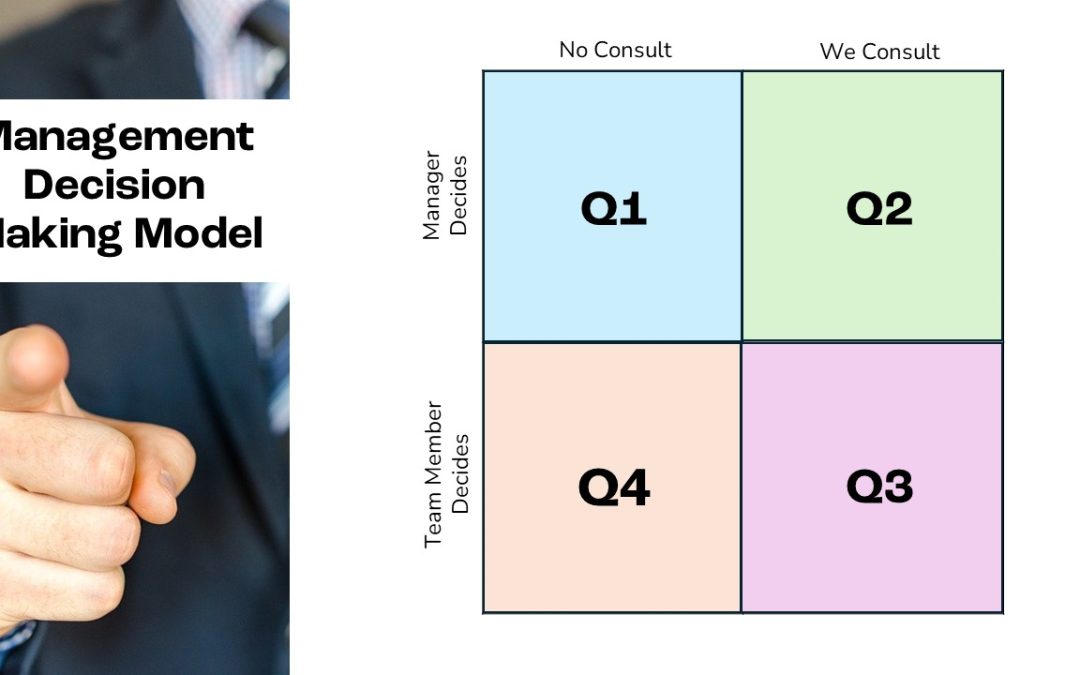
At the heart of this model lies simplicity, breaking down decision-making into four distinct quadrants.
In Quadrant 1 (Q1), the boss takes the reins independently.
Quadrant 2 (Q2) involves a discussion, but the final call rests with the boss.
Quadrant 3 (Q3) encourages team discussions, but the team member makes the ultimate decision.
Lastly, Quadrant 4 (Q4) requires minimal discussion; the team member autonomously decides.
This straightforward framework provides a roadmap for navigating the intricacies of decision-making within your small business team.
Quick Tips for Implementation
To seamlessly integrate this model into your business, set clear expectations for each quadrant. Discuss potential scenarios pertinent to your business, fostering conversations around roles and responsibilities.
For example, certain decisions may fall within the team member’s domain (Q3), while others necessitate the boss’s input (Q2). Making the model a regular reference point during discussions ensures a shared understanding among your team, promoting consistency and efficiency in the decision-making process.
Implementing with Your Team
When introducing this model to your small business team, simplicity is key.
Explain it in clear, straightforward terms, and prominently display it in your workspace as a visual guide.
Encourage your team to refer to it during discussions, creating a shared language and approach to decision-making.
By making the model an integral part of your team’s dynamics, you promote transparency and efficiency, paving the way for smoother decision-making.
Conclusion
In essence, this accessible decision-making model is tailored to empower small business teams. By incorporating it into your operations, you simplify decision-making, enhance accountability, and foster a more transparent and efficient decision-making process.
For any queries or further assistance, feel free to reach out. Here’s to smoother decision-making and the success of your business!

![[Lessons Learnt] Sales and Networking](https://shifft.com.au/wp-content/uploads/tips-1080x675.jpg)