If you’re a business owner striving to efficiently track your sales budgets and ensure they automatically adjust based on actual performance to meet your annual targets, you’re in the right place.
In this video, renowned Australian Business Management Consultant Russell Cummings will guide you through an ingenious approach to transform the Takt Time concept—a tool traditionally used in manufacturing—into a dynamic model for creating self-adjusting sales budgets.
The challenge we often face in business is having fixed annual targets, and we need to know by what margin our monthly targets should adapt if we want to stay on course. Using a practical example of a $6 million sales budget over 50 weeks or 12 months, we’ll illustrate how this concept can revolutionize your sales planning.
In the spreadsheet we’ve built for this purpose, we’ve laid out the 50 weeks with a weekly budget of $120,000, totaling $6 million. As we input our actual sales figures, the model automatically recalibrates our future targets to ensure we still hit our annual goal. It’s a remarkably straightforward yet powerful tool that keeps your business on track.
For instance, if you achieve $100,000 in the first month, the model indicates that you should aim for $120,408 in every subsequent month to reach your annual target. If your performance varies, the model adapts accordingly, making it easier to strategize and reallocate efforts.
The beauty of this approach is its flexibility. Whether you prefer a weekly or monthly tracking system, the principles remain the same. It allows your team to self-adjust their efforts, preventing constant sprinting and enabling you to fine-tune your focus based on real-world results.
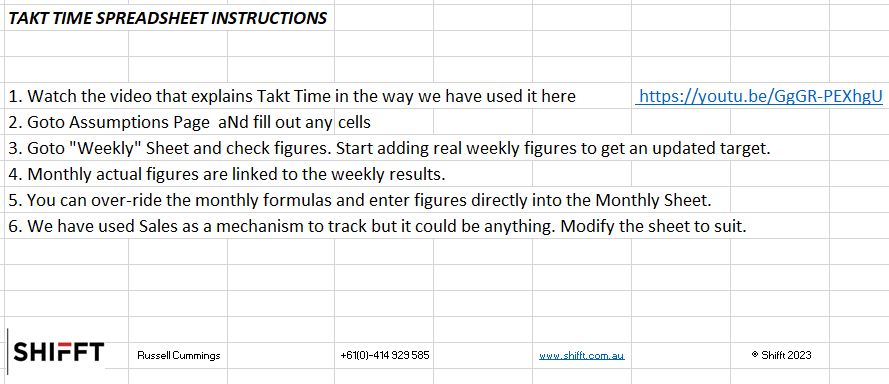
But that’s not all. You can also download the spreadsheet we’ve used in this video from our website. It’s a free resource that you can tailor to your specific needs, whether you prefer hourly, daily, or other timeframes. Simply visit our website through the links provided in the video description.
At Shifft, we’re dedicated to helping you grow your business and reach new heights. Check out our website for a wealth of resources and tools to empower your business journey.
Thank you for tuning in, and we can’t wait to hear about your success with implementing Takt Time for your sales budgets. Cheers to your business’s continued growth and prosperity! Russ
In today’s rapidly changing business environment, learning new skills are necessary to stay relevant. Regardless of what your role is in a business, you will very quickly go backwards if you are not continuously growing and evolving.
The list of new skills required to succeed globally is long but the most in-demand are:
• Turning salespeople from order takers to business people who sell • Turning leaders from the star player to head coach • Turning managers from task-focused to team-focused • Turning administrators into business analysts
It may seem easy to learn any new skill, but we fall short most of the time because of challenges that appear amid the learning process. With that said, here is a list of the 10 key issues we see when learning new skills and how to address them.
1. Too much theory, not enough practice – While it is important to understand the theory/background to a new model or approach you are learning, it is more important to apply it to a real life situation so you can quickly learn what works and what doesn’t in the field.
2. Get the context right – Before starting any sort of training experience, spend the time to outline ‘why’ it is required in the context of your personal or business vision (and strategies). This will assist greatly in ensuring it’s completed properly and applied quickly in the business.
3. Fear of failure – This is very often one of the biggest hurdles to adopting new skills. The saying often comes to mind that fear stands for “False Evidence Appearing Real,” so realize that very often all these thoughts are just irrational beliefs raising in your head.
4. Fear of success – It sounds strange but very often business leaders/owners hold themselves back due to the extra pressures and lifestyle changes that may come with increased success.
5. Just-in-time learning – Take an online course or an ‘e-learning’ solution when you find yourself in a situation where you need a new skill to solve a problem right now. Often, these courses will feature videos from leading experts from around the world to help you get up to speed and apply instantly to your learning need. A great, just-in-time solution.
6. Ensure the learning is customized to your needs – Most courses in the market are very prescriptive by nature but also take on board the experience of the person or their desired objectives to build a learning experience tailored to the specific needs of the individual.
7. Before and after the learning – Before you learn a new skill, ensure you define at the start a clear definition on ‘why’ you are going through the training and upon completion, allocate time to de-brief what you are going to do to start applying the new skills. ‘Doing’ the actual course is only a small part of the learning journey.
8. Retaining your new skills – Those that attend a face-to-face course forget 90% of what they have learnt 24 hrs after the event, which is a lot of wasted time and energy to only retain 10% of what you learnt. So what are your options? E-learning provides the opportunity to continuously go back via an online platform and review the content you have learnt, the videos you have watched to ensure that you continuously re-learn the skills over a period of weeks and months. Retention of learning is dramatically increased.
9. Great Leadership support –Good leadership support will ensure the new skills can be applied quickly, hurdles overcome and time allocated for the development process.
10. No Time – Look for ways to break the training up into smaller, bite-sized chunks allows new skills to be learnt and implemented quickly. Experiment with more a blended learning approach (balance between face-to-face learning and e-learning) and different time-frames (potentially 3-4 hour blocks once a week) to overcome time hurdles and fit into the busy, business environment.
If you or your team are faced with hurdles to learning new skills for yourself or your team think through the issues above and determine those most applicable.
Ask the questions:
• What is stopping you from learning the new skills required for success? • What are your options? • What should you do first?
And from there, you can quickly develop 3-4 strategies to overcome each and dramatically improve your ability to change and adapt.
If you are looking for fully customised training programs for you and/or your team, then we can create a tailored program specifically for your business.
We can deliver the programs as 100% face-to-face or 100% online or a blended learning program that incorporates elements of both to meet your specific outcomes and/or budget.
Creating the ideal organisation is considered to be much like finding the Holy Grail – hard if not impossible. But this didn’t stop Rob Goffee and Gareth Jones, experts in Organisational Behaviour, to take up the challenge. Three years and many hundreds of hours of research, they found that an ideal organisation must be authentic and must nurture the development of authenticity in all those involved in the firm.
But the question still remained: what does an authentic organisation look like? And with more research, Goffee and Gareth came to the conclusion that an ideal organisation has 6 virtues which they kindly summarised in their simple questionnaire which is replicated below.
The simplicity of the questionnaire may produce a false confidence that these elements can be easily drafted into a firm – but that is not so.
Change – cultural change, takes time and resources. It is unsettling and creates fear. And to ease the fear, leaders must show the way and let all people in and around the firm know what the firm will look like when the mantle is changed. Careful planning and monitoring is required for the transition to become successful.
Have you created an ideal organisation? It would be fun (and informative) to consider your firm against what is considered to be the best. Complete the questionnaire to gain insight into where your firm differs to this perfection. It is reasonable to assume that few ticks will equate to less than optimal results. It is also reasonable to assume that your results will improve if you increase the number of ticks you get.
When you finish this task, ask yourself the question – what is it costing you and your firm to keep the status quo, and what would be gained if you had more ticks? Identify the strategy needed, then ask yourself the BIG question – what can you do now, this minute and in the next 3 months to make this change happen? The next step is up to you.
Examine the number of ticks in your questionnaire – the more ticks the better. Then, identify the strategies that you can apply to make a massive change in your business. What can you do now, this minute and in the next 3 months to make this change happen? The next step is up to you.
One of the many obligations for all enterprises – big, small, not for profit or private is making a profit. And everyone involved in these enterprises know that a policy of maintaining the status quo will not produce quality and sustainable profits, and may eventually result in the firm’s rapid demise. A responsive business is one that grows in direct response to the needs of the market.
Often, “speed to market” is a crucial part of successful business strategies but speed itself is not sufficient – it is responsiveness, or the ability to respond rather than react, that is the goal. So how does an enterprise be responsive and make profit in a rapidly changing VUCA (Volatile, Uncertain, Complex and Ambiguous) environment?
There are many things which support a strategy of responsiveness. Here are 4 key elements of culture and purpose.
Seek constant renewal.
A responsive business seeks constant renewal by creating the ability for its people to flex to meet needs as they arise. A business must seek to change and shape its environment especially with the Social Media revolution where products can become unfashionable mere days or weeks from successful launch.
Everyone in a responsive firm must understand that each individual should make a contribution to the overall success of the firm and accept their responsibility in the success. Small businesses are generally best at this, as their systems are less fixed, and decision making is concentrated. Large firms should adapt to a small business psyche if the safety of hierarchy and protection of systems is not too difficult to shift. As Francis Bacon said, “He who will not apply new remedies must expect new evils; for time is the greatest innovator.”
Where a business is aging rather than renewing, its problems are systemic. No amount of creativity and eagerness can make a difference if the reality is systemic stagnation. Trying to force more business through an incapable system is a recipe for disaster.
Have vision that motivates.
Create a picture of the future to focus the efforts of the team. For Fred Hollows, an Australian specialist in eye disease, his vision was to stop Australian Aborigines losing their sight to trachoma – a preventable disease. His ability to visualise and communicate that picture has gained world-wide money and support.
Most businesses do not have a vision with lofty humanitarian goals but do have vision of how the business fits into the future. Responsive businesses are clear on what the business is, and will be, and communicates this well to their people, customers and others. For further insights into understanding the purpose of your business – watch Simon Sinek’s TED Talk on “Why?”
Start a community.
Seth Godin, in his book “Tribes” promotes the idea of building your business around a collective of like-minded individuals (The Tribe) to optimise business returns. The central theme for your Tribe is your business purpose and your core values. He defines a tribe as: “a group of people connected to one another, connected to a leader, and connected to an idea”.
Develop a culture of dissent.
Developing a culture of dissent encourages people to try something new and to succeed or fail in doing so. Looking at something anew can change a system, product, process or relationship. Leaving it as it is does nothing. So often, our risk adverse society identifies failure as something which must be avoided. A responsive business says that failure is part of each person’s responsibility.
Where does innovation arise if not from people finding something lacking in the current product, procedure or service? Where people see the failure and look for ways to tap into the idea to produce success for the future, all failures will be seen as a stepping stone to success, not the end of a journey.
Thomas Edison, when asked by a young journalist if it felt like failure when he had to go through 10,000 bulbs to get one that worked, responded: “I didn’t fail. I just found 10,000 ways that did not work.”
New ideas come from changing the status quo, not keeping it as it is.
In conclusion, no longer is a competitive advantage just differentiation or cost. It must now include speed of response because in a changing market no business can afford to stand still. Strategies supporting agility, flexibility and responsiveness are essential regardless of the external forces on the firm.
Flexibility and responsiveness are driven from the top, and assumed by all in the firm. How leaders will guide and implement these strategies is key.
Is your business responsive enough that it can cope with the changing market and still make profit?